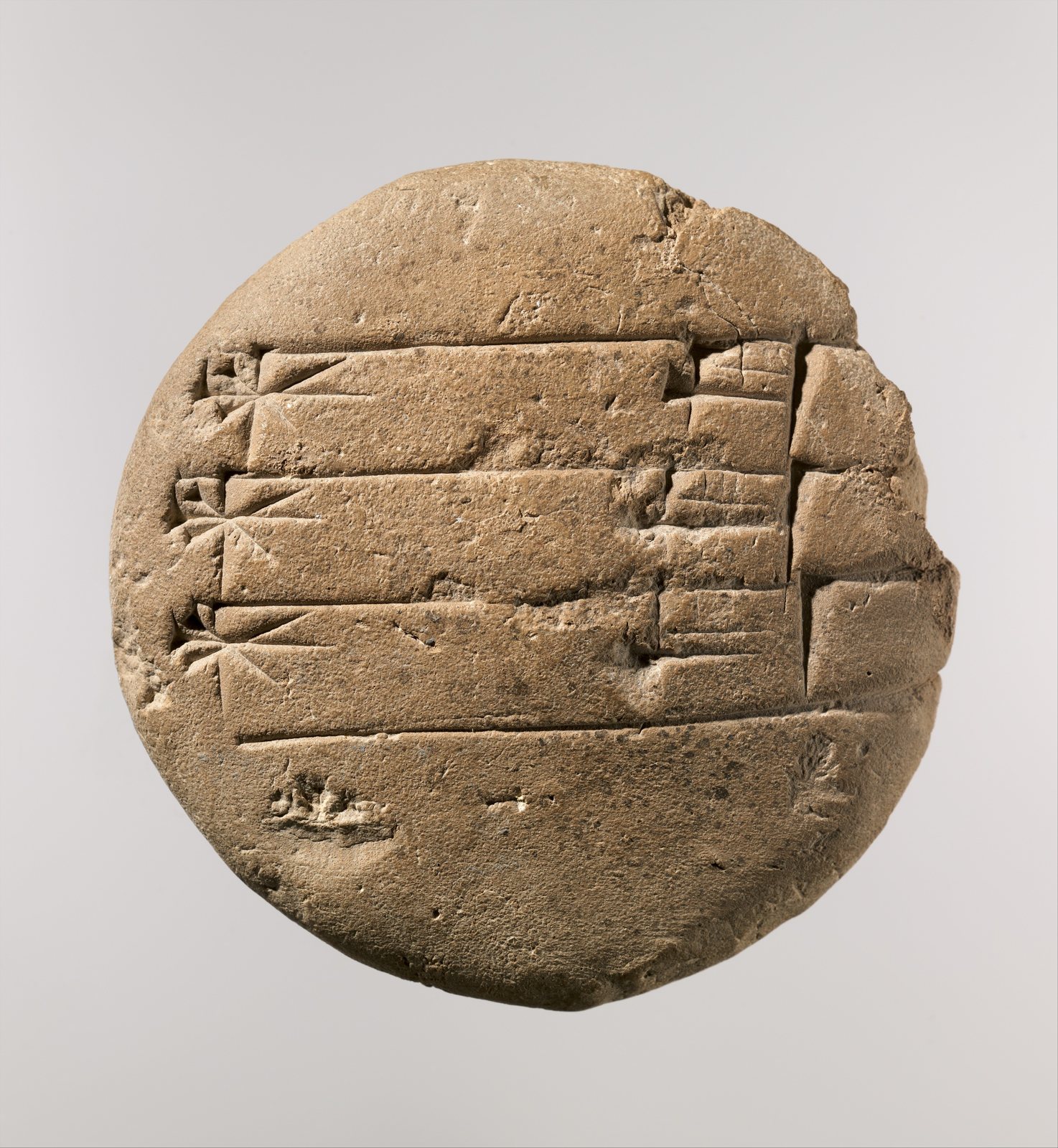
Cuneiform tablet: student exercise tablet (ca. 20th–16th century BCE), The Metropolitan Museum of Art, CC0
Somewhere in the city of Ugarit, on the Syrian coast, around 1300 BC, a student sat down with a lump of damp clay and a reed and copied out the alphabet. All thirty letters of it, in order, pressed in as wedges. Several of the practice tablets that survive are plainly a beginner's work, with uneven signs and lines that wander. Then the clay dried, the city burned about a century later, and the tablets sat under the rubble until French archaeologists began digging them out in the 1930s and 1940s.
It begins, in our terms, a, b, g, d. Anyone who has learned Hebrew or Arabic, or sat through a Greek class, will recognise that sequence. So, with a bit of squinting, will anyone who has learned English. The order we file, sort, index and sing to small children was already settled before the Trojan War, and nobody has ever produced a convincing reason for it.
A school exercise that survived the fire
Ugarit was a trading city, rich on copper and textiles, with a palace archive written in half a dozen languages. Its scribes used Babylonian cuneiform for diplomacy, but for their own Semitic language they did something unusual: they invented an alphabet of thirty cuneiform signs, roughly one per consonant, and wrote it on clay like everyone else in the region.
More than a dozen of these practice tablets, which scholars call abecedaries, have turned up in the ruins. The most complete one is in the National Museum in Damascus. Its order is the one that matters. Strip out the eight signs that Ugaritic needed and later alphabets dropped, and what remains is the sequence of the twenty-two Phoenician letters, which is also the sequence of the Hebrew letters, which is, with a few swaps and additions, the sequence a child in Leeds or Lagos learns today.
The alphabet itself is older than Ugarit. Scratched inscriptions in the Sinai turquoise mines and at Wadi el-Hol in Egypt, usually dated to around 1900 to 1800 BC, show Semitic-speaking workers borrowing Egyptian picture signs and using them for the first sound of the word they depicted: a house for b, water for m, an eye for the throaty sound Hebrew calls ayin. (A team from Johns Hopkins announced in 2024 that four small clay cylinders from a tomb at Umm el-Marra in Syria, dated to about 2400 BC, carry alphabetic writing, which would push the whole thing back another five centuries. The claim has not been confirmed by other scholars, and in any case the cylinders are too short to tell us anything about order.) What Ugarit gives us is the first proof that the letters had a fixed sequence, taught in school and tested.
There was a rival order, and it lost
Here is the part I find oddly moving. Ugarit also had a second alphabet order, found on a tablet in 1988, which begins h, l, ḥ, m. Scholars call it the halaham order. A broken tablet from Beth Shemesh in Israel, dug up in 1933 and only properly read decades later, uses the same sequence. So in the thirteenth century BC two competing arrangements of the same letters were in circulation, like two competing keyboard layouts.
The halaham order did not die. It went south, into the kingdoms of Yemen, and from there across the Red Sea, and it survives today as the order of the Ethiopic script used for Amharic and Tigrinya. Everyone else, from the Phoenician traders to the Greeks to us, got the abgad order. I have never seen a good explanation of why one won in the north and the other in the south, and I am suspicious of anyone who offers one.
The Greeks kept the order and threw away the meanings
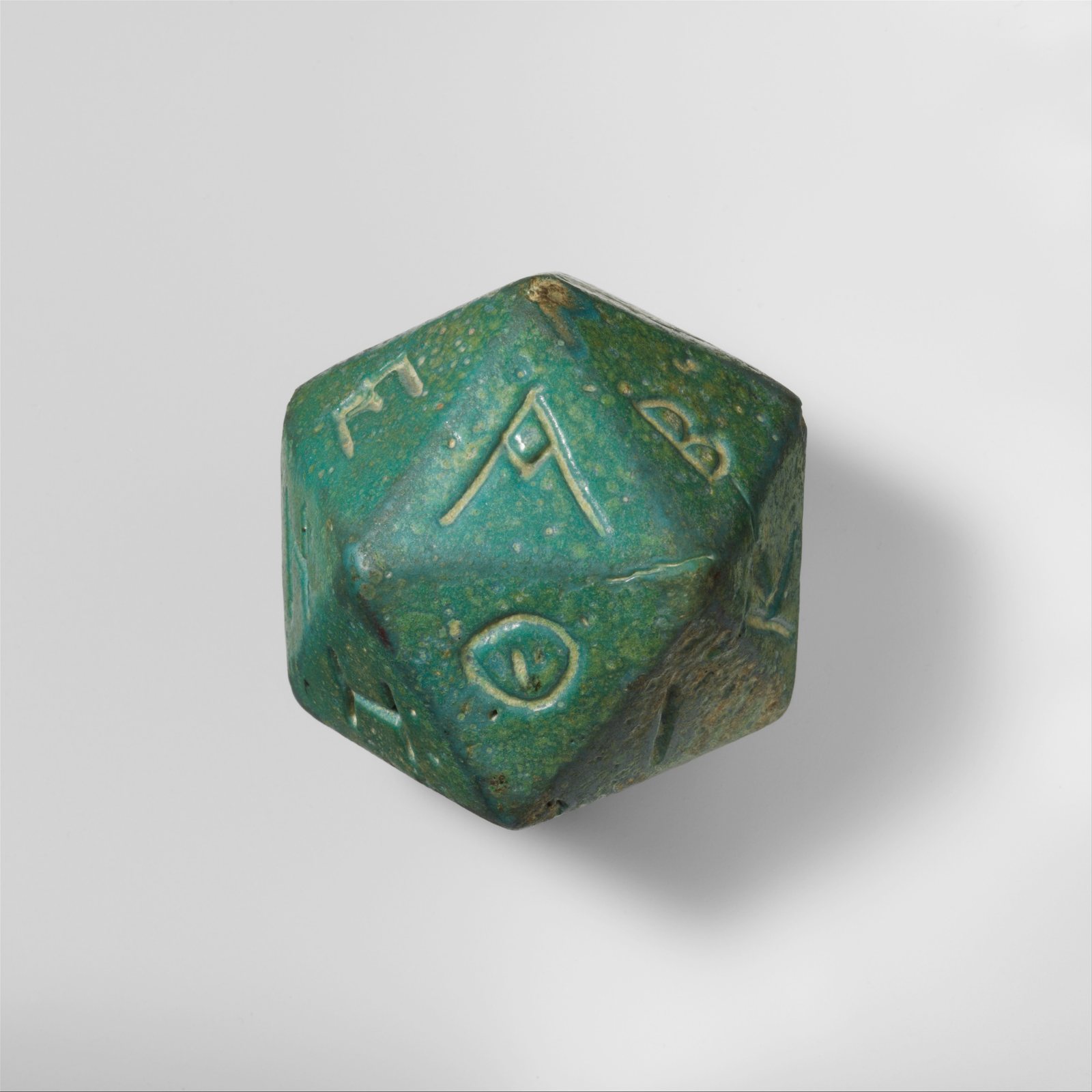
Faience twenty-sided die inscribed with letters of the Greek alphabet, 2nd to 3rd century AD, The Metropolitan Museum of Art, CC0
Phoenician letters had names that were ordinary words: aleph was an ox, bet a house, gimel probably a throwing stick or camel, dalet a door. When the Greeks borrowed the script, around 800 BC, they kept the names as sounds, alpha, beta, gamma, delta, which mean nothing at all in Greek. They also kept the order exactly. This is the single best piece of evidence that the sequence was learned as a chant, by rote, and that the borrowers never asked what it was for.
What the Greeks changed was the inventory. Phoenician wrote only consonants. Greek needed vowels, so letters for sounds Greek lacked were recycled: aleph became the vowel a, he became e, yod became i, ayin became o. The Greeks also added a few letters of their own at the end, which is where new letters always go, since nobody wants to relearn the middle of the song. The word alphabet is simply the first two names run together.
How Z ended up at the back
The Romans got the alphabet second-hand, from the Etruscans, and treated it roughly. Early Latin had no use for the sound of zeta, so the letter was dropped, and in the third century BC the gap in the seventh position was filled by a new letter, G, which a freedman and schoolmaster named Spurius Carvilius is traditionally credited with inventing. (I give the attribution the respect it deserves, which is some.) Two centuries later, when educated Romans began spelling Greek loanwords properly, they needed Z back, and Y with it. Both were tacked on at the end. That is the whole reason Z is last: it was fired and rehired.
J, U and W are medieval and early modern inventions, variants of I and V that gradually became separate letters, and they slotted in next to their parents rather than at the end, which is why they break the pattern. Into the nineteenth century, English schoolchildren reciting the alphabet finished with a twenty-seventh item, the symbol &, chanted as "and per se and", which wore down into the word ampersand.
Three thousand years of not using it to sort things
The strange coda is that having an alphabetical order and using it to organise anything are different ideas, and the second one took an astonishingly long time. The librarians of Alexandria in the third century BC used first-letter alphabetisation for some of their catalogues, and then the habit more or less lapsed. Medieval scholars arranged knowledge by subject, by importance, by the order of the Bible or the hierarchy of heaven. Putting God under G was not a neutral act. Full alphabetical order, down to the second and third letter, only became normal for indexes and dictionaries in the thirteenth century and after, and people needed instructions on how to use it well into the age of print.
Today the sequence runs everything from the contact list on your phone to the seating of delegates at the United Nations, and schools still teach it with a song. As for why the ox comes before the house, and the house before the door, there are theories: a lost mnemonic verse, pairs of signs linked by meaning, a calendar, a scribe's whim. The student in Ugarit knew, or at least knew what the teacher said. We do not, and after 3,400 years I doubt we are going to find out.
Enjoyed this story?Get a new one every day on social.