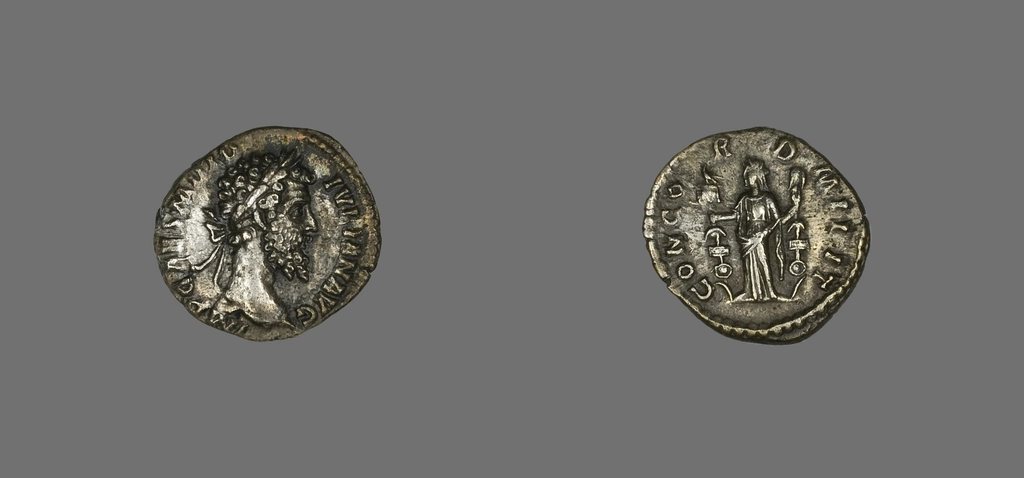
Denarius portraying Didius Julianus, Art Institute of Chicago, CC0, via rawpixel
Towards evening on 28 March 193, a senator in his sixtieth year stood under the wall of the Praetorian camp on the north-eastern edge of Rome and shouted numbers at the soldiers on the rampart. His name was Marcus Didius Julianus. He had been at dinner when the news came that the emperor was dead, and his wife and daughter, according to one account, had talked him into going down to the barracks to see what could be had. The gates were shut. On the inside of the wall was another senator, Titus Flavius Sulpicianus, the prefect of the city, who was also making an offer. The soldiers went back and forth between them like auctioneers, and the lot on sale was the Roman Empire.
What the Guard had done that afternoon
Three months earlier, on the last night of 192, the emperor Commodus had been strangled in his bath by a wrestler, on the orders of his own household. The conspirators had picked a replacement in advance: Pertinax, a sixty-six-year-old former teacher's son who had risen through the army to the city prefecture, a sober man with a reputation for honesty. The Praetorian Guard, the nine thousand or so soldiers who garrisoned Rome and guarded the emperor, accepted him in exchange for a promised bonus.
Pertinax then made the mistake of governing. He paid the Guard less than they had been led to expect, tried to put them back under discipline after twelve years of Commodus letting them do as they pleased, and sold off Commodus's slaves, concubines and dinner services to refill the treasury. On 28 March a party of two or three hundred soldiers walked from the camp to the palace, the gates were opened to them, and Pertinax, who refused to run, went out to talk them round. He nearly managed it. Then one of them threw a spear, and the rest finished the job. He had reigned eighty-six days.
The killers carried his head back to the camp on a pole and shut the gates, and only then, it seems, began to wonder who the next emperor would be, and what he would pay.
The bidding
Our best witness was in Rome that night. Cassius Dio was a young senator in 193, and he wrote the story up some thirty years later with the open disgust of a man who had had to stand in the Senate and applaud the result. He says Sulpicianus, who was already inside the camp and happened to be Pertinax's father-in-law, offered twenty thousand sesterces to every soldier. Julianus, outside, bid twenty-five thousand, and added an argument the Guard could not ignore: Sulpicianus was the dead man's family, and sooner or later he would want revenge for him. Julianus owed nobody anything.
For scale, a legionary earned about twelve hundred sesterces a year. Julianus was offering each guardsman twenty years' pay. He had the money, or claimed to; he was one of the richest men in the Senate, raised, oddly enough, in the household of Marcus Aurelius's mother, and he had governed provinces from Belgium to North Africa without doing anything anyone remembered. The soldiers opened the gates, hailed him, and marched him to the Senate house with a guard so large that, Dio says, the senators had no choice but to vote him every title there was. Dio's own verdict is short: the soldiers had put the empire up for sale like a piece of property in the marketplace.
Sixty-six days of owning it
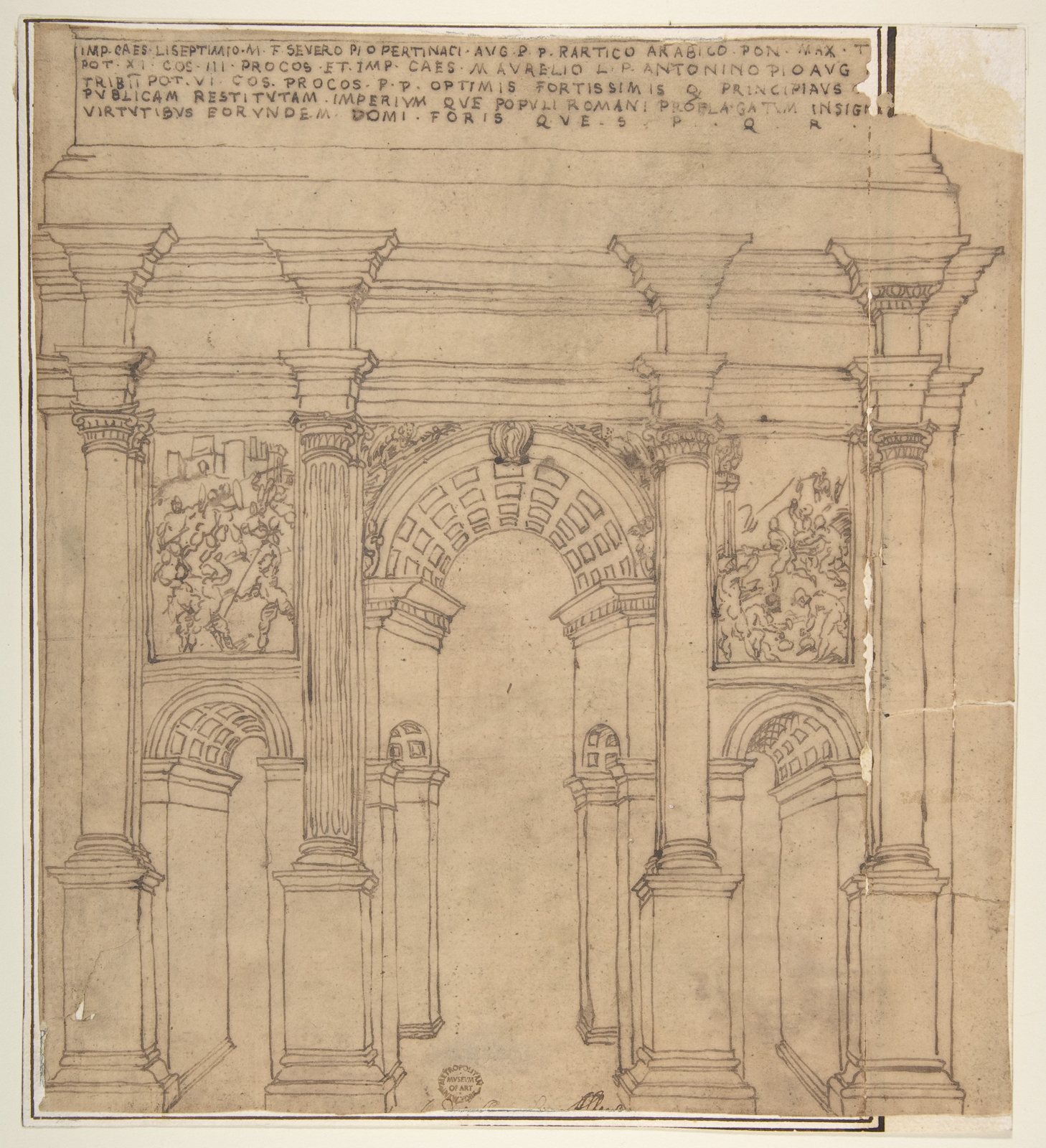
Drawing of the Arch of Septimius Severus in the Roman Forum by Bartolomeo Neroni, sixteenth century, The Metropolitan Museum of Art, CC0
The purchase came with no customers. When Julianus went to the Circus the next day the crowd shouted insults and called for Pescennius Niger, the governor of Syria, to come and take the throne; a little later they threw stones at him on the way to the Capitol. His coins, which he struck quickly, carry the legend CONCORD MILIT, the harmony of the soldiers, which was true for as long as the money lasted. He cut the silver in the denarius to help it last. And within weeks he learned that the armies on the frontiers, who had not been invited to bid, had decided the sale was void.
Three governors declared themselves emperor in April: Niger in Syria, Clodius Albinus in Britain, and Septimius Severus on the Danube, who was closest, who had the most legions within reach, and who bought Albinus off by naming him heir. Severus's troops saluted him at Carnuntum, near modern Vienna, on 9 April, and he marched on Italy, roughly a thousand kilometres in under two months, sleeping in his armour.
Julianus did what he could. He had the Senate declare Severus a public enemy. He sent a centurion to assassinate him, and a delegation of senators to talk his legions round; the legions talked the senators round instead. He set the Praetorians to building fortifications on the Campus Martius, where, Dio says with some pleasure, the elephants brought in from the circus games threw off the towers strapped to their backs, and the soldiers, who had done no real work in years, could barely dig. He offered to share the throne. Severus did not reply.
A soldier in the palace
The end came from the Guard, as the beginning had. Severus sent word to the Praetorians that any man who handed over Pertinax's actual murderers would be pardoned. They gave them up. At the start of June the Senate, reading the situation correctly, passed a sentence of death on Julianus, declared Severus emperor and voted Pertinax a god. A soldier was sent to the palace and found Julianus almost alone. Dio records his last words as a question: "But what evil have I done? Whom have I killed?" He had reigned sixty-six days. His wife and daughter, who had both been made Augusta, were allowed to collect the body and bury it in his great-grandfather's tomb on the road out of the city.
Severus entered Rome a few days later and dealt with the Guard in person. He summoned them to parade outside the walls in ceremonial dress, had them surrounded by his Danubian legionaries, stripped them of their belts and daggers, and banished every one of them to at least a hundred miles from Rome on pain of death. Then he refilled the Guard with his own men. He is supposed to have told his sons on his deathbed, eighteen years later, to enrich the soldiers and ignore everyone else. Whether he said it or not, the third century took it to heart: the price of the empire had been set in public, and the soldiers never forgot the figure.
The camp is still there, in a manner of speaking. Constantine demolished it in 312, after the Guard backed the wrong man at the Milvian Bridge, but three of its four walls had already been built into Rome's city wall and they stand yet, red brick with the arches filled in, along the Viale Castro Pretorio. The metro station is named after it, and the Italian national library sits inside the old parade ground. Didius Julianus's silver, with his heavy bearded face on one side and the harmony of the soldiers on the other, turns up in museum trays from Chicago to Leiden, in quantities that suggest he struck a great deal of it, quickly.
Enjoyed this story?Get a new one every day on social.