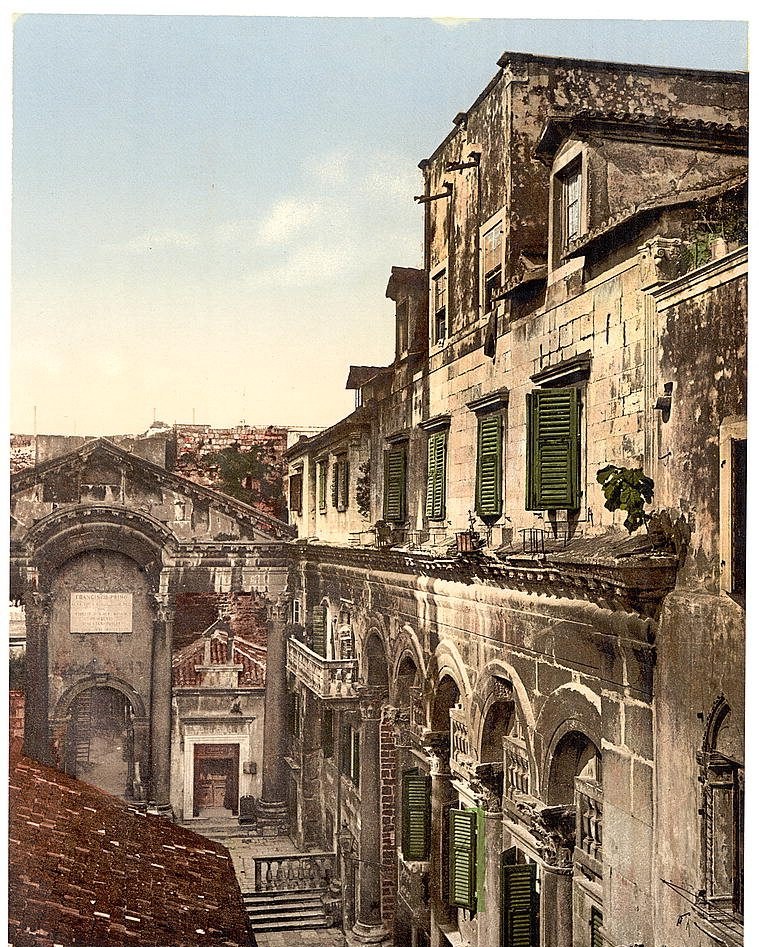
Photochrom print, Detroit Publishing Co., between about 1890 and 1900, Library of Congress Prints & Photographs Division, no known restrictions
On the first day of May in the year 305, on a hill about three miles outside Nicomedia in what is now Turkey, the emperor Diocletian stood before his army under a column topped with a statue of Jupiter, wept, told the soldiers he was old and tired, and took off his purple cloak. He put it on the shoulders of a younger man, climbed into a carriage and left for the coast of Dalmatia. He had ruled for twenty years and he had chosen the hill deliberately: it was where the same army had proclaimed him emperor in 284.
No Roman emperor had done this before. Emperors died in bed, in battle or at the hands of their own guards, and the handful who had wished to retire had found that the job did not permit it. Diocletian built an entire political system so that he could walk away from it, and the system lasted about a year after he did.
A Dalmatian soldier takes the purple
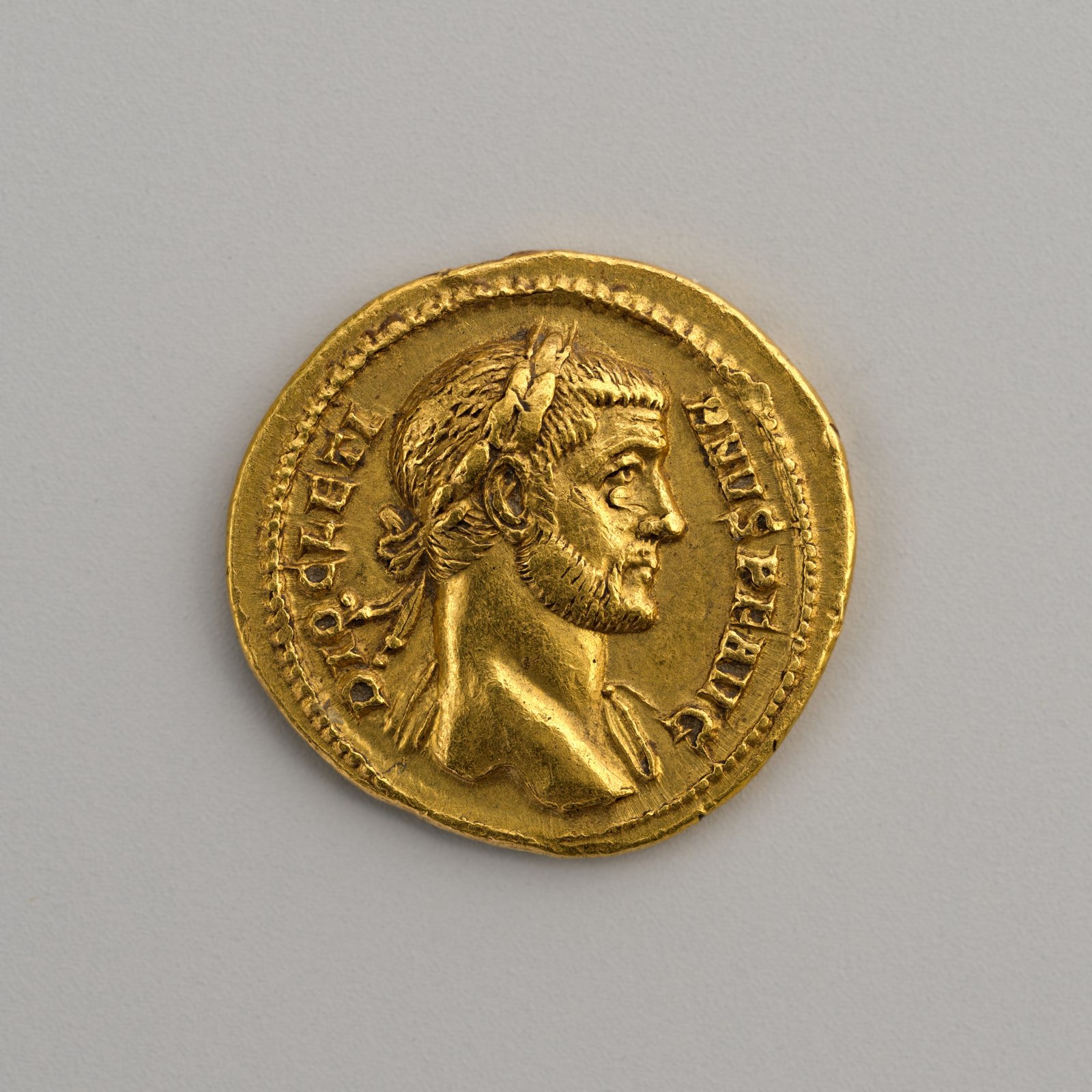
Gold aureus of Diocletian, struck in 293. The Metropolitan Museum of Art, CC0
Diocletian was born Diocles, around 244, near Salona on the Adriatic, to a family with no standing at all; one tradition makes his father a freedman clerk. He rose through the army during the half century in which Rome went through roughly two dozen emperors, most of them murdered. In November 284, after the emperor Numerian was found dead in his litter on the road home from Persia, the troops at Nicomedia chose Diocles. His first act as emperor was to accuse the praetorian prefect Aper of the murder, in front of the assembled soldiers, and run him through with his sword. Then he took the name Diocletian.
The lesson he drew from the previous fifty years was simple: one man could not hold the empire, because the moment he was in the east, someone in the west would be proclaimed by his own troops. So in 286 he made an old comrade, Maximian, a full co-emperor with the title Augustus and gave him the west. In 293 he went further and appointed two junior emperors, Caesars, one for each Augustus: Galerius under himself, Constantius under Maximian. Four rulers, four courts, four armies, and an agreed line of succession in which the Caesars would step up when the Augusti stepped down. Historians call it the Tetrarchy. Diocletian seems to have thought of it as a machine.
Twenty years of rebuilding
The machine worked while he ran it. Diocletian doubled the number of provinces to around a hundred, grouped them into larger units called dioceses (the Church later borrowed the word), separated military commands from civil governorships so that no governor had both money and soldiers, and rebuilt the tax system around regular censuses.
He also changed what an emperor looked like. He wore a diadem and robes of purple and gold, received visitors who knelt and kissed the hem of his garment, and styled himself dominus, master, rather than the old republican princeps, first citizen. Later Roman writers complained about this as Persian affectation. It was more practical than that: a man treated as sacred is harder to stab.
Two of his policies failed badly. His Edict on Maximum Prices of 301, which fixed the price of everything from wheat to lions, drove goods off the market and was quietly abandoned. And in 303 he began the last and most systematic persecution of Christians in Roman history, ordering churches demolished, scriptures burned and clergy arrested.
The decision on the hill
In 304 Diocletian fell seriously ill on the way back from celebrating his twentieth year in Rome. He spent the winter close to death in Nicomedia, and when he appeared in public again in March 305 the historian Lactantius, who disliked him and was living in the city, says he was barely recognizable. Whether the retirement was his own idea or Galerius pressed it on him is still argued about. Lactantius says Galerius bullied a sick old man. Most modern historians think the plan was older than the illness, because Diocletian had built the Tetrarchy with exactly this handover in mind, and because he made Maximian swear to abdicate on the same day, which Maximian did, reluctantly, in Milan.
So on May 1, 305, Galerius and Constantius became Augusti, and two new Caesars were named: Severus and Maximinus Daia, both Galerius's men. The sons of the two retiring emperors, Constantine and Maxentius, were passed over, and that, more than the abdication itself, was the decision that mattered. Diocletian had designed a succession based on merit and loyalty rather than blood, which left two ambitious young men with armies behind them and no place in the plan.
What happened to the machine
Constantius died at York in July 306. His troops proclaimed his son Constantine on the spot. Three months later the praetorians in Rome proclaimed Maxentius. Maximian came out of retirement, twice. By 308 there were six or seven men claiming to be emperor.
That November the claimants met at Carnuntum on the Danube to sort it out, and they invited Diocletian. According to the Epitome de Caesaribus, written a century later, when Maximian and Galerius urged him to take the purple back he answered that if they could see the cabbages he had planted with his own hands at Salona, they would not ask him to trade that happiness for the storms of power. I would like the quotation to be verbatim, but it comes from a late source and reads like the sort of thing people wished he had said. What is certain is that he refused, went home and stayed there.
The wars went on until 324, when Constantine, having beaten everyone, ruled alone, as a Christian. Diocletian died at his palace around 311; the exact year is disputed.
A palace with a town inside it
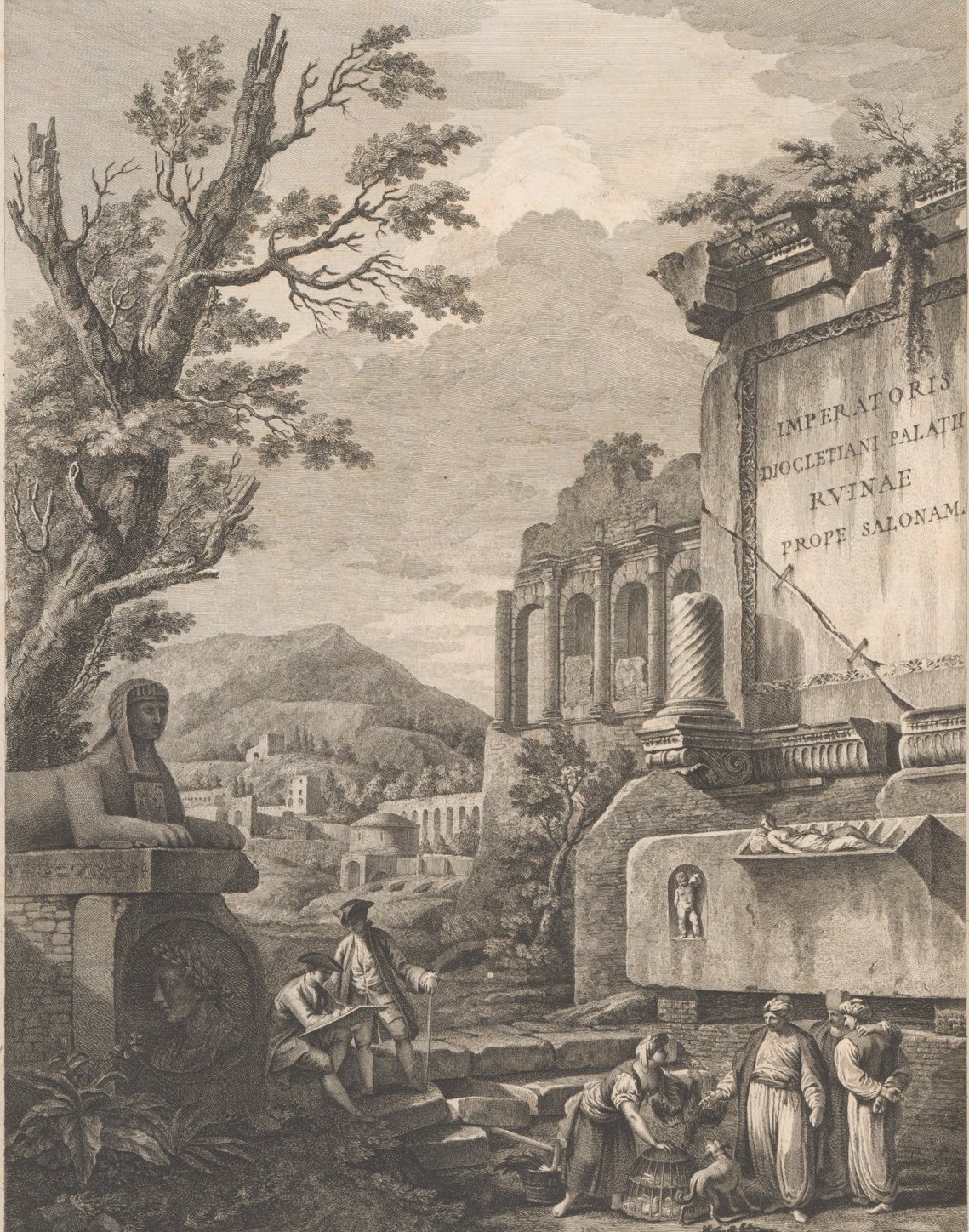
Engraving of the ruins of Diocletian's palace at Spalato, from Robert Adam's 1764 survey. The Metropolitan Museum of Art, CC0
The retirement home is still there, and it is one of the strangest buildings in Europe. Diocletian had it built in the years before 305 on the shore a few miles from Salona: a rectangle of walls about 200 yards on a side, half military camp and half villa, with his apartments on the sea front, a mausoleum, a temple of Jupiter and a sphinx shipped in from Egypt.
Some three centuries later, when Avar and Slav raiders destroyed Salona, the survivors moved inside the palace walls and never left. They built houses in the corridors, shops in the guard rooms and churches in the temples. The result is the old town of Split, Croatia, where roughly 3,000 people still live within the Roman walls and a cafe occupies the Peristyle, the courtyard where the emperor's visitors once knelt. His mausoleum became the cathedral of St Domnius, a bishop of Salona executed during Diocletian's own persecution. The sarcophagus of the emperor himself vanished long ago; nobody knows where his body went.
The palace has been a UNESCO World Heritage Site since 1979. My own view is that Diocletian understood power better than any Roman since Augustus, and that the one thing he never understood was that a system built to run without him would be tested the moment he proved it could.
Enjoyed this story?Get a new one every day on social.