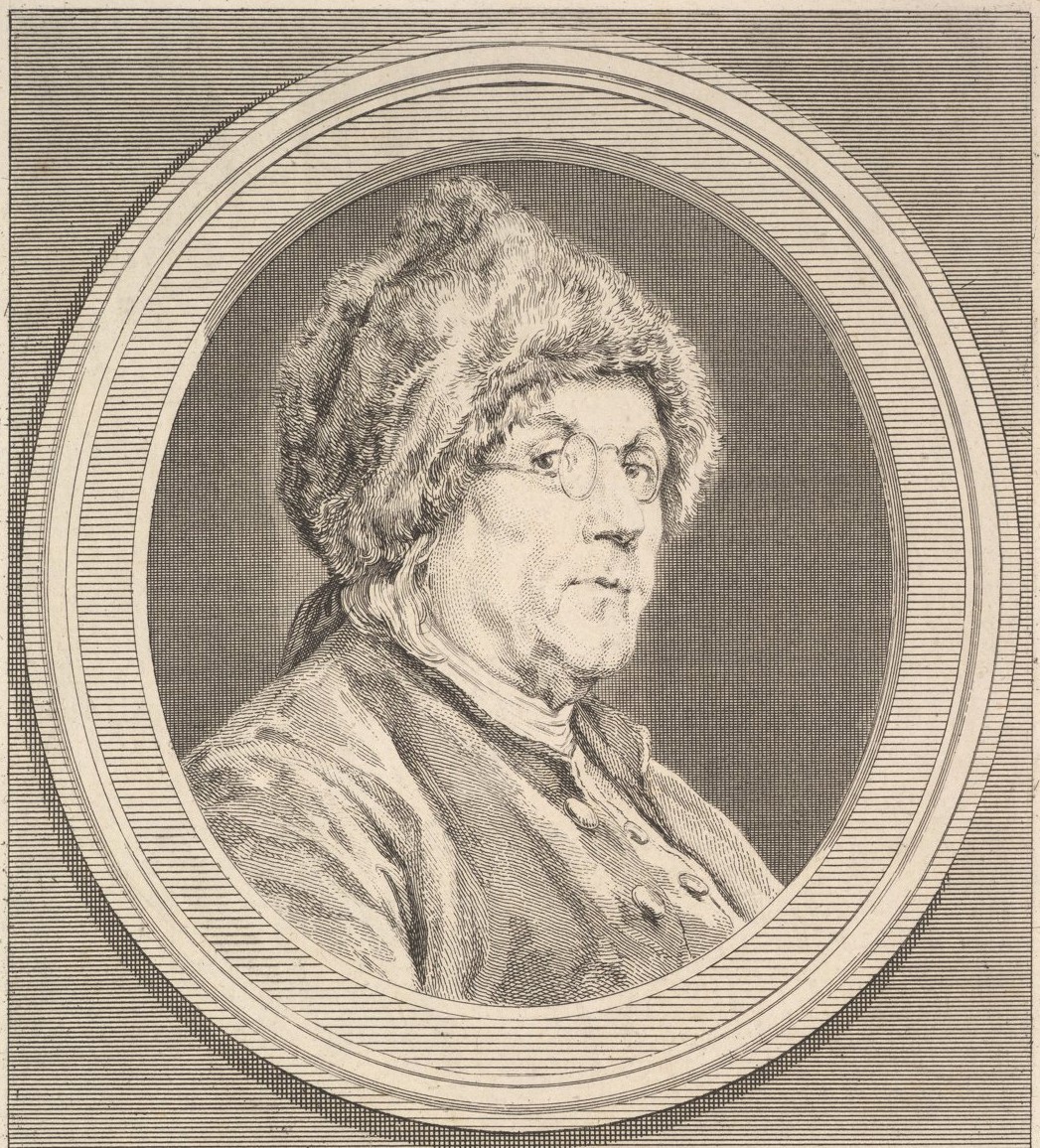
Augustin de Saint-Aubin after Charles-Nicolas Cochin, Portrait of Benjamin Franklin (1777), The Metropolitan Museum of Art, CC0
In February 1777 an old man in a borrowed house at Passy, on the hill above Paris, sat down to answer a letter from a woman he had known in London. He was seventy-one, he had arrived in France two months earlier, and he wanted her to be able to picture him. "Figure me in your mind," Benjamin Franklin wrote to Emma Thompson, "as jolly as formerly, and as strong and hearty, only a few years older; very plainly dressed, wearing my thin grey straight hair, that peeps out under my only coiffure, a fine fur cap, which comes down my forehead almost to my spectacles. Think how this must appear among the powdered heads of Paris!"
He knew exactly how it appeared, which was the point.
A seventy-year-old on a warship
Congress had named Franklin one of its three commissioners to France on 26 September 1776. The job was to persuade Louis XVI, an absolute monarch, to pay for a republican rebellion against his neighbour. Franklin was the obvious choice and a slightly absurd one: the most famous American alive, which helped, and seventy years old with gout and a skin complaint, which did not. He took two grandsons with him, Temple, sixteen, and Benny Bache, seven, and most of his savings in cash to lend to Congress.
On 24 October Congress ordered Captain Lambert Wickes of the Continental sloop Reprisal to carry him to Nantes, and the ship slipped down the Delaware at the end of the month. The crossing took about five weeks. The old man lived on salt beef and whatever the galley could do with a tough chicken. He landed on the coast of Brittany in early December so weak he could barely stand, with boils that made a carriage a trial, and reached Paris just before Christmas. (The Reprisal went down off Newfoundland the following October with all hands but the cook.)
Where the hat came from
The cap was not a costume. Franklin had bought it, of marten fur, for a mission to Canada the previous spring, when Congress sent him to Montreal in March 1776 to try to talk the Canadians into joining the rebellion. It was a miserable trip through late snow and he came back ill, convinced he would not live out the year. The hat stayed in his luggage.
In France he put it back on, partly because his scalp bothered him and a wig was intolerable, and partly, I think, because he saw within days what it did. Paris in 1777 had been reading Rousseau for fifteen years. It believed in the noble simplicity of men who lived close to nature, and Rousseau himself had made a point of wearing a fur hat. Here was a philosopher from the American woods, famous for taming lightning, in plain brown cloth, spectacles, and a fur cap, among courtiers who spent two hours a day under the powder. Many Parisians took him for a Quaker. He was not, and he never corrected them.
A face as well known as the moon
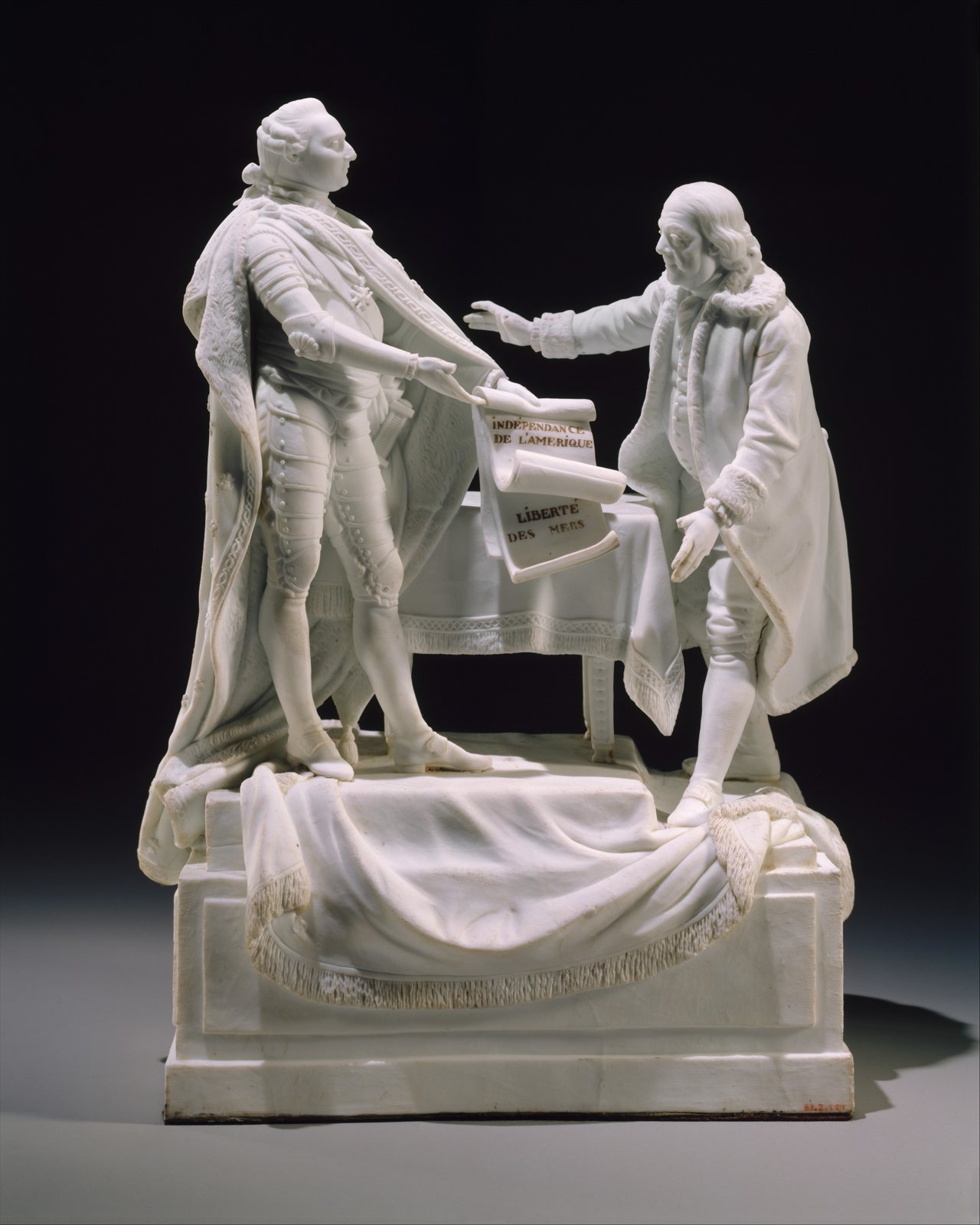
Biscuit porcelain group of Louis XVI and Benjamin Franklin by Charles-Gabriel Sauvage, made at Niderviller about 1780-85, The Metropolitan Museum of Art, CC0
Within a few months the cap had become his trademark, and the trademark had become an industry. Charles-Nicolas Cochin drew him in profile in 1777 and Augustin de Saint-Aubin engraved it, fur cap, spectacles and all; the print sold in its thousands. His landlord at Passy, Jacques-Donatien Le Ray de Chaumont, owned a pottery on the Loire, and its Italian modeller Jean-Baptiste Nini turned out terracotta medallions of Franklin in the hat that went into drawing rooms across the country. His face went onto snuffboxes and rings. Women, according to letters of the time, had their hair dressed in a high curled pile "à la Franklin" to suggest the cap. I have looked for a surviving example and never found one.
Franklin told his daughter Sally in June 1779, with a mock complaint, that the medallions, busts and prints, "of which copies upon copies are spread everywhere," had "made your father's face as well known as that of the moon." The king, by some accounts, got tired of it. Madame Campan, one of Marie Antoinette's ladies, later wrote that Louis XVI had Franklin's portrait painted on the bottom of a Sèvres chamber pot and sent it to a countess who talked about him too much. Campan was writing years afterwards and had reasons to make the court look foolish, so I would not swear to it. It sounds like him, though.
What the hat was for
None of this would have mattered if the diplomacy had failed, and for a year it nearly did. The foreign minister, Vergennes, wanted to hurt Britain but would not back a loser, and through 1777 the Americans mostly lost. What changed his mind was the news in December that a British army had surrendered at Saratoga. Franklin signed the Treaty of Alliance on 6 February 1778 and was presented to the king at Versailles the following month in a plain brown suit, his own hair, spectacles, no sword and no wig. By then he had largely retired the fur cap. It had made him recognisable to a country that needed to decide whether it liked Americans before it decided whether to pay for them.
Versailles is making a fuss of him this year. A new American Independence gallery opened at the palace on 4 July with his portraits hung beside those of Vergennes, and a mixed-reality show in the south wing walks visitors through his time at court until the end of January. There is a statue of him in Paris too, near the Trocadéro on the street that carries his name, seated, bareheaded, with a plain cloak over his knees. Someone decided the hat was beneath the dignity of the occasion. Franklin, who spent two years proving otherwise, would have had something to say about that.
Enjoyed this story?Get a new one every day on social.