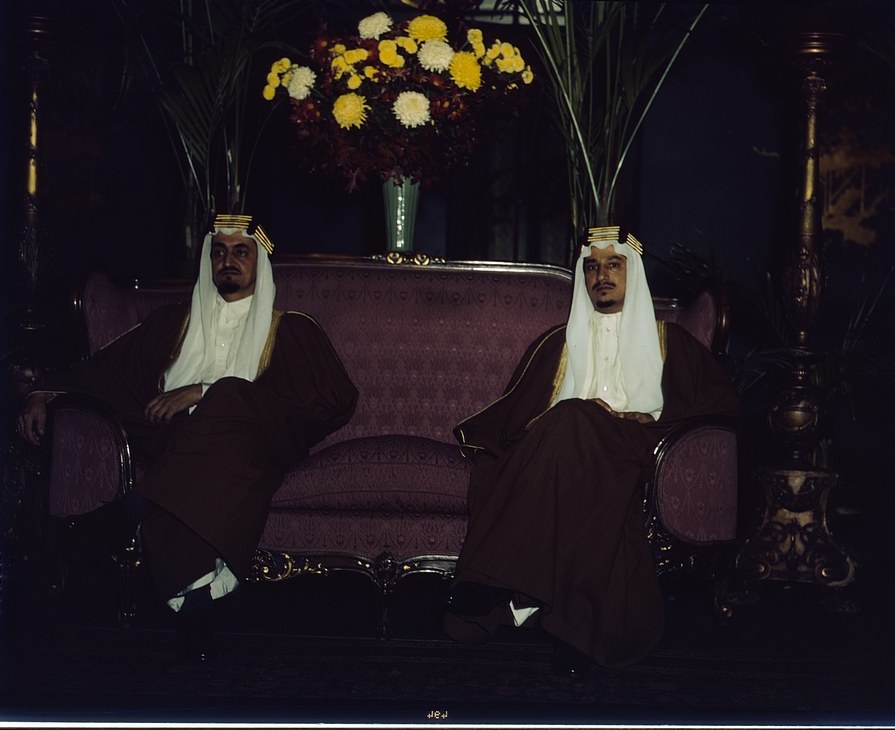
Prince Faisal (left) and Prince Khalid, sons of Ibn Saud, in the United States in 1943. Photo: John Rous, Library of Congress Prints & Photographs Division, no known restrictions
"Who is this Bedouin coming to challenge my family's 900-year rule?" Imam Yahya of Yemen is supposed to have asked that about Ibn Saud, some time before the two of them went to war in 1934. The line turns up in a lot of accounts. I have never found where it first appeared, and I would not bet much on its being real. But the boast, if anything, was modest: the line of imams Yahya stood in went back more than a thousand years. Some of that history is still in play along the same border today.
The war now
The fighting between Saudi Arabia and the Houthi movement, which holds Sanaa and most of northern Yemen, has been going on for months. On October 5 the Saudi-backed government launched an offensive it called Operation Dawn of Yemen, with Saudi aircraft in support. Houthi missiles and drones have hit Riyadh's airport and an Aramco building in the capital. On November 9 the health ministry in Sanaa said Saudi air strikes on the village of al-Shariya, east of the city, had killed at least 44 people, 21 of them children.
The border those missiles cross was drawn after a war that lasted about two months, ninety-two years ago.
Nine hundred years at Saada
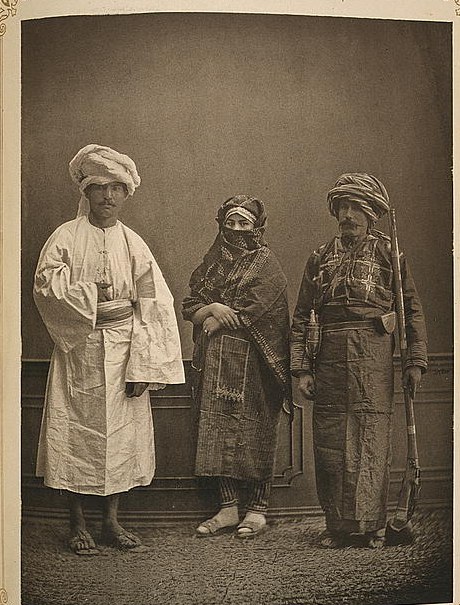
Studio photograph from 1873 of three people in Yemeni dress: a man in a white robe and turban, a veiled woman, and a man with a rifle and dagger. Photo: Pascal Sébah, Les costumes populaires de la Turquie, Library of Congress, no known restrictions on publication in the U.S.
Yahya's family were Zaydi imams, the line of religious and political rulers that began when al-Hadi ila'l-Haqq came to Saada, in the far north of Yemen, in 897. The imamate had come and gone over the centuries (the Ottomans held much of the country twice), but it had never quite died, and in 1918, when the Ottomans left for good, Yahya ruled an independent kingdom from Sanaa.
The Houthis are a Zaydi movement too, and their heartland is Saada. That is not the same thing as saying they are the imamate come back, and they would not put it that way. It does mean that when Saudi Arabia fights in the northern highlands, it is fighting in the old heartland of the imams.
Ibn Saud was a newcomer by any measure. He had taken the Hejaz, with Mecca and Medina, in 1925, and he proclaimed the Kingdom of Saudi Arabia only in 1932.
Asir and Najran
Between the two kingdoms lay Asir, a coastal province with its own small dynasty, the Idrisids, who had quarrelled with Yahya for years. In 1926 the Idrisid emir put himself under Saudi protection, and by 1930 Asir had been absorbed into Ibn Saud's kingdom. Yahya regarded much of it, and the oasis of Najran inland, as his. A border agreement in December 1931 did not hold. In late 1933 Yemeni forces moved on Najran, and a Saudi delegation sent to talk ended up in the imam's custody.
Saudi Arabia declared war on 20 March 1934. Ibn Saud sent two sons. Crown Prince Saud went inland toward Najran and the mountains, which is where the Yemenis were strongest, and his column made slow work of it. The younger son, Faisal, went down the Red Sea coast.
Faisal's road to Hodeidah
The coast was easier ground, and Faisal moved fast. His side had some British-built aircraft; most of the Yemenis facing them had rifles and not much else. Luhayya fell on 1 May. Hodeidah, Yemen's main port, fell on 4 May, about six weeks into the war.
That brought in the Europeans. A British sloop, HMS Penzance, took British and Indian residents and other foreigners out to Kamaran Island, about 300 people in all. Three Italian warships arrived on 6 May. British sailors went ashore to stop Saudi tribesmen looting Indian-owned shops. Britain held Aden, at the southern tip of Yemen, and Italy held Eritrea across the water, and neither wanted Ibn Saud sitting on the far side of the Red Sea from its colony.
The Treaty of Taif
Talks started within days. Ibn Saud dropped an early demand that the imam abdicate. The peace was signed at Taif, in the hills above Mecca, in 1934; sources give either May or June, depending on whether they mean the signing or the ratification. Yemen accepted Saudi rule over Asir, Najran and Jizan and paid an indemnity of £100,000 in gold. Saudi Arabia gave back Hodeidah and everything else it had taken. The last Saudi troops left Yemen on 7 July. Somewhere around 2,100 people had died.
The treaty was to run for twenty years and then be renewed. It also left the border east of Najran undrawn, a gap that took until 2000 to close.
Why give back a port your son had just captured? The British and Italian ships were one reason. Ibn Saud's own answer, as reported, was that Yemen could only be ruled by its own ruler and that he did not have the men to hold it. The second part sounds right to me, and I would add that a Saudi army in the Yemeni highlands, among people who had outlasted the Ottomans, was a problem he had the sense not to want.
After Taif
Yahya was assassinated in 1948. The imamate itself ended in a revolution in 1962 and a civil war in which Saudi Arabia backed the royalists. Faisal, the prince who took Hodeidah, became king in 1964. The undrawn stretch of border was finally settled in the Treaty of Jeddah in June 2000, which confirmed the line of 1934 and extended it east across the desert.
So the frontier the Houthis fire across is, in its western half, the one Faisal's campaign fixed. The Saudi side of it now includes Najran and Jizan, both of which have been targets this autumn. Ibn Saud, who thought the Yemeni highlands were better left to Yemenis, would probably have had something dry to say about that.
Enjoyed this story?Get a new one every day on social.