Photo: Joyofmuseums, CC BY-SA 4.0, via Wikimedia Commons
A reader wrote in last month to ask a question I had never thought about in forty years of losing at chess: why do we say checkmate, when neither word is English? The short answer is that the phrase is Persian, the game is Indian, the bishop was an elephant until Europeans got hold of it, and the queen, the strongest piece on the board, did not exist in her present form until the generation of Columbus. The long answer is below, with the shakier parts marked as such, because the early history of chess is a field where confident claims tend to collapse under a footnote.
An army of four parts on the Ganges
The oldest game that is recognisably chess is chaturanga, played in northern India by the sixth century AD, in the last years of the Gupta kings or just after. The Sanskrit name means something like "four limbs", the four divisions of an Indian army: foot soldiers, cavalry, elephants and chariots. Those four, plus a king and his counsellor, are the six pieces still on every board.
The earliest references are literary rather than archaeological. A seventh-century Sanskrit prose work, the Harshacharita, makes a pun about the kingdom being so peaceful that the only four-part armies were the ones on the eight-by-eight board. Nobody has dug up a sixth-century Indian chess set, and the dating rests on texts like this one. Some writers push the origin back to the second century or earlier; I have never seen a good source for that.
Persia names the pieces and the ending
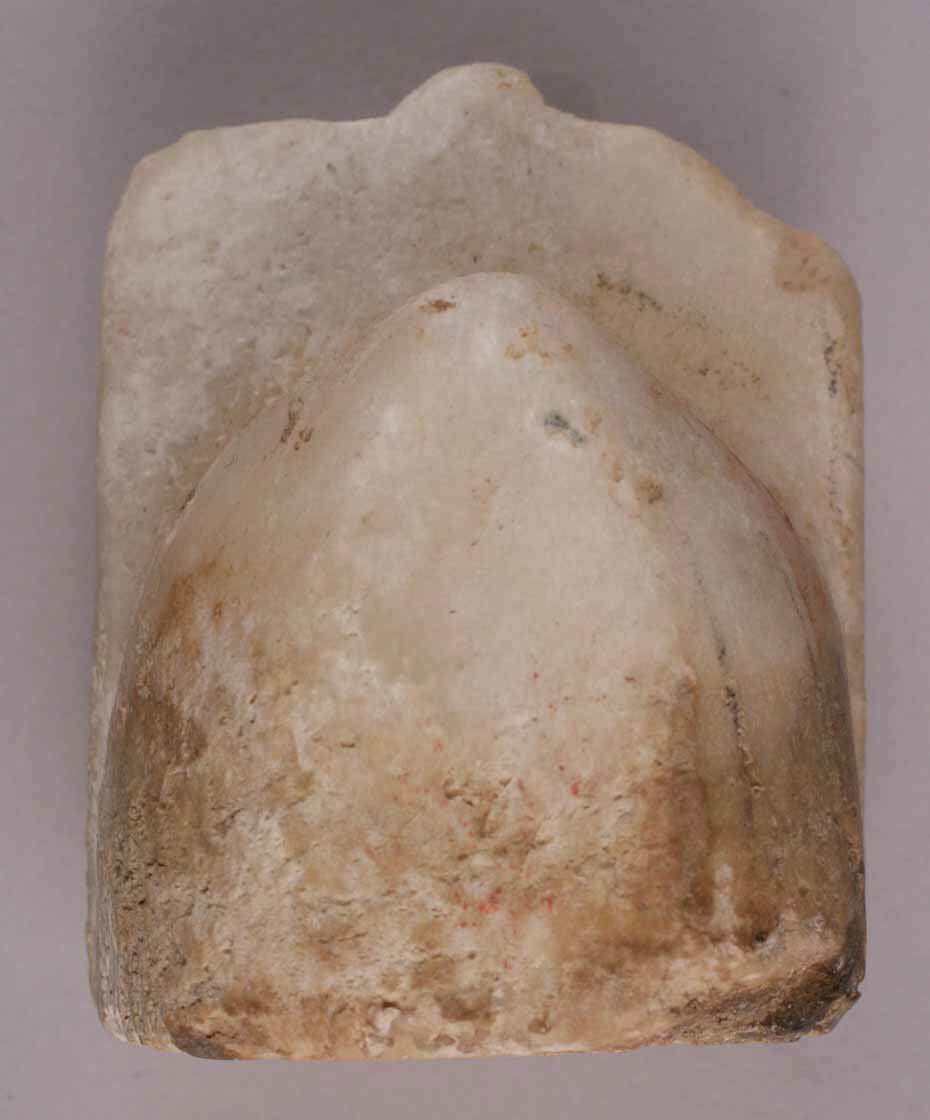
A twelfth-century ivory chess king from Iran, carved as an abstract throne shape rather than a human figure. Chess Piece, King (9th to 12th century), The Metropolitan Museum of Art, CC0
Chaturanga crossed into Sasanian Persia in the sixth century, and the Persians, who kept better records, tell a story about how. A Middle Persian text, the Chatrang-namak, describes an envoy from India arriving at the court of Khosrow I, who reigned from 531 to 579, with a chess set and a challenge: work out the rules, or pay tribute. The king's vizier worked them out overnight. That is obviously a story rather than a report, but the game's Persian name, chatrang, is the Sanskrit one with the edges worn off, which points the same way.
Persian is where our vocabulary comes from. The king was the shah, and when a player attacked him he said so: "shah". The game ended with "shah mat", and this is the phrase my reader was asking about. Mat in Persian means something close to helpless, stunned, at a loss. So checkmate originally meant "the king is left helpless", not "the king is dead", which is the gloss in most popular books. The "dead" version comes from reading mat as the Arabic mata, to die, and people who read both languages tell me the Persian sense is the older and the right one.
The chariot was the rukh, which came into English as rook. The elephant was the pil, and I will come back to him, because his fate in Europe is the oddest part of the story.
The Arab world turns it into a science
When the Arab armies overran Persia in the seventh century they took the game along with everything else, and under the name shatranj it became, for about four hundred years, a Muslim pursuit above all. The ninth and tenth centuries produced the first real chess literature: al-Adli wrote a treatise under the Abbasid caliphs, and as-Suli, who died in 946, was still the benchmark for strong play two centuries later. The pieces of this period are usually abstract, like the ivory king above, because carving people and animals was frowned on. The elephant became a lump with two bumps for tusks. Hold that thought.
Shatranj was slower than our game: the counsellor moved one square diagonally, the elephant jumped exactly two, pawns crept, and games were long and often drawn.
Europe gets the game and loses the elephant
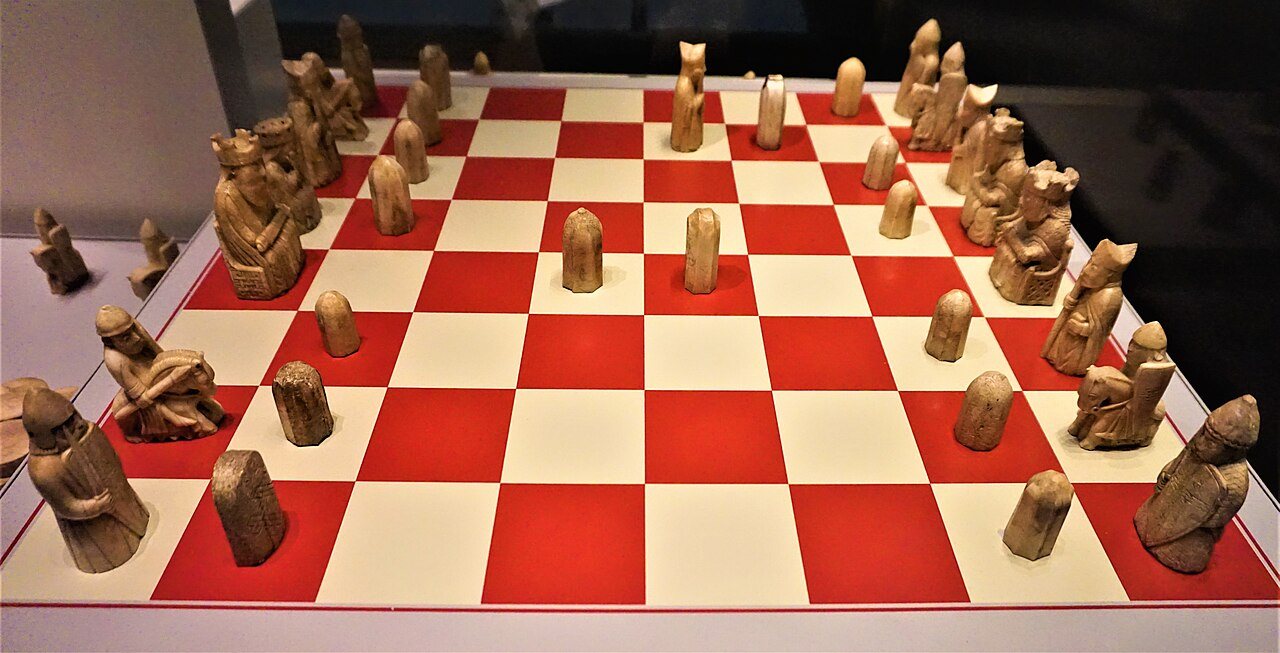
Chess arrived in Christian Europe by at least three doors: Muslim Spain, Sicily and Byzantium. The earliest European text about it is a Latin poem copied at the monastery of Einsiedeln in Switzerland around 997, and the earliest dated reference is a will: in 1010 Count Ermengaud of Urgell, in what is now Catalonia, left his chess pieces to a convent. By the twelfth century it was the game of the castle hall, and the Lewis chessmen, the walrus-ivory set found in a sand dune on the Isle of Lewis in 1831, show how thoroughly it had been dressed in European clothes: kings on thrones, mounted knights, foot soldiers reduced to plain stubs.
Europeans had no elephants and no use for one on a board. What they had were the Arabic pieces, with those two tusk-bumps, and they read them as what they knew. In England the bumps looked like a mitre, so the elephant became a bishop. In France they looked like a jester's cap, so he became the fou, the fool, which he still is. In Germany he became a runner, the Läufer. In Russia, which got the game from the east, he simply stayed an elephant, slon. The same lump of ivory is a bishop in London, a fool in Paris and an elephant in Moscow, which tells you more about medieval Europe than most books.
The counsellor had a stranger fate. In a court with a king, a lady beside him made more sense than a vizier, and the Einsiedeln poem already calls the piece regina. For nearly five centuries, though, the queen kept the counsellor's feeble move, one square at a time.
The queen gets her power and the game gets fast
Somewhere in Spain or Italy, around 1475, somebody gave the queen the moves of rook and bishop combined and turned the slowest piece on the board into the most dangerous. A Valencian poem from about that year, Scachs d'amor, already uses the new rules, and in 1497 Luis Ramírez de Lucena printed the first surviving book on the modern game in Salamanca. The Italians called it "chess of the mad queen". The bishop got his long diagonal at the same time, and pawns their double first step.
Why then, and why there? The historian Marilyn Yalom argued that the piece grew to match Isabella of Castile, who was ruling Spain in her own right at exactly that moment. It is an attractive idea and I half believe it, but nobody has found a document that says so. A game that could take a day now ended in an afternoon, and the whole apparatus of modern openings, tactics and sacrifices dates from the century after the queen was let loose.
Where the board stands now
The pieces have not changed since Lucena, and the names still carry their passports: an Indian army, a Persian king and chariot, a European bishop and a Spanish queen. The world title has been held since December 2024 by Gukesh Dommaraju of India, who won it at eighteen, the youngest champion in the title's history.
On November 24 he defends it in Geneva, at the Fondation Martin Bodmer in Cologny, against Javokhir Sindarov of Uzbekistan, who is twenty and won this year's Candidates tournament. An Indian champion and a challenger from the old Persian cultural world, playing over a board both their countries can claim. Whichever of them is left helpless at the end of it, the word for it will be the one Khosrow's vizier used, and I doubt either will give it a thought.
Enjoyed this story?Get a new one every day on social.