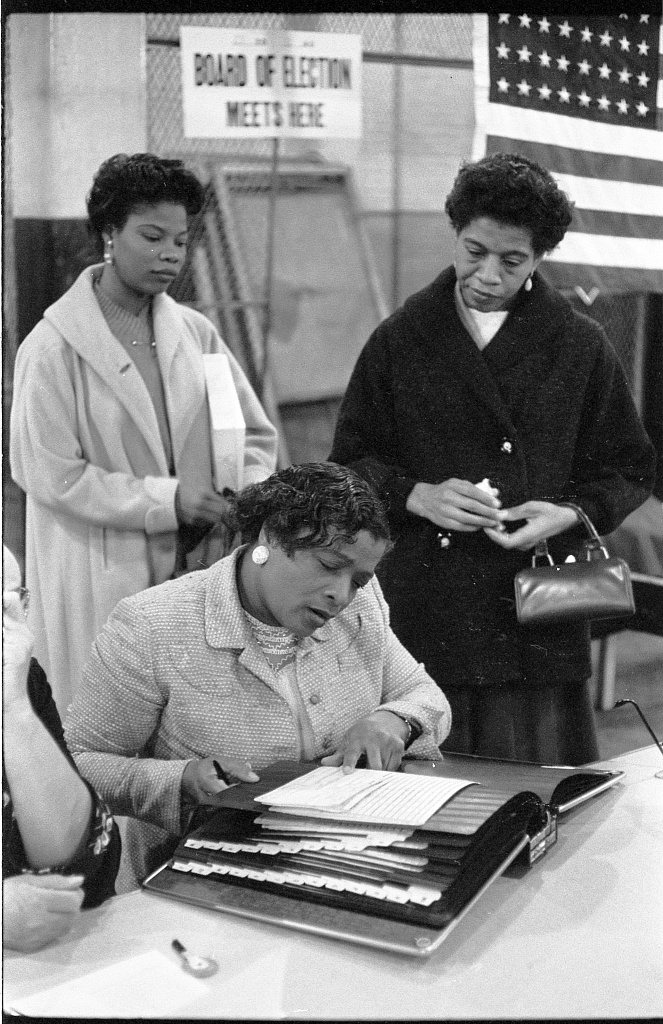
Photo: Thomas J. O'Halloran, 5 November 1957, Library of Congress Prints & Photographs Division, no known restrictions
"The Ballot. To protect the elector in the exercise of his vote." That was the second of the six points of the People's Charter, printed in London in 1838 and signed, over the next ten years, by several million British working men. It was the point the governing classes found most absurd. A secret vote, its opponents in the Commons said, was fit only for people too cowardly to say in public what they thought. Parliament threw out the Charter three times.
Eighteen years later a colony on the far side of the world, full of men who had failed to find gold and had plenty of time to think about politics, simply did it. The thing Americans will do on 3 November, going behind a screen and marking a printed paper that nobody else sees, is still called, in the older election textbooks, the Australian ballot. The name was not a compliment when it was coined.
What voting looked like before
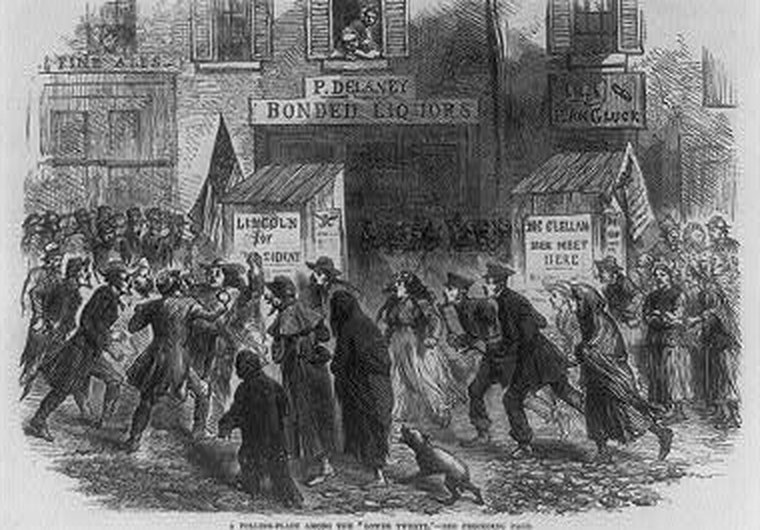
Election day in New York in 1864: two polling places from The Illustrated London News. Library of Congress Prints & Photographs Division, no known restrictions
A reader who has only ever voted in private may not realise how recent the privacy is. In Britain until 1872 a parliamentary vote was spoken aloud to the returning officer and written in a poll book, which was then printed and sold. Your landlord could buy a copy. So could your employer, your parish priest and the brewer who held your tenancy. Bribery was open and priced: a vote in a tight borough in the 1850s went for a few pounds, or a barrel of beer, and the money changed hands at the hustings.
America had paper ballots, which sounds better than it was. The ballots were printed and distributed by the parties, not the state, and each party used its own colour and size of paper so that the men watching the box could see which "ticket" a voter dropped in. A man who wanted to split his vote had to find scissors and paste. A man who wanted to keep his vote private had, in practice, no way to do it.
A Chartist in Melbourne
The idea travelled with the people who had been beaten by it. Henry Samuel Chapman, a lawyer and former newspaper editor, had been a radical in London in the Chartist years. By 1855 he sat in the Legislative Council of Victoria, the colony that had found gold at Ballarat and Bendigo four years earlier and had been swamped by diggers who read newspapers, held meetings and thought the vote was theirs by right. Around thirty of them had died at the Eureka Stockade the December before.
In December 1855 another member, William Nicholson, moved that the colony's new elections be held by secret ballot. He had no detailed plan for how that would work. Chapman did, and he drafted the clauses that went into the Electoral Act of March 1856. His scheme had three parts, each now so ordinary that it is hard to see any of them as an invention. The government, not the parties, would print the ballot paper. The paper would list every candidate. The voter would mark it alone, in a screened compartment, fold it and drop it in a locked box.
South Australia passed a similar law a few weeks later, and there is a long-running quarrel between Adelaide and Melbourne about which colony actually held the first election under it. Victoria's was in September 1856. I have read both sides' pamphlets and I think Victoria has the stronger claim, though a South Australian will tell you the Adelaide law was better drafted.
Britain takes sixteen years, with a riot thrown in
Chapman's ballot was reported in London as a curiosity from the colonies. The men who ran British elections did not want it. The Ballot Act of 1872 passed only after a Royal Commission had listed, constituency by constituency, the intimidation that open voting invited, and after Gladstone's government had lost patience with its own backbenchers. The first vote under it was a by-election at Pontefract in August 1872, held in a schoolroom with the ballot boxes borrowed from a local engineering works and sealed, so a Yorkshire story goes, with liquorice stamps from the town's sweet factory.
The Act had a sunset clause, because the Lords were sure the country would come to its senses by 1880. It was renewed every year for decades and then made permanent, because nobody could find a constituency that wanted to go back.
America calls it un-American, then adopts it in four years
The ballot reached the United States late, and the objections were the ones heard in London, plus one more: the system was foreign, which in the 1880s was usually enough to kill a reform. The reformers' answer was a fat book of testimony on vote-buying in Boston, Philadelphia and New York, where in some wards the going rate was two dollars and the party worker walked the voter to the box to make sure he got what he paid for.
Louisville, Kentucky, used an Australian-style ballot at a city election in February 1888, the first in the country. Massachusetts passed the first statewide law the same year and used it in 1889. Then the dam went. By the presidential election of 1892, most states (thirty-eight, by the count I trust) had some version of the Australian ballot, and the party-printed coloured ticket was gone almost everywhere within a decade. (South Carolina held out longest; it did not require a secret ballot in general elections until 1950.) The thing had taken Britain thirty-four years from the Charter to the Act. It took America four years from Louisville to nearly everywhere.
One thing was lost in the crossing. The Australian paper was a plain list of names. American states, under pressure from the parties, added the party column and the straight-ticket box, so that a voter could still vote the whole slate with one mark. That is why an American ballot looks like a ledger and a British or Australian one looks like a shopping list.
What it looks like today
The screen, the printed paper and the locked box are still there in the polling place, though in many states the paper is a card that a scanner reads, and in several the compartment is a kitchen table, because the ballot came in the post. The mail ballot is Chapman's system with one piece missing: nobody can be sure the voter was alone when the mark was made. Strip away the shouting and that is the argument that will run through the midterm elections on 3 November, which fill all 435 seats in the House and 35 in the Senate. The president said last year that he wants to end mail-in voting by executive order; whether the courts and the states will let him is a question for the news pages, not for this one.
Chapman himself left Victoria for New Zealand, where he became a judge and died in 1881. The word "ballot" comes from the Italian for a small ball, from the days when Venetians voted by dropping a ball into an urn. The Australians kept the word and threw away the ball, and the paper they put in its place is the one, more or less, that goes into the box next week.
Enjoyed this story?Get a new one every day on social.