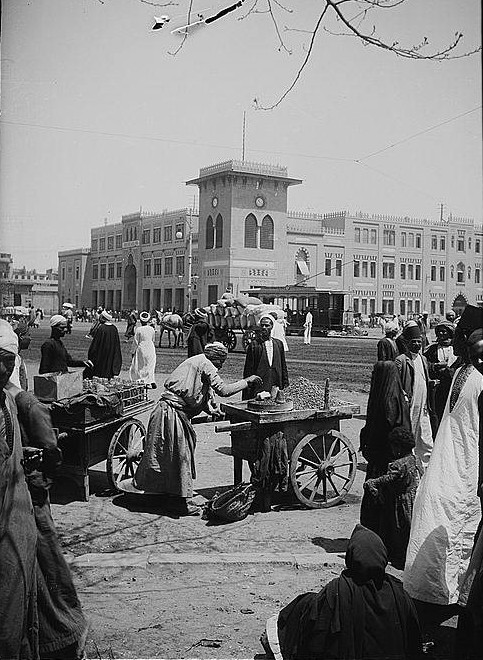
Photo: American Colony (Jerusalem) Photo Department, about 1900 to 1920, Library of Congress Prints & Photographs Division, no known restrictions
Thirty-two years old, heir to the governorship of Egypt, and drowned in the Nile along with the train he was riding in. That was Ahmad Rifaat Pasha on 15 May 1858, at a place called Kafr el-Zayyat, where Egypt's first railway ran out of track at the river and the trains went across on a boat.
I have been thinking about him since Saturday. On 8 November a train running between Giza and Faiyum ran into the back of a stationary Cairo to Aswan train at El Ayyat, about 70 kilometres south of Cairo. At least seven people were killed, one of them a driver, and more than 125 were hurt; the figures moved all through Sunday and may move again. President Abdel Fattah el-Sisi has ordered an investigation and promised to hold anyone negligent to account, and there are calls for the transport minister, Kamel al-Wazir, to resign. El Ayyat is not a lucky name on the Egyptian network. In February 2002 a Cairo to Luxor train caught fire there and ran on for about nine kilometres while it burned; the official death toll was 383, and some people put it much higher. There was another deadly collision at El Ayyat in 2009.
Egyptians have been arguing about the safety of their railway for a long time. The argument is almost exactly as old as the railway.
A line for the road to India
Muhammad Ali, the Albanian soldier who made himself master of Egypt, planned a railway from Cairo to Suez as early as 1833. The point was the route between Europe and India, which in those days meant a ship to Alexandria, an uncomfortable overland crossing, and another ship from Suez. According to the standard British engineering histories, French pressure killed the scheme, because Paris wanted a canal instead.
His grandson Abbas I revived it. In 1851 he contracted Robert Stephenson, son of George and the most famous railway engineer alive, to build a standard gauge line from Alexandria to Cairo. The first section, Alexandria to Kafr el-Zayyat, opened in 1854. The line reached Cairo in 1856 and Suez in 1858. It was the first railway in Africa and in the Middle East, and for eleven years, until the canal opened in 1869, it was the quickest way to get from the Mediterranean to the Indian Ocean.
The gap at Kafr el-Zayyat
There was one awkward place. At Kafr el-Zayyat the line met the Rosetta branch of the Nile, and the first arrangement for getting across was a car float, a flat vessel about 80 feet long that carried the carriages over the water. It sounds alarming now. In the 1850s it was a common enough solution on rivers that did not yet have a railway bridge.
On 15 May 1858 a special train carrying Ahmad Rifaat Pasha came down to the river. It was loaded onto the float, and the train fell off it into the Nile. The prince drowned. I have not found a reliable account of how many others died with him, and I would rather leave the number out than guess at it.
Why one prince mattered so much
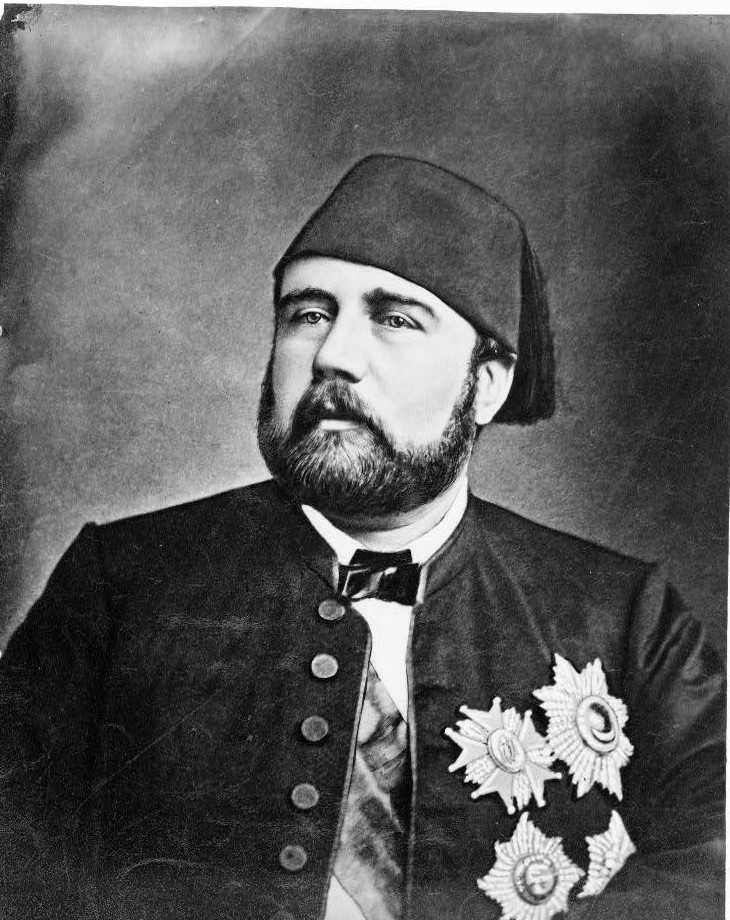
A photograph catalogued by the Library of Congress as "The Khedive," generally identified as Ismail Pasha, about 1860 to 1890. Library of Congress Prints & Photographs Division, no known restrictions
Ahmad Rifaat was born in Cairo in December 1825, the eldest son of Ibrahim Pasha, Muhammad Ali's great general. Egypt was still formally an Ottoman province, and its governorship passed by Ottoman custom to the eldest male of the family, not from father to son. In 1858 the ruler was Said Pasha, Muhammad Ali's son. Under the seniority rule, Ahmad was next.
With Ahmad gone, the next in line was his younger half-brother Ismail.
A story that Ismail had been expected on the same train and stayed behind has been repeated for a century and a half. I have never found a firm contemporary source for it, and nobody has shown that he had anything to do with the float. It is the kind of tale that attaches itself to anyone who profits from an accident, and Ismail profited enormously.
The heir who rewrote the rules
Said died in January 1863 and Ismail succeeded him. He was not a man to leave the succession to chance a second time. In 1866 he persuaded the Sultan in Istanbul, at considerable cost, to change the rule so that Egypt would pass to his own eldest son. The next year he obtained the title of Khedive.
What followed is the better known part. Ismail rebuilt Cairo on Parisian lines, opened the Suez Canal with an enormous party in 1869, built more railways, and borrowed money on a scale the country could not carry. In 1875 he sold Egypt's shares in the canal to Britain. In 1879 the Sultan, pushed by Britain and France, deposed him, and his son Tewfik took over. Three years later British troops occupied the country, and they did not fully leave for more than seventy years.
It would be too neat to blame the float at Kafr el-Zayyat for any of that, since Ismail made his own decisions. He got the chance to make them because the man ahead of him in line drowned in 1858.
The bridge Stephenson built
Stephenson replaced the float with a swing bridge nearly 1,600 feet long, so that the trains could cross the Rosetta branch on rails. Egypt's network grew from that one line into one of the largest in Africa, and its safety record is something Egyptian governments have promised, many times, to fix.
Saturday's crash happened on dry land, on a network that has had its Nile bridges for well over a century. A moving train ran into the back of one that was standing at El Ayyat, and the investigation Sisi ordered has not yet said why.
Enjoyed this story?Get a new one every day on social.