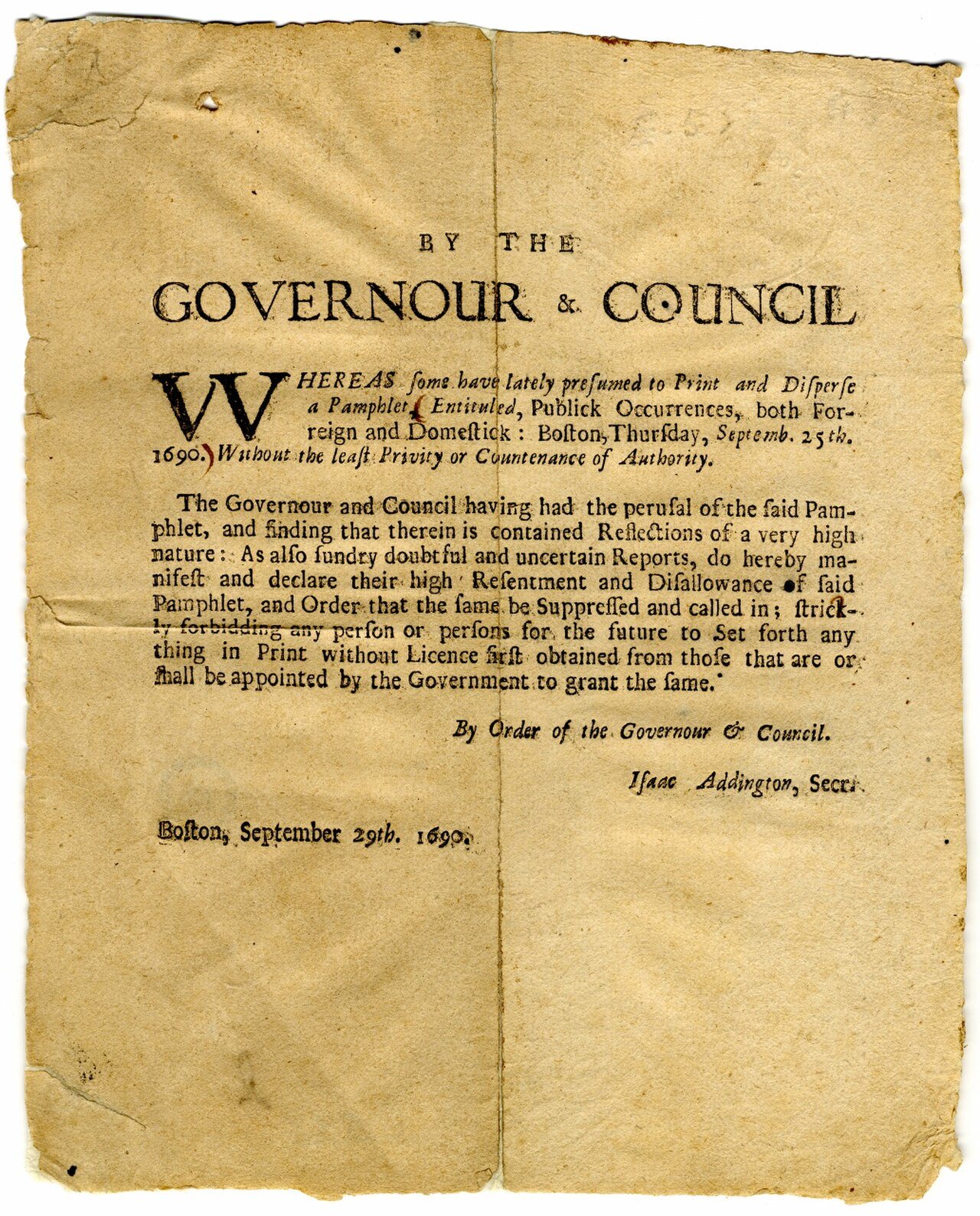
Order of the Governour and Council, Boston, 29 September 1690, signed by Isaac Addington, Secretary; public domain (CC0), via Wikimedia Commons
"It is designed, that the Countrey shall be furnished once a moneth (or if any Glut of Occurrences happen, oftener,) with an Account of such considerable things as have arrived unto our Notice." So begins Publick Occurrences Both Forreign and Domestick, printed in Boston on Thursday 25 September 1690, and sold, presumably, for a few pence from the London Coffee House, which the publisher ran. It was the first newspaper in the English colonies of America. It was also the last for fourteen years, because on the following Monday the governor and council of Massachusetts ordered it suppressed, and nobody dared try again until 1704.
I like the modesty of the promise, and the hedge in the brackets. The publisher had been in the news business long enough to know that occurrences do not arrive on schedule.
A man who had already been to the pillory
Benjamin Harris was a London bookseller and pamphleteer of the fiercely Protestant kind. In 1679 he had started a twice-weekly paper called Domestick Intelligence, during the panic over an alleged Catholic plot, and in 1680 he was fined, jailed and stood in the pillory for publishing a pamphlet the government considered seditious. He kept printing. When a Catholic king, James II, came to the throne in 1685, Harris judged London unhealthy and left for Boston the next year with his family.
In Boston he did what he knew. He opened a shop and coffee house, sold books, and printed a small reader for children called The New England Primer, the rhyming alphabet ("In Adam's Fall, We sinned all") that taught several generations of New Englanders to read and sold in the millions over the next century. He was not a radical by Boston standards. He was a Protestant bookseller who thought people should know what was going on.
What was in the paper
Publick Occurrences was four pages, each roughly the size of a sheet of modern printer paper, printed in two columns by Richard Pierce, with the fourth page left blank. The blank page was deliberate: readers were expected to write their own news in the space and send the sheet on to friends and relations in the country, which tells you how news travelled in 1690.
The three printed pages are a decent snapshot of a frightened colony. Smallpox had been in Boston through the summer and was, the paper reported, easing. The "Christianized Indians" at Plymouth had held a day of thanksgiving for a good harvest.And the big story, running over most of the second page, was the war. Massachusetts had sent an expedition north against French Canada under Fitz-John Winthrop, and it had failed. Harris reported the failure and added that the colony's Mohawk allies had treated French prisoners with great cruelty, which, he suggested, was not the sort of thing a Christian government should permit.
Then, as a bit of foreign colour, he passed on a story from France that Louis XIV had been sleeping with his son's wife, and that this was why the king and the dauphin were at odds. He gave no source. It was almost certainly untrue, and it was exactly the kind of thing a Protestant pamphleteer of 1690 printed about a Catholic king.
Four days
The order came on Monday 29 September. The governor, Simon Bradstreet, then eighty-seven, and his council declared their "high Resentment and Disallowance" of the pamphlet, as they called it, noted that it had appeared "without the least Privity and Countenance of Authority", found that it contained "Reflections of a very high nature" and "sundry doubtful and uncertain Reports", and ordered that nothing further be printed without a licence first obtained. Remaining copies were to be collected and destroyed.
Which reflections, precisely, had given offence has been argued over ever since. The complaint about the Mohawks embarrassed a government that needed them. The item about the French king was indecent. And the plain fact of an unlicensed press, run by a man who had already been pilloried once for the habit, was more than a Puritan magistracy was going to tolerate while it was fighting a war and waiting for a new charter from London. There was no trial. There was no second issue.
What became of Harris
Harris stayed in Boston another five years, printing almanacs and the Primer and, in 1692, briefly printing for the very government that had shut him down, which I have always found funny. In 1695 he went back to London and started another paper. He died there, around 1720, having spent his whole life in a trade that kept arresting him.
Fourteen years of silence, then a licence
Boston went without a newspaper until April 1704, when the postmaster John Campbell began The Boston News-Letter, a sheet of mostly reprinted London news carrying the words "Published by Authority" at the top, which was the lesson learned. The News-Letter ran for seventy-two years.
The copy in London
As for Publick Occurrences, every copy in Massachusetts was destroyed, as ordered. One had been sent to London, presumably by an official as evidence of what the colonists were up to, and it was filed with the colonial papers and forgotten. In 1845 a Massachusetts clergyman and antiquarian, Joseph B. Felt, found it in the State Paper Office while hunting for something else. It is still there, in the National Archives at Kew. The first American newspaper is, and has been for 336 years, a British government record. I suspect Harris would have had something to say about that, in brackets.
Enjoyed this story?Get a new one every day on social.