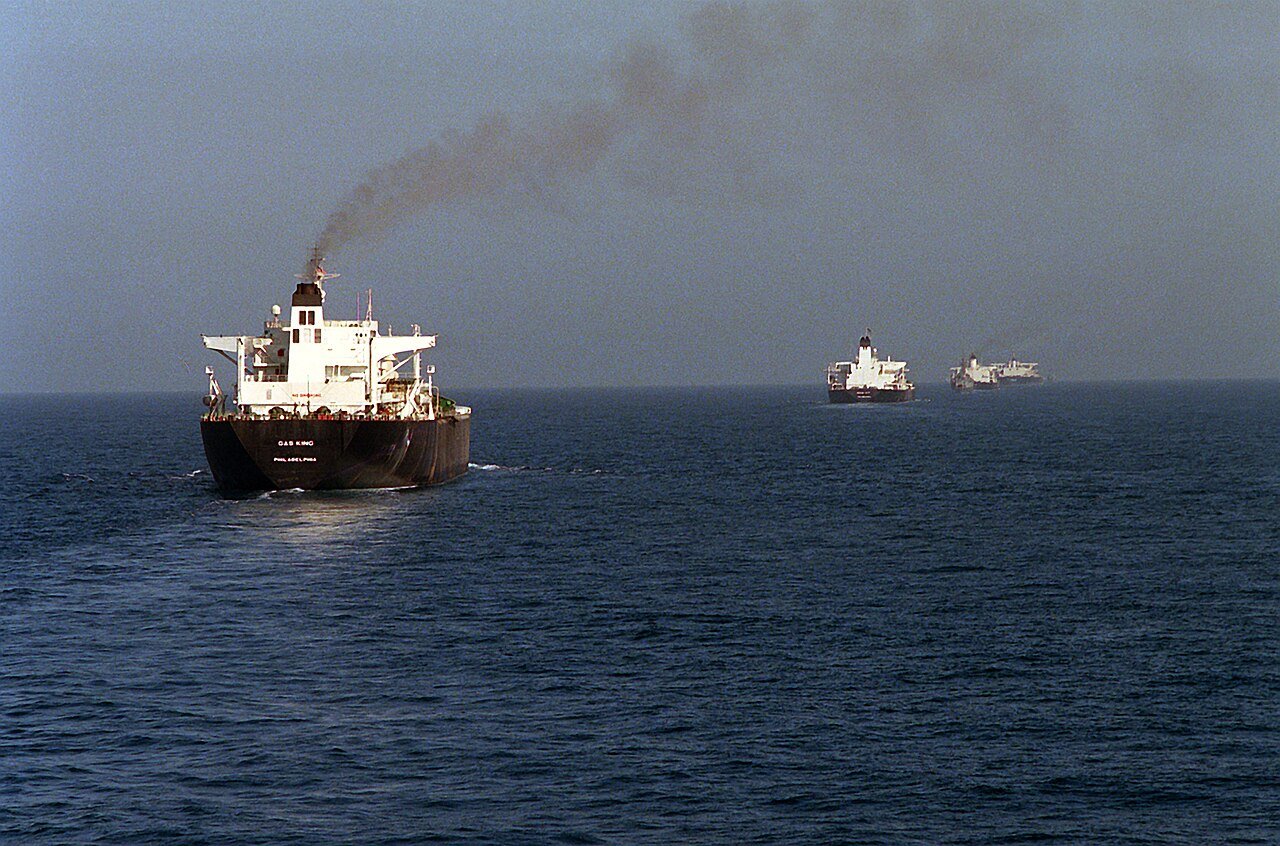
Photo: PH2 Tolliver, US Navy, public domain, via Wikimedia Commons
Iran's Revolutionary Guard navy said on Monday, 24 November, that three "violating" oil tankers had struck naval mines in the Strait of Hormuz and caught fire, and that the American military escort they were relying on had "failed to prevent the incidents from occurring." On Thursday it claimed two more: tankers it said had switched off their transponders north of Khasab, on the Omani side of the strait, one of them a supertanker carrying more than two million barrels that was left burning. It named none of the ships.
US Central Command has rejected the claims, pointing to its October statement that every internationally recognised shipping lane through the strait has been cleared of mines, and nobody outside Tehran has yet confirmed a single one of this week's strikes. What is not in dispute is the pressure on the route. Maritime security trackers counted more than 30 attacks on shipping in October and at least 22 in the first three weeks of November, nine months after the war with Iran began. A tanker hitting a mine while an American warship watches is, in other words, the exact scenario both sides are now arguing over. It is also something that has really happened, in the same waters, to the very first convoy the US Navy ever ran there.
Why Kuwait's tankers flew the American flag
By 1987 Iran and Iraq had been at war for nearly seven years, and since 1984 both had been attacking merchant ships, in what became known as the Tanker War. Iraq went after the tankers carrying Iranian oil. Iran went after the shipping of the Gulf states bankrolling Iraq, and Kuwait was near the top of its list.
Kuwait asked both superpowers for protection. Moscow agreed to lease it Soviet tankers. That was enough to move the Reagan administration, which in the spring of 1987 agreed to put eleven Kuwaiti tankers under the American flag, so that an attack on them became an attack on a US ship. The escort operation was called Earnest Will. In May, before it had even started, an Iraqi jet fired two Exocet missiles into the frigate USS Stark by mistake and killed 37 sailors, which did nothing to calm a Congress that was already uneasy about the whole plan.
Three days out, near Farsi Island
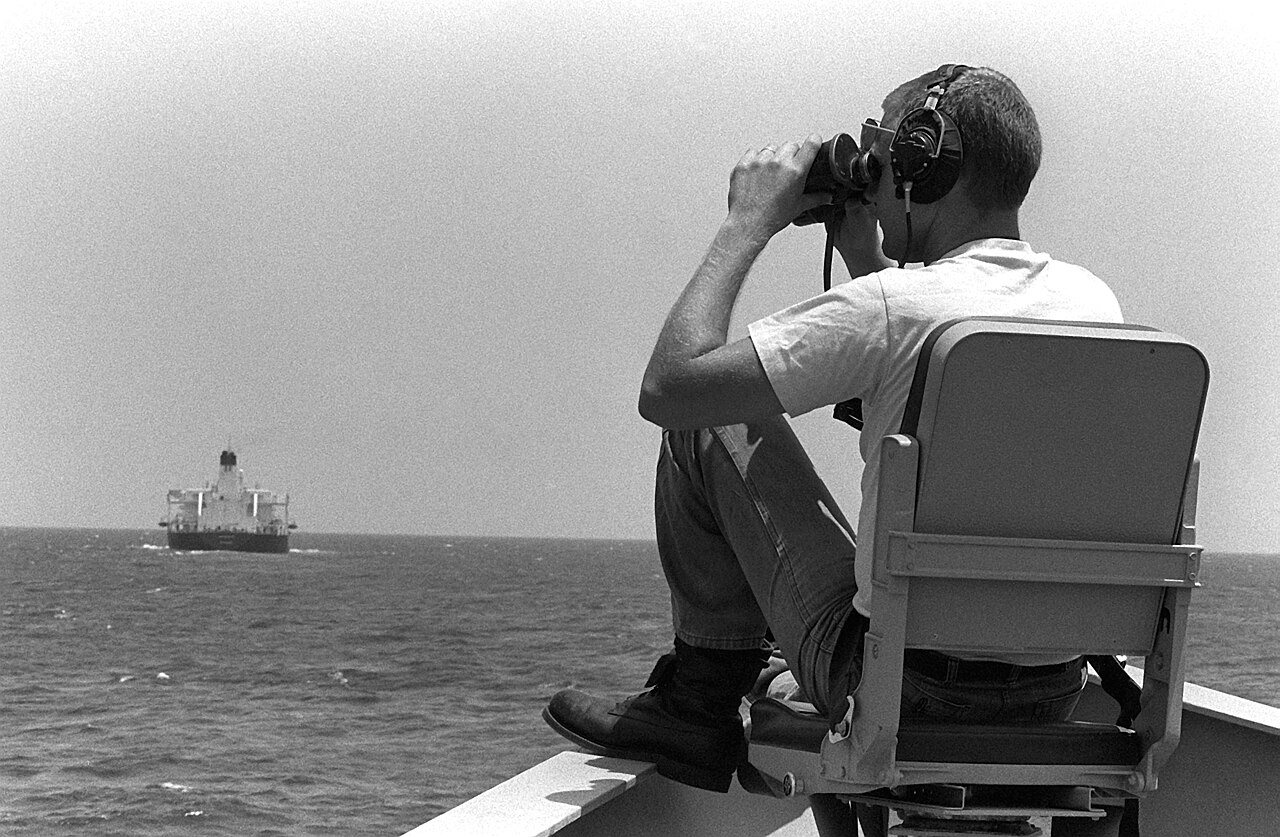
A US Navy lookout watches a reflagged tanker during an Earnest Will escort. Photo: Senior Chief Photographer's Mate Mitchell, US Navy, public domain, via Wikimedia Commons
The first convoy formed in the Gulf of Oman on 22 July 1987. At its centre was the Bridgeton, until days earlier the Kuwaiti supertanker Al-Rekkah, at roughly 400,000 tons one of the biggest tankers in the Kuwaiti fleet. With it went the reflagged gas carrier Gas Prince and an escort that included the destroyer USS Kidd, the frigate USS Crommelin and the cruiser USS Fox. Reporters were aboard, and the administration plainly wanted the first run to look routine. It was routine for about two days.
Early on the morning of 24 July, in open water near Iran's Farsi Island, well inside the Gulf, the Bridgeton struck a mine. Nobody was hurt. The blast tore a hole in the hull and flooded several compartments, but a ship that size barely noticed: she slowed and kept going on her own power.
Then came the detail every account of the convoy repeats, and the one that embarrassed Washington most. The escorts were thin-skinned warships with no mine protection, and a second mine could have sunk one. So for the rest of the trip to Kuwait the warships fell in behind the tanker, following in her wake, and the ship they were there to protect led the way through the minefield.
A navy without minesweepers
The mine itself was an old design, a moored contact type whose basic pattern dated back to the years before the First World War. Mines like it cost very little and could be rolled off the deck of almost any small boat at night. The Navy had prepared for missiles and fast attack craft. It had not brought minesweepers, partly because it had very few in service.
The fix took weeks, and it was improvised. Helicopters equipped for mine clearing were flown to the region, old ocean minesweepers followed, and Kuwait and Saudi Arabia were pressed to help. In September, American helicopters caught the Iranian landing ship Iran Ajr laying mines at night, fired on her, and boarded her the next morning with the mines still on deck. Washington put the photographs on display, and Tehran called the whole episode piracy.
None of that made the mines go away. In April 1988 the frigate USS Samuel B. Roberts struck one and very nearly broke in half, and four days later the Navy fought a single day of open battle with Iran's navy, a story told here on History All Day. Earnest Will kept running until after the ceasefire of August 1988.
What the Bridgeton says about this week
The parallel is unusually close, with one twist. In 1987 Iran did not admit to laying the mines, and the United States could not immediately prove it did; this week Iran is announcing the hits itself, framing them as the fault of ships on "unauthorized" routes, and Washington is denying they happened at all. Each side has swapped the role it played in 1987, while the mines (if they are there) work exactly as they did then.
The Bridgeton showed two things that still apply. An escort deters missiles and boats, which it can see, far better than it deters mines, which it cannot. And a big laden tanker is very hard to sink with one: the Bridgeton took a direct hit and still delivered her cargo. That is why the claims of burning supertankers matter less for what they did to steel than for what they do to insurance premiums, and to the willingness of crews to make the run at all.
I have read a lot of second-hand accounts of the 1987 convoy and they tend to treat the warships-behind-the-tanker moment as a joke at the Navy's expense. I think it was the most sensible decision anyone made that week. It is also a decision commanders in the strait may have to think about again if any of this week's claims turns out to be true.
The ship afterwards
The Bridgeton was repaired and went back into service. The Navy, stung, kept mine countermeasures ships in the Gulf for the rest of the war, and when the Fifth Fleet was re-formed in 1995, with its headquarters in Bahrain, mine clearance came with it as one of its standing jobs in those waters.
Enjoyed this story?Get a new one every day on social.