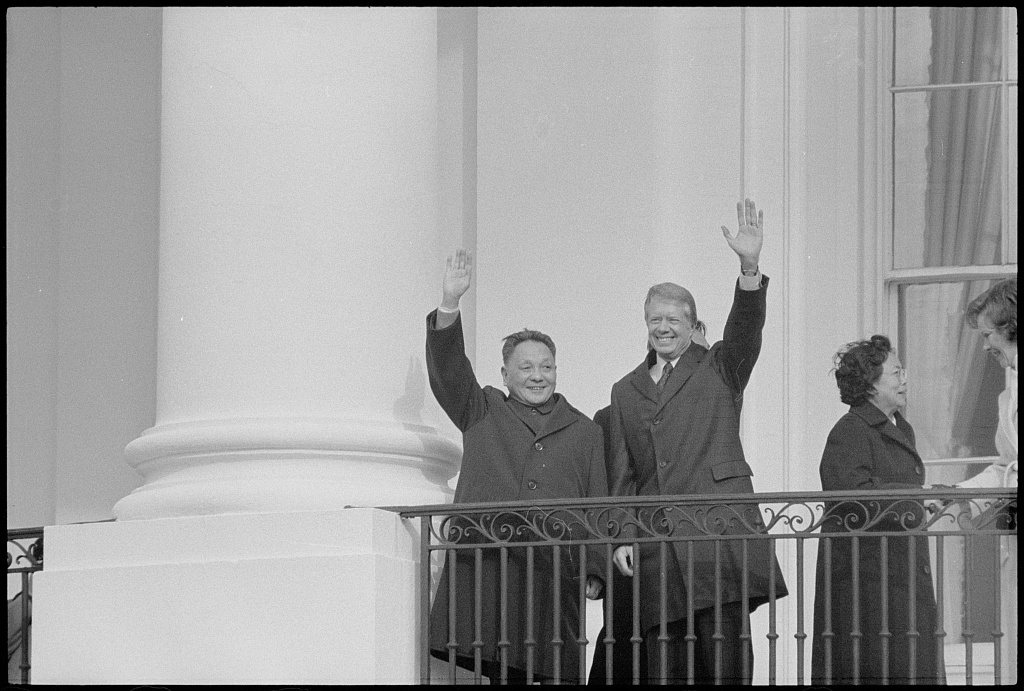
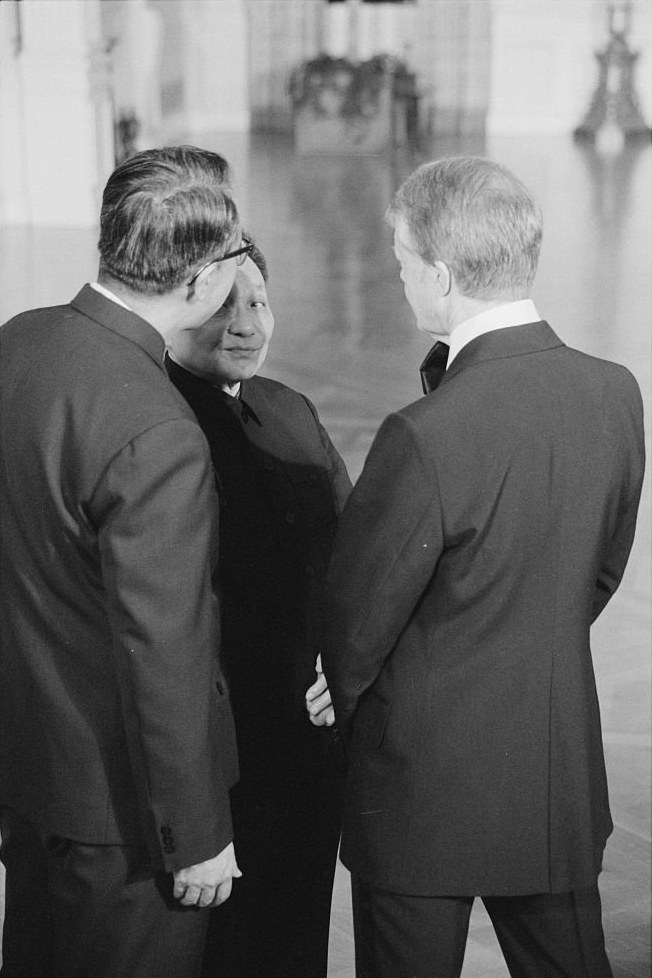
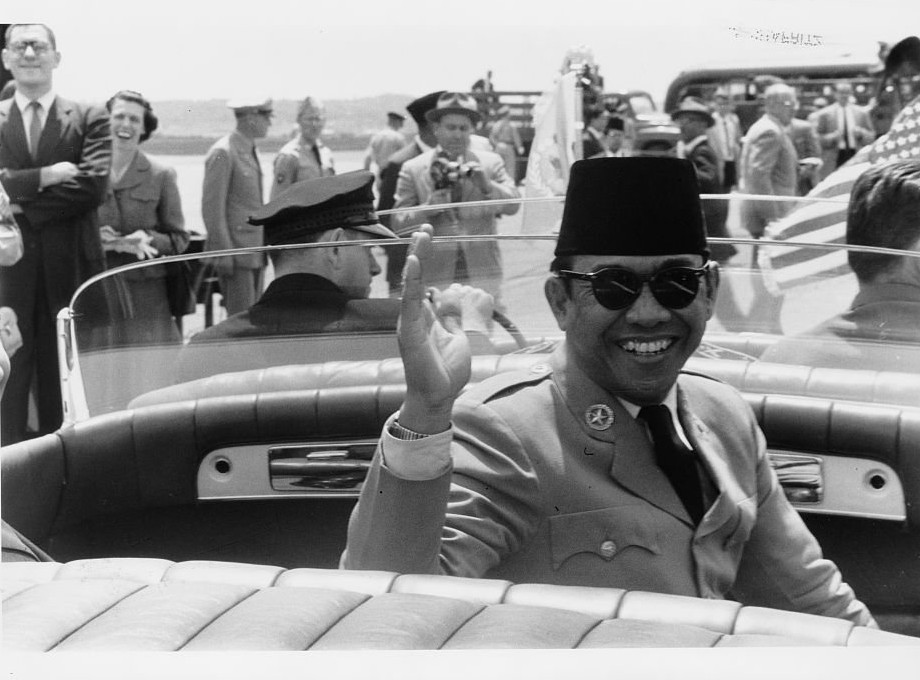
Photo: Deng Xiaoping and Jimmy Carter at the White House, 29 January 1979. Library of Congress Prints & Photographs Division, no known restrictions
Someone asked me this week why China would hold an APEC summit in Shenzhen rather than Beijing or Shanghai, which hosted it in 2014 and 2001. Part of the answer is that it is Shenzhen's turn to be shown off. The other part is family history, and it belongs to the host.
The leaders meet in Shenzhen on 18 and 19 November. Donald Trump is expected to sit down with Xi Jinping there, and Trump has said he thinks Vladimir Putin will be in town too. The talk is of trade, Iran and a hotline for incidents involving artificial intelligence, with the larger agreements, by most reporting, saved for the G20. Whatever comes out of it, the photographs will be taken in a city of more than seventeen million people that did not exist, as a city, before 1979.
A county people left by water
In the late 1970s the place was Bao'an County, a stretch of paddy fields, fish ponds and small towns across a narrow river from Hong Kong's New Territories. The town of Shenzhen itself was a market and a railway halt at the Lo Wu crossing. (The line that it was "a fishing village" is a slogan, and people in Shenzhen have been correcting it for decades.)
What Bao'an was known for in Beijing was leaving. Through the 1960s and 1970s, young people from the Pearl River Delta tried to get into Hong Kong by swimming across Deep Bay or crossing the hills at night, and there were large waves of attempts, including one in 1979. The figures that circulate run to the hundreds of thousands over three decades; I would treat any exact total with care, because the people counting had reasons of their own. What is not in doubt is the gap. A day's work in a Bao'an commune paid a small fraction of a day's work on the other side of the river, and everyone in the county knew someone who had gone.
Xi Zhongxun goes to Beijing
Deng Xiaoping with Jimmy Carter at the White House, 29 January 1979. Warren K. Leffler, Library of Congress Prints & Photographs Division, no known restrictions
In 1978 the Party sent a new first secretary to Guangdong. Xi Zhongxun was a veteran revolutionary who had spent most of the previous sixteen years purged, jailed or in internal exile. According to the account now told in Shenzhen's own museums, one of his first trips was to Bao'an, and he came away convinced that guarding the border harder would not stop people from crossing it.
In April 1979, at a work conference in Beijing, Xi and his colleagues asked for Guangdong to be allowed to run its own experiments with foreign investment and trade along the coast. Deng Xiaoping liked the idea and gave it a name. The standard version of his reply, repeated in Chinese histories ever since, is that Beijing had no money to give, so Guangdong would have to be given policy instead, and "fight its way out along a bloody path." The phrase has been quoted so often that it has turned into a kind of company motto for the city.
The groundwork had started earlier. On 31 January 1979, while Deng was in the United States on the visit pictured at the top of this page, Beijing approved a proposal from Yuan Geng of the China Merchants company to open an industrial zone at Shekou, on the western edge of Bao'an. Bao'an itself was renamed Shenzhen and raised to a city in March 1979. On 26 August 1980, the Standing Committee of the National People's Congress passed the regulations that created the Shenzhen Special Economic Zone, along with Zhuhai, Shantou and Xiamen.
A billboard in Shekou
It is hard now to convey how strange the early zone looked to the rest of China. Shekou put up a sign in the early 1980s that read "Time is money, efficiency is life," which sounds like a bank's advertising today and at the time read to many cadres as close to heresy. Workers were paid by the piece. Construction crews on the International Trade Centre tower were celebrated for finishing a floor every three days, and "Shenzhen speed" entered the language.
Deng went to see it in January 1984 and wrote an inscription saying that the zone's development proved the policy correct. He went back in January 1992, at 87, at a moment when the reforms had stalled after Tiananmen, and his remarks on that southern tour restarted them. A large painted billboard of Deng went up on Shennan Road, the city's main artery, and versions of it have stood there since.
The son's first trip
When Xi Jinping became general secretary in November 2012, his first trip outside Beijing was to Shenzhen. He laid a wreath at the bronze statue of Deng on Lianhua Mountain, which most people read, correctly I think, as a statement about where he meant to take the economy. In October 2020 he was back to give the speech for the zone's 40th anniversary.
He did not need to mention his father on either occasion, and the official accounts mostly did it for him. Xi Zhongxun died in 2002, and his name turns up on museum panels across the city.
Seventeen million and counting
The population of Shenzhen was about 330,000 in 1980, most of them farmers. The 2020 census counted 17.56 million. The city is now the home of Huawei, Tencent and BYD, and in 2018 its economy grew larger than Hong Kong's for the first time, which is a long way from the years when the traffic across the river went the other way. Next week's visitors will be driven past the towers on Shennan Road, and past the Deng billboard, on their way to talk about tariffs. Nobody, as far as I know, has proposed swimming.
Enjoyed this story?Get a new one every day on social.