The Unknown Soldier's Tomb Got a Guard Because People Picnicked on It
By Priya Raman · November 12, 2026 · 5 min read
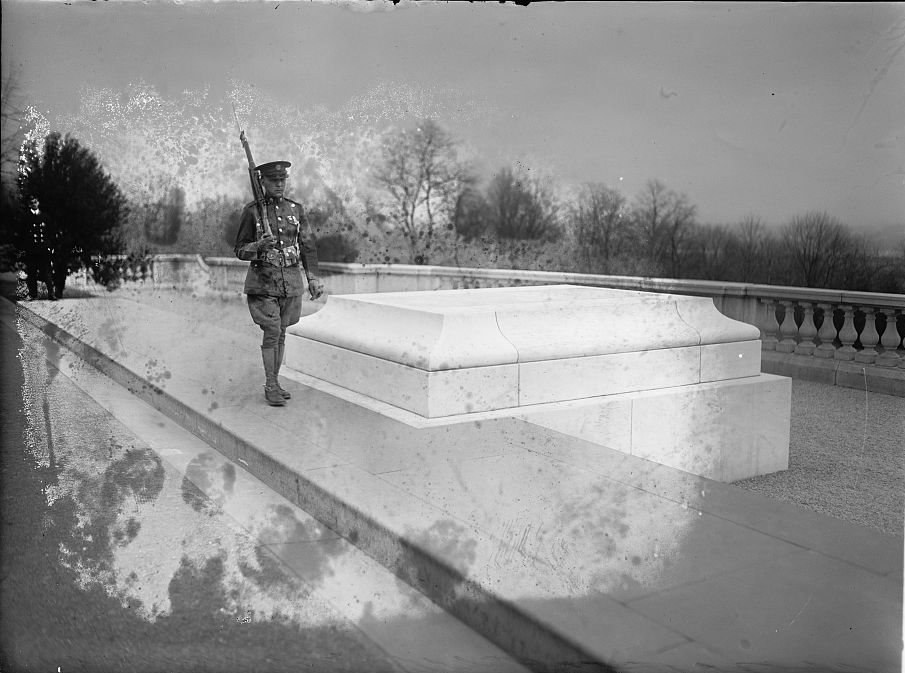
Photograph of the first permanent soldier guarding the low marble Tomb of the Unknown Soldier at Arlington, March 1926
Photo: the first permanent guard at the tomb, 25 March 1926. Library of Congress Prints & Photographs Division, no known restrictions

"Here rests in honored glory an American soldier known but to God." The words were cut into the back of a block of white Colorado marble in 1932, eleven years after the man they describe was buried. For most of those eleven years the grave was a low, flat slab on a terrace with a fine view of Washington, and people treated it accordingly: they sat on it, and some of them ate their lunch there.

On Wednesday, Veterans Day, a soldier guarding that grave raised his voice at a group that included Defense Secretary Pete Hegseth. The party had laid a wreath and posed for a photograph, and as they walked off somebody laughed. The sentinel called out, "All visitors will maintain an atmosphere of silence and respect at all times." It is not clear who laughed. The Pentagon's chief spokesman, Sean Parnell, said afterwards that "a soldier correctly and respectfully reminded everyone to maintain decorum," which is about as gracious as a press office gets.

The sentinels do this a few times a day, by their own account. It made the news because of who was on the receiving end. What interests me more is that the line exists at all, and that the post behind it was created to deal with exactly this problem.

Four coffins at Châlons
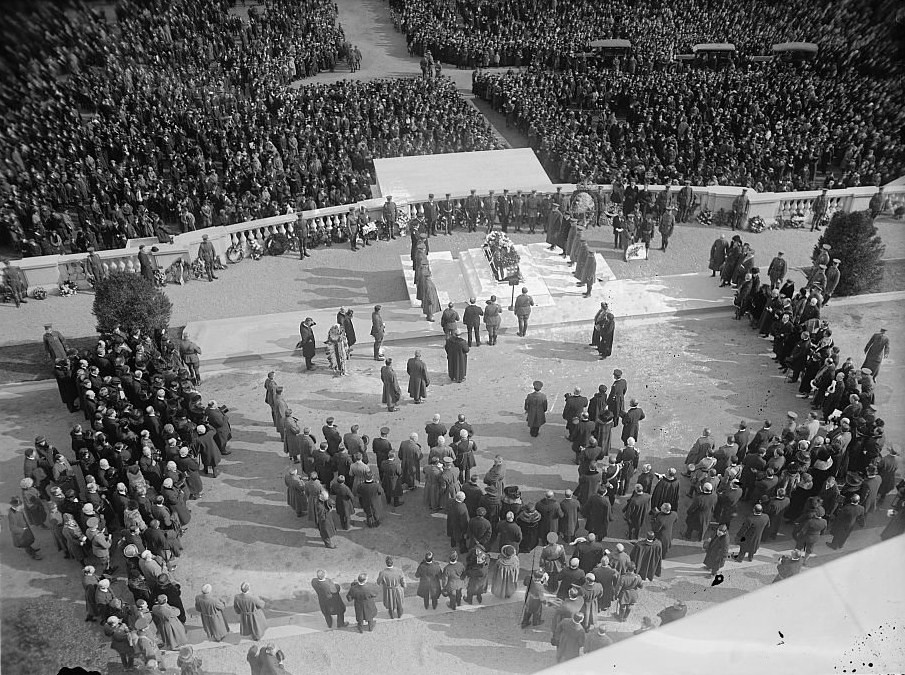
Crowds at the burial of the Unknown Soldier, Arlington, 11 November 1921. Library of Congress Prints & Photographs Division, no known restrictions

The idea came from Britain and France, which each buried an unidentified soldier on 11 November 1920, one in Westminster Abbey and one under the Arc de Triomphe. A congressman from New York, Hamilton Fish III, introduced a bill the following month for an American equivalent. Woodrow Wilson signed it on 4 March 1921, his last day in office.

In October, four unidentified Americans were exhumed from cemeteries in France and brought to the town hall at Châlons-sur-Marne. On 24 October, Sergeant Edward F. Younger, a wounded and decorated infantryman, was handed a spray of white roses and sent into the room to choose. He walked around the coffins several times and laid the roses on the third. The other three were reburied at the Meuse-Argonne cemetery.

The chosen coffin crossed the Atlantic on the cruiser USS Olympia, Dewey's old flagship from Manila Bay, lay in state under the Capitol dome, and was buried at Arlington on 11 November 1921 after a service led by President Harding.

One of the people at the graveside was Plenty Coups, the Crow chief, who laid his war bonnet and coup stick on the coffin. They are kept at Arlington to this day.

A grave at ground level
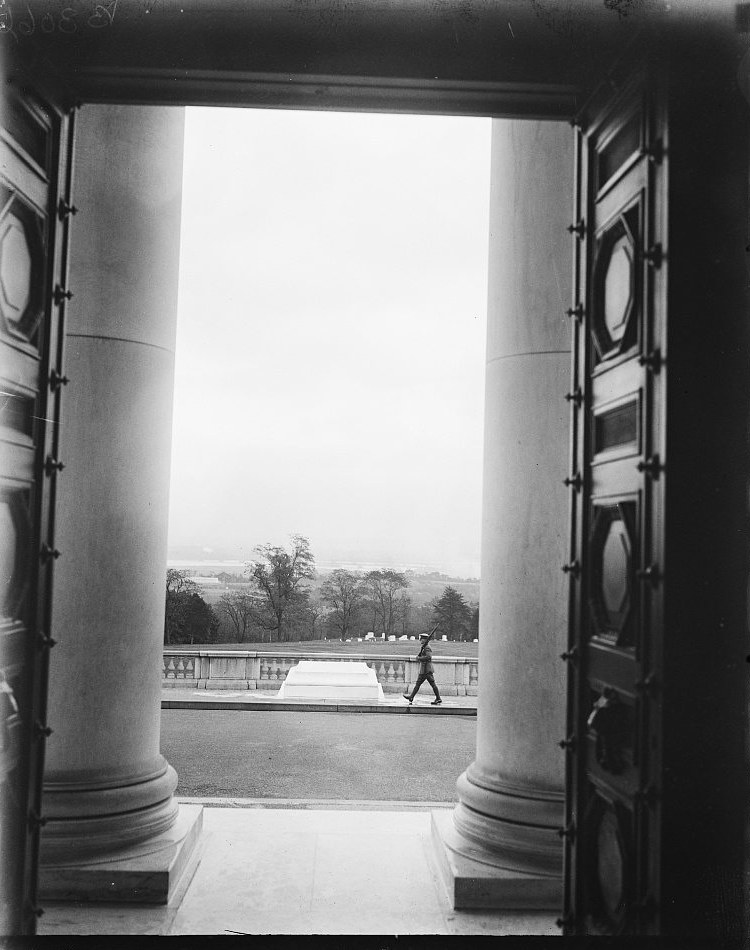
A sentinel passing the original flat tomb, seen through the doors of the Memorial Amphitheater, 5 November 1928. Harris & Ewing, Library of Congress Prints & Photographs Division, no known restrictions

What Congress paid for in 1921 was a burial, not a monument. The tomb that went in was a simple marble slab more or less flush with the plaza, the base for a memorial that had not yet been designed. It had no rail and no guard. The history kept by the Tomb Guards' own society is blunt about what followed: visitors climbed on it, rested on it and in some cases picnicked on it. The most important grave in the country had become a bench.

A civilian watchman was posted in November 1925, but only while the cemetery was open. The complaints kept coming, many of them from veterans' groups, and on 2 March 1926 Congress passed a joint resolution telling the War Department to keep a military guard at the tomb from sunrise to sunset. The first soldier took up the post on 25 March. A photographer from the National Photo Company was there, and the picture at the top of this page is the result. (The spots on it are damage to the glass negative, not snow.)
From daylight to midnight

The daytime guard lasted eleven years. The American Legion pressed for more, and in July 1937 the watch became continuous, twenty-four hours a day, which is how it has stayed. By then the low slab had been replaced. Work on the present tomb, designed by the architect Lorimer Rich with carving by the sculptor Thomas Hudson Jones, began in August 1931, and the finished block was unveiled in April 1932, raised high enough that nobody would mistake it for furniture again.

Since April 1948 the guard has come from the 3rd U.S. Infantry Regiment, the Old Guard. The routine is the one people film on their phones: 21 steps along the mat, a 21-second pause facing the tomb, a turn, 21 more steps. The number is a nod to the 21-gun salute. Guards have kept the walk through blizzards and through Hurricane Isabel in 2003, when, as the regiment tells it, they were cleared to take shelter and stayed out anyway.

The crypt that is empty

The tomb has held more than one soldier. Unknowns from the Second World War and Korea were buried beside it on Memorial Day 1958, and one from Vietnam in 1984. That last one did not stay unknown. In 1998 his remains were exhumed and DNA identified him as Michael Blassie, an Air Force pilot, shot down near An Lộc in 1972. His family took him home to St. Louis. The Pentagon decided not to replace him, partly because DNA testing made it likely that no Vietnam casualty would stay unidentified for long, and the crypt now carries an inscription for the missing instead.

The first woman to earn the Tomb Guard badge, Sergeant Heather Johnsen, did so in 1996. The badge is often called the second least awarded in the Army after the astronaut badge. I have never found an official count that settles the ranking, but the number of holders is in the hundreds, not the thousands.

What the post looks like now

On an ordinary weekday the plaza is quiet except for the click of heels on the mat and the shuffle of school groups. Signs ask for silence. Most people give it without being told, and the ones who forget hear a version of the sentence that was shouted on Wednesday, delivered in the same flat, parade-ground voice to tourists, teenagers and, now and then, the Secretary of Defense. Behind the sentinel, the marble block that went up in 1932 still faces the city, and the empty crypt sits in the row in front of it with its new inscription.

See more of us on GoogleAdd History All Day as a preferred source and our stories can show up more often for you in Top Stories.