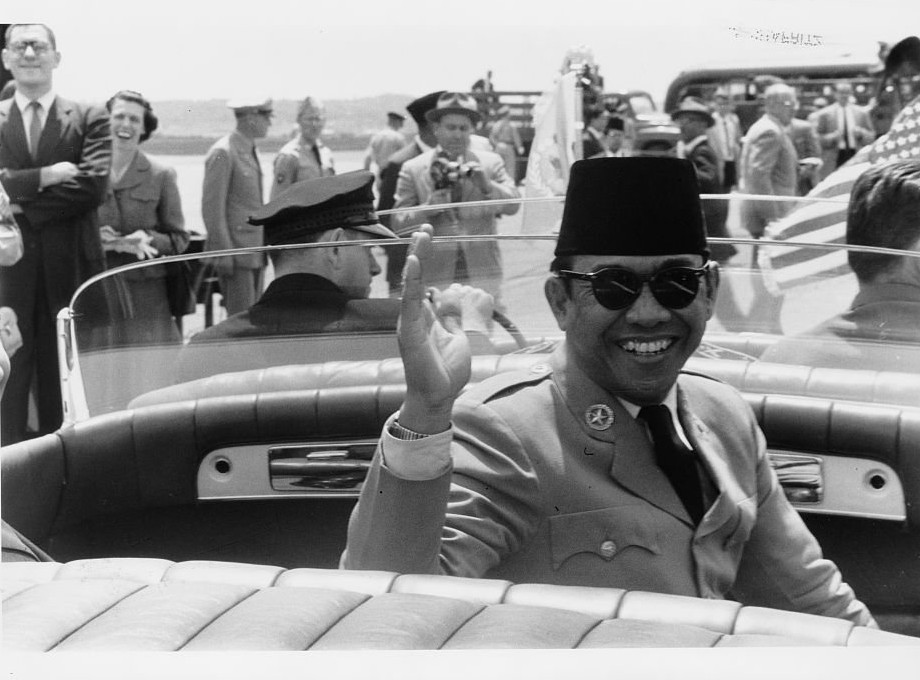
Photo: Warren K. Leffler, 16 May 1956, U.S. News & World Report collection, Library of Congress Prints & Photographs Division, no known restrictions
On 20 July 1956 Mohammad Hatta, vice president of Indonesia, sat down and wrote a letter to parliament saying he wanted to stop being vice president. He sent copies to President Sukarno and to the cabinet. Parliament did nothing with it. Four months later he wrote again, this time with a date: he would leave on 1 December. The House accepted on 30 November, and the next morning one half of the partnership that had founded the country went home.
Nobody took his place until March 1973.
That gap has been on my mind since Tuesday afternoon in Jakarta. Vice President Gibran Rakabuming Raka, who is 39 and the son of the former president Joko Widodo, met President Prabowo Subianto at the palace for more than two hours and offered to resign. The state secretary, Prasetyo Hadi, confirmed it to reporters. Last month the Supreme Court ruled that the documents Gibran had filed about his overseas schooling did not meet the requirements for the election, and some lawmakers have been talking about impeachment ever since. According to Prasetyo, Prabowo told him to keep defending his documents in the courts. Whether the offer has been accepted was still unclear when I wrote this.
Two names on one proclamation
The reason a vice president's departure mattered so much in 1956 goes back to the morning of 17 August 1945, when Sukarno read out a two-sentence proclamation of independence in front of his house in Jakarta. It was signed by two men, Sukarno and Hatta, "on behalf of the Indonesian people." The next day the independence committee made Sukarno president and Hatta vice president. Indonesians called the pair the Dwitunggal, roughly "the two-in-one."
They were not much alike. Sukarno was a Javanese engineer and one of the great platform speakers of his generation anywhere. Hatta was a Minangkabau from Bukittinggi in Sumatra, a trained economist who had spent most of the 1920s in the Netherlands studying at the commercial college in Rotterdam and running the Indonesian students' association. The Dutch put him on trial in The Hague in 1928 for his politics; he defended himself with a long speech called "Indonesia Free," and the court acquitted him. Back home he was arrested again in 1934 and sent to the prison camp at Boven Digoel in New Guinea, then to the island of Banda Neira, where he stayed until the Japanese invasion. He took crates of books with him into exile, which tells you most of what you need to know about him.
Sukarno, for his part, is said to have complained that Hatta thought like a book. I suspect he meant it as a criticism.
The vice president who ran things
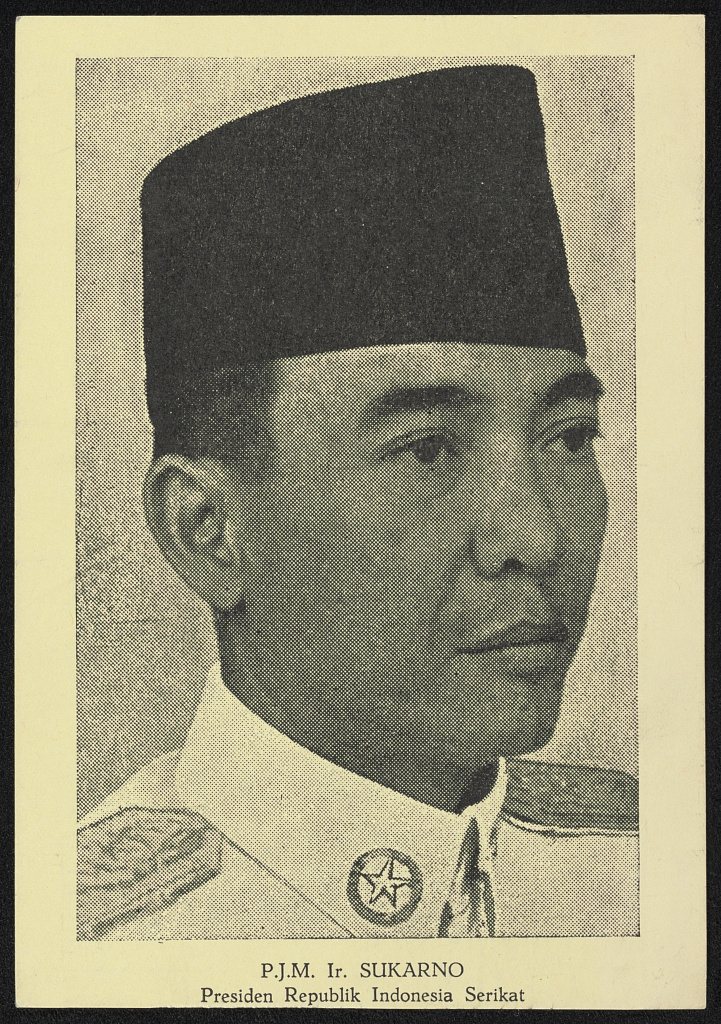
A 1950 postcard printed in Bandung of Sukarno as president of the federal Republic of the United States of Indonesia, the year Hatta went back to being his vice president. Postcard: Toko Buku Economie, Bandung, Library of Congress Prints & Photographs Division, no known restrictions
For the first years the vice presidency was not a ceremonial job. Hatta served as prime minister as well during the worst of the war with the Dutch, and in 1949 he led the Indonesian delegation to the Round Table Conference in The Hague. The Netherlands transferred sovereignty at the end of that December. Hatta was briefly prime minister of the new federal republic, then went back to being vice president under the provisional constitution of 1950.
Under that constitution the cabinet answered to parliament and the president and vice president were meant to sit above politics. In practice it meant a quick run of short-lived cabinets, and two founders with less and less to do and diverging ideas about what should happen next.
Why he went
The usual summary, and it is a fair one, is that Hatta left because he could not go along with where Sukarno was taking the country. Sukarno was talking openly about burying the parties and replacing parliamentary democracy with something he would soon call Guided Democracy, and he was moving closer to the Communist Party. Hatta believed in political parties and in cooperatives, and he thought presidents should be bound by the rules like everybody else.
There was also a timetable. Indonesia held its first national elections in 1955, and on 10 November 1956, seventy years ago today, the elected Constituent Assembly was opened at the Gedung Merdeka in Bandung to write a permanent constitution. As Hatta's position is usually explained, he regarded his job as finished once an elected parliament and the Assembly were sitting. His second letter followed thirteen days after the opening.
Seventeen years without a deputy
The constitution of the day did not say how to fill the post, and Sukarno did not try very hard. By 1959 he had dissolved the Constituent Assembly by decree and brought back the 1945 constitution, which made the president far stronger. He ruled without a vice president until he lost power after the upheaval of 1965, a process that took until 1967. Suharto, who replaced him, also took his time. Only in March 1973 did the People's Consultative Assembly elect Hamengkubuwono IX, the Sultan of Yogyakarta, to the job.
Hatta did not go quiet. In 1960 he published a long essay, "Demokrasi Kita" ("Our Democracy"), criticising the new order of things; the Islamic magazine that printed it, Panji Masyarakat, was banned. He lived as a private citizen in Jakarta, lectured, and wrote. When he died in March 1980 he was buried, as he had asked, in the ordinary public cemetery at Tanah Kusir rather than in the heroes' cemetery at Kalibata.
What the rules say now
Gibran's case would not leave the same kind of hole. After the constitutional amendments that followed the fall of Suharto, a vacancy in the vice presidency has a procedure: the president puts forward two candidates and the People's Consultative Assembly must choose one of them within sixty days. Indonesia has used something like it before. When Megawati Sukarnoputri moved up to the presidency in 2001, the Assembly elected Hamzah Haz to take over her old job.
So if Gibran does go, it will be Prabowo who names the two candidates. Hatta left over a matter of principle between two old comrades. Gibran's offer comes out of a court ruling on his school papers, at a moment when, by the AP's account, the rift between Prabowo and Gibran's father has been getting wider (which may or may not be a coincidence, and I would not bet on it either way).
The two men who could not share a government after 1956 now share Jakarta's main airport, Soekarno-Hatta International, where millions of travellers who have never heard of the 1956 letters queue for taxis under both names every year.
Enjoyed this story?Get a new one every day on social.