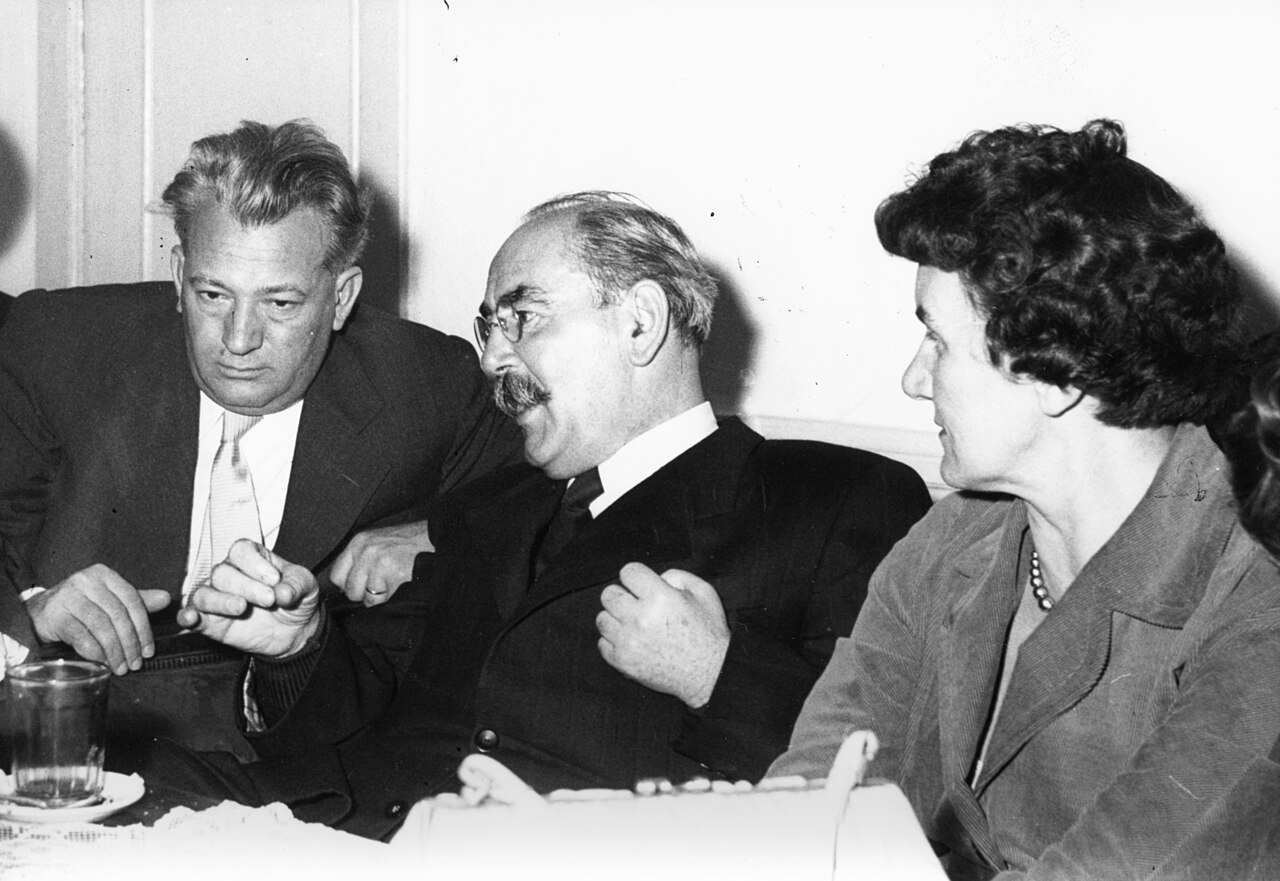
Photo: Fortepan / Jánosi Katalin, CC BY-SA 3.0, via Wikimedia Commons
On the evening of 23 October 1956 a crowd of perhaps two hundred thousand people stood in front of the Hungarian Parliament and chanted a name. The man they wanted was a stout, bespectacled 60-year-old agricultural economist who had been thrown out of the Communist Party the year before and was at home having dinner. When friends finally got Imre Nagy to the balcony, he opened with the word "Comrades". The crowd booed. He corrected himself to "Friends" and asked everyone to go home.
They did not go home. Within hours the secret police had fired on a crowd at the radio building, Soviet tanks were rolling into the city, and Nagy had been named prime minister of a country in open revolt. Twelve days later Soviet forces crushed the uprising. Nineteen months after that, Nagy was hanged in a Budapest prison yard and buried face down in an unmarked grave.
He makes an awkward national hero. He spent most of his life serving the system that killed him, and he ended up standing for Hungarian freedom more or less against his will. Seventy years on, Hungary's governments are still arguing about him, mostly by moving his statue.
A Bolshevik from Kaposvár
Nagy was born in 1896 in Kaposvár, in south-west Hungary, the son of a manorial servant. Drafted in the First World War, he was wounded and captured by the Russians in 1916, was in Russia when the Bolsheviks took power, and joined them. He came home in 1921 a committed communist, which in Horthy's Hungary meant arrests and secret organising, and in 1930 he left for Moscow, where he spent fourteen years at the Comintern's agricultural institute and Radio Moscow and survived the purges that killed many of his Hungarian comrades.
Files opened after 1989 suggested he had informed for the NKVD during those years, under the code name "Volodya". Some see a frightened man buying his survival; others think the documents were leaked in the 1990s precisely to muddy his reputation. I lean towards the first reading, but I would not stake much on it.
The man who gave out the land
What made Nagy popular at home was 1945. Back in Budapest with the Red Army, he became minister of agriculture in the provisional government and ran the land reform that broke up the great estates and handed plots to some six hundred thousand peasant families. A third of the population had been landless farm labourers, and Nagy's name was on the reform that changed that.
He was never comfortable in the party's hard core. When Mátyás Rákosi pushed forced collectivisation and show trials in the late 1940s, Nagy objected and was sidelined. Then Stalin died, in March 1953, and Moscow decided Rákosi had gone too far and picked Nagy as prime minister to soften things. His "New Course" closed internment camps, slowed collectivisation, released prisoners and moved money from heavy industry towards things people could eat and wear. It lasted less than two years. Rákosi, still running the party, undermined him, and Nagy was dismissed in April 1955 and expelled from the party that December. He retreated to his house on Orsó Street and became, without doing much, the man every disappointed communist in Budapest talked about.
Twelve days
The demonstration on 23 October 1956 began as a student march in sympathy with Poland. Its sixteen demands included free elections, the withdrawal of Soviet troops and Nagy's return as prime minister. By nightfall it had become something nobody had planned.
The party reappointed Nagy on 24 October, hoping his name would calm the streets. For the first few days he disappointed almost everyone. He appeared to go along with martial law and the Soviet intervention (he later insisted both had been decided before he arrived and announced over his name), and tried to run a government from inside the party building while workers and teenagers fought tanks with petrol bombs.
Then, over the last days of October, he moved. On 28 October he declared the uprising a national democratic movement rather than a counter-revolution and secured a ceasefire and the start of a Soviet withdrawal from Budapest. On 30 October he restored multi-party government. On 1 November, with fresh Soviet divisions reported crossing the border, he announced that Hungary was leaving the Warsaw Pact, declared it neutral and appealed to the United Nations.
That last step was the one Moscow could not accept. At dawn on 4 November Soviet forces attacked Budapest. Nagy's final broadcast, at 5:20 in the morning, lasted about a minute: "Our troops are fighting. The government is in its place." Then he and a few dozen colleagues and relatives took refuge in the Yugoslav embassy.
Safe conduct
Nagy spent eighteen days in the embassy while János Kádár, the man the Soviets installed in his place, negotiated. On 22 November Kádár's government guaranteed in writing that Nagy and his group could go home freely. They boarded a bus outside the embassy. Soviet officers took it over, drove it to a Soviet base, and the group was flown to Romania and held near Snagov.
He was brought back in 1957 and tried in secret in June 1958 for organising the overthrow of the people's democratic order. He refused to ask for clemency. He was hanged on 16 June 1958 together with Pál Maléter, his minister of defence, and the journalist Miklós Gimes, and the three were buried in a corner of the Budapest municipal cemetery, plot 301, under false names.
Kádár ruled Hungary for the next thirty years. Nagy's name was unmentionable for most of them.
Plot 301
The reburial came on 16 June 1989, thirty-one years to the day after the hanging. The bodies had been dug up from plot 301 that spring, which took some doing (the graves were unmarked, and Nagy's had been covered in rubbish and tar paper). The coffins were laid out on the steps of the Kunsthalle in Heroes' Square, with a sixth, empty, for the unknown dead of 1956. Something like a quarter of a million people filed past. A 26-year-old named Viktor Orbán, speaking for the young liberal party Fidesz, demanded the withdrawal of Soviet troops and free elections. Kádár, elderly and confused, died three weeks later. Within a year Hungary had held its first free election since 1945.
A life-size bronze of Nagy, standing on a small bridge and looking across towards the Parliament, was put up in 1996 on Martyrs' Square. In December 2018 the Orbán government removed it overnight to restore the square's pre-war layout, which meant putting back a monument to the victims of Hungary's 1919 communist dictatorship. The Nagy statue went up again in 2019 on Jászai Mari Square, a few hundred metres away, facing the Danube instead of the Parliament. Critics called it a demotion. The prime minister who ordered the move was the same Viktor Orbán who had made his name speaking over Nagy's coffin in 1989.
What the statue leaves out
It is tempting to make Nagy simpler than he was. He was a reform communist who wanted a more humane version of the system he had believed in since 1917, and he took the step to neutrality only when the alternative was fighting on the wrong side of his own people. He hesitated for days. He was, by most accounts, not a very good speaker.
What he did do was refuse, at the end, to say that any of it had been a mistake. The transcript of his trial, published after 1989, has him telling the court that he expected history to judge the case, and that the people who had sentenced him would one day have to answer for it. I find that harder to explain than anything the teenagers with petrol bombs did, and I suspect it is the real reason the statue keeps moving: whoever holds the square gets to say what 1956 was for.
Enjoyed this story?Get a new one every day on social.