Photo: Bain News Service, about 1910 to 1915, Library of Congress Prints & Photographs Division, no known restrictions
"This memorandum is a meaningful first step, but any future investment would require stable policies." That is ExxonMobil, in the statement it put out on Monday after signing a non-binding memorandum of understanding with Venezuela's state oil company, PDVSA, to look at upstream opportunities in the country. The company also asked for clear regulations, strong protection for investors and competitive returns, and it did not say which oil areas it has in mind. A final contract would still be needed before it drills anything.
Exxon left Venezuela nearly twenty years ago, after Hugo Chávez's government took control of the heavy-oil projects in the Orinoco belt in 2007, and the two sides spent years after that in international arbitration. Its history in the country goes back a lot further than Chávez, though. It goes back, in a roundabout way, to a single well on the shore of Lake Maracaibo that the people who drilled it had already given up on.
A dry hole in a cattle and coffee country
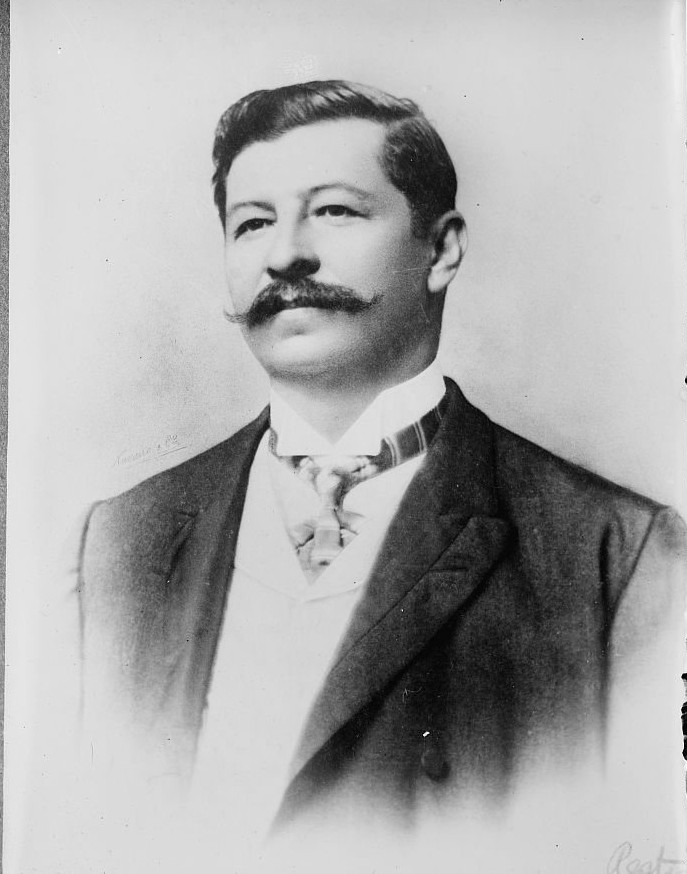
At the start of the 1920s Venezuela made its money from coffee, cacao and cattle. It was ruled by General Juan Vicente Gómez, who had taken power in 1908 and treated the country more or less as his estate. One of the things Gómez's government handed out was concessions, and in 1906 one of them, a huge tract around the Maracaibo Basin, went to a man called Antonio Aranguren. In 1913 it was bought by Venezuelan Oil Concessions, a company tied to Royal Dutch Shell.
The company found oil at a field called La Rosa, near the village of Cabimas on the eastern shore of the lake, in 1917. Not every hole was a success. One of them, Los Barrosos No. 2, was abandoned in August 1918 as a shallow dry hole. In July 1922 the crews came back and started drilling it deeper, under a new number, R-4.
Fourteen to twenty-three December
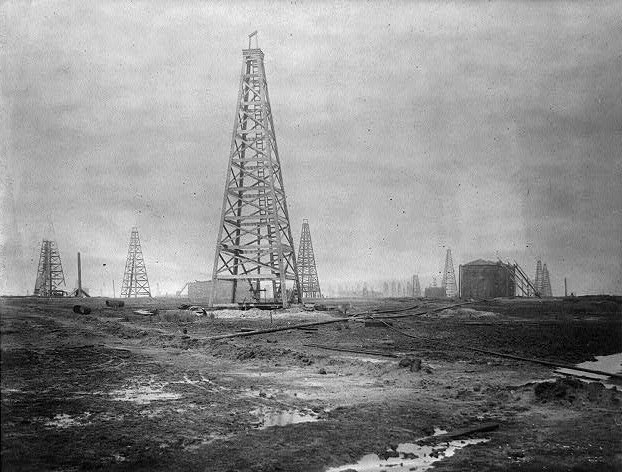
The Lucas gusher field at Spindletop, Texas, in 1901, the American blowout that made gushers famous two decades before Cabimas. Photo: Library of Congress Prints & Photographs Division, no known restrictions
On 14 December 1922 the well came in from about 1,550 feet down. It started at an estimated 2,000 barrels a day and then, as one account puts it, erupted into a spout reported at about 200 feet above the derrick. A Shell geologist, Hans Karl Stauffer, estimated the flow at around 100,000 barrels a day of heavy crude. Nobody had any way to cap a well like that in 1922, so it kept going day and night, with the black rain coming down on Cabimas and running off into the lake.
The estimates of the mess are enormous: something like 840,000 barrels of oil fouled the lake and its shore. Workers threw up earth banks to hold some of it, and about 350,000 barrels were later pumped out of those pools and shipped to Shell's refinery on Curaçao., which tells you something about the priorities of the time.
Then, on 23 December, it stopped. The geologists put it down to the producing sands collapsing and choking the hole. The people of Cabimas had a different explanation, and credited San Benito, the town's patron saint. I am not in a position to referee that one, and I notice that neither explanation has ever been formally withdrawn.
The rush
What the blowout did was prove, in the most public way possible, that there was a great deal of oil under Lake Maracaibo. Oil companies arrived in force. The next few years brought new fields at Lagunillas in 1926, Tía Juana in 1928 and Bachaquero in 1930, many of them under the lake itself, with derricks standing in the water. Gómez's government did very well out of oil, and so, by most accounts, did Gómez himself.
This is where Exxon's ancestor comes in. In 1928 Standard Oil of New Jersey took control of the Creole Petroleum Corporation, which had large concessions around the lake. Creole became one of the biggest foreign producers in Venezuela and, for a few years before 1951, the largest oil producer in the world; in 1951 it brought in more than a third of Jersey Standard's net income. On 1 January 1976 Venezuela nationalized the industry, and Creole's Venezuelan business became Lagoven, part of the new PDVSA. Jersey Standard had renamed itself Exxon in 1972. ExxonMobil's later stake in the Orinoco came mostly through Mobil, which it merged with in 1999, and it was held as a partner of PDVSA rather than as an owner. That was the arrangement that ended in 2007.
So when Exxon talks about "stable policies," it is talking to a country it has been dealing with, in one form or another, for almost a century, and I doubt anyone in Caracas needed the phrase explained.
The well in the backyard
R-4 itself did not die in 1922. It was cleaned up in 1925, produced about 5,130 barrels a day at first and then less and less, down to 12 barrels a day by the end, and was abandoned in October 1970. After that the town grew around it and people more or less forgot where it was. In 1980 the writer Orlando Méndez went looking and found the wellhead in a backyard in Cabimas, still marked "CSV/R-4/Abandoned."
Today the spot is a public monument, a plaza in Cabimas built around the old well. President Luis Herrera Campins opened it on 14 December 1983, sixty-one years to the day after the blowout, and PDVSA made it bigger in 2012. The lake the well once turned black is a short way off, with a great many more derricks standing in it than there were in 1922.
Enjoyed this story?Get a new one every day on social.