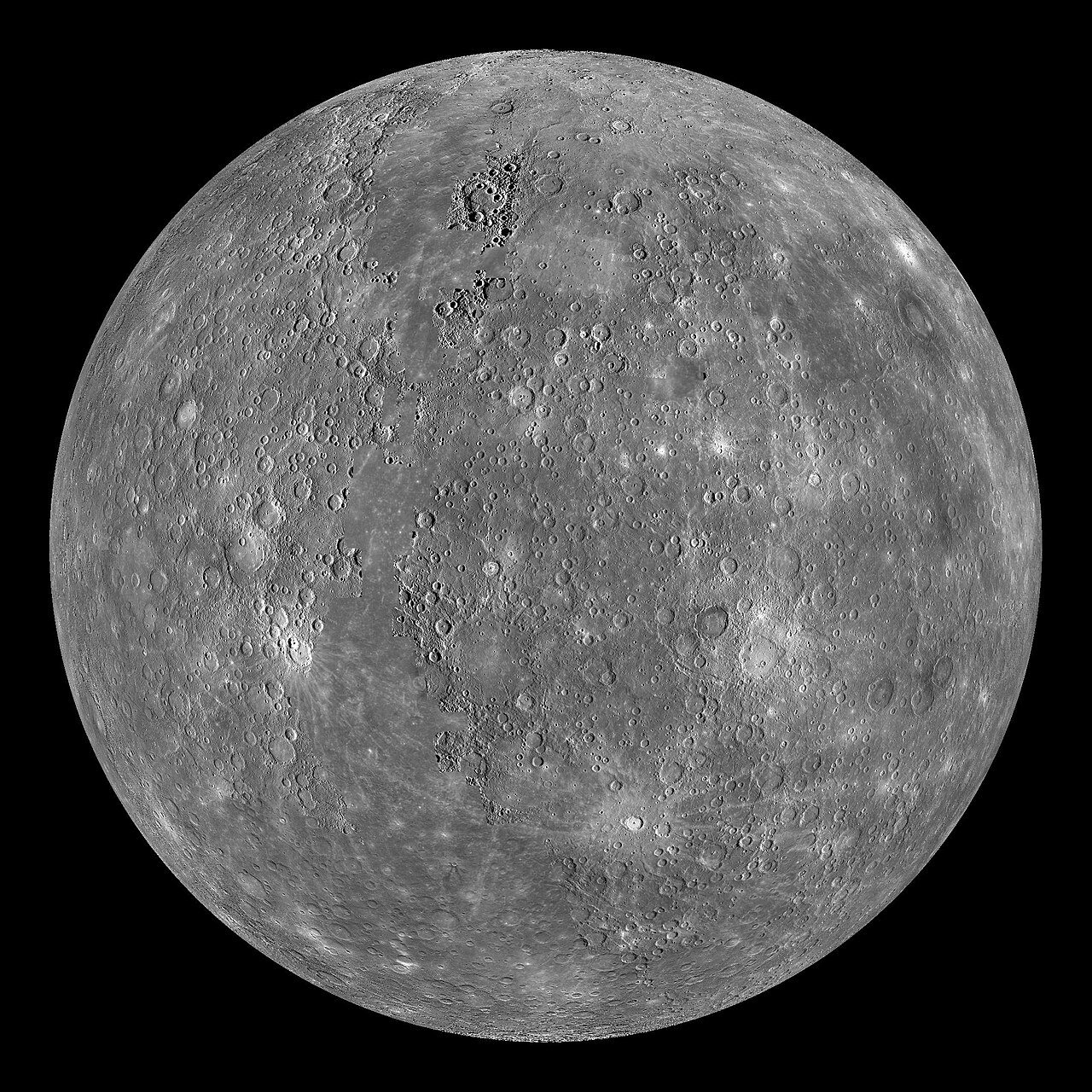
Image: NASA/Johns Hopkins University Applied Physics Laboratory/Carnegie Institution of Washington, public domain, via Wikimedia Commons
On the afternoon of 26 March 1859, in the village of Orgères-en-Beauce, south-west of Paris, a country doctor named Edmond Modeste Lescarbault was between patients and looking at the Sun. He did this often. He had built a small observatory beside his house, and his telescope projected the solar disc where he could watch it safely. That afternoon he saw a small, perfectly round black dot moving across it, much smaller than a sunspot and far too fast to be one. He timed it with a watch and a pendulum, scribbled the figures down, and watched it leave the far edge of the Sun about an hour and a quarter later.
Then he told nobody for nine months.
This weekend the European and Japanese spacecraft BepiColombo is due to fire its way into orbit around Mercury after eight years in transit, only the second mission ever to do so. One of its radio experiments is designed to test Einstein's theory of gravity against the motion of Mercury itself. That is a strange thing to need a spacecraft for, and the reason runs straight back to Dr Lescarbault's black dot.
The man who found Neptune with a pen
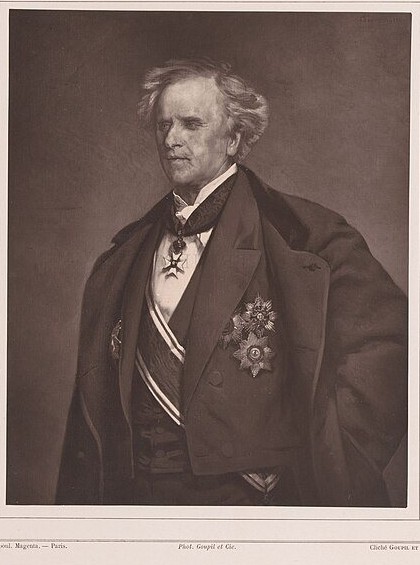
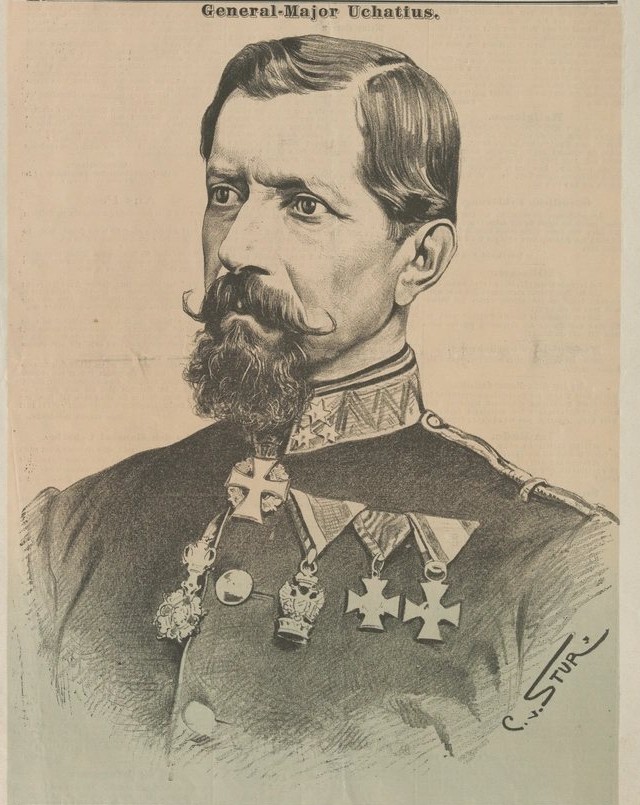
Urbain Le Verrier, photographed for the Galerie contemporaine in the 1870s. Rijksmuseum, CC0, via Wikimedia Commons
Urbain Le Verrier was the most famous astronomer in France, and arguably the rudest. In 1846 he had worked out, from tiny wobbles in the orbit of Uranus, that an unseen planet must be pulling on it, and told astronomers where to point their telescopes. Johann Galle in Berlin found Neptune within a degree of the predicted spot on his first night of looking. It was the great triumph of Newtonian mechanics, and Le Verrier never let anyone forget it.
By 1859 he had turned to Mercury, and Mercury did not behave. Every planet's orbit is an ellipse whose closest point to the Sun slowly swings round over time, mostly because the other planets tug on it. Le Verrier added up every tug he could account for and found Mercury's orbit was still swinging about 38 seconds of arc per century faster than it should. That is a minuscule amount. It was also, by the standards he had set with Neptune, an outrage. In September 1859 he suggested the obvious answer: something else was in there, a planet or a ring of small bodies orbiting closer to the Sun than Mercury, lost in the glare.
Lescarbault read about it and finally wrote to him.
A visit to the surgery
Le Verrier went to Orgères himself, at the end of December 1859, apparently without warning. The accounts of the meeting (most of them written later, and some of them clearly improved in the retelling) agree that he arrived in a foul temper and questioned the doctor like a magistrate. Where were the observations? Lescarbault produced them, written in pencil on a wooden board he used for calculations, which he had been planing clean after each use and had not yet planed. How had he timed it? With an old watch with no second hand, checked against a pendulum made from a silk thread and an ivory ball. How did he know the dot was not a sunspot? Because it was round, it was dark all the way through and it crossed in under an hour and a half.
Le Verrier left convinced. On 2 January 1860 he announced the discovery to the Académie des sciences, the new planet was christened Vulcan, after the god of the forge, and within weeks Lescarbault had been made a knight of the Légion d'honneur. A country doctor had done what the observatories of Europe had not.
There was one awkward letter. Emmanuel Liais, a French astronomer working in Brazil, wrote that he had been watching the Sun on that same afternoon and had seen nothing at all cross it. Liais was in a different hemisphere, and that was enough for most people to set his letter aside. I find it the most persuasive document in the whole affair.
Fifty years of almost
What followed was a very long search for something that kept nearly turning up. Amateurs reported round dots on the Sun. Professional astronomers waited for predicted transits that never came. Le Verrier recalculated the orbit several times, using sightings that did not agree with each other, and died in 1877 still sure Vulcan was there.
The best chance came with the total solar eclipse of 29 July 1878, visible across the American West, when the Sun's glare would be blocked for a few minutes. James Craig Watson, director of the observatory at Ann Arbor, set up at Rawlins in Wyoming Territory and reported two bright objects near the Sun where no known star should be. Lewis Swift, observing from Colorado, also reported something. Their positions did not quite match each other, other astronomers at the same eclipse saw nothing, and the claims were picked apart for years. After 1878 the hunt mostly faded. Mercury's orbit kept swinging, though, and Simon Newcomb's better calculations in 1882 made the excess slightly larger, about 43 seconds of arc per century.
Einstein's November
On 18 November 1915 Albert Einstein presented a paper to the Prussian Academy of Sciences in Berlin applying his new theory of general relativity to Mercury. In his theory, space and time are curved by the Sun's mass, and the effect is strongest closest in. Run the numbers for Mercury and the orbit swings an extra 43 seconds of arc per century, which was the whole of the discrepancy. Newton's gravity was very slightly wrong that close to the Sun, nothing had to be hiding there, and Vulcan was no longer needed by anyone.
What Lescarbault actually saw is still anyone's guess. A small sunspot, an asteroid passing much nearer the Earth, a flaw in a lens and a doctor who very much wanted to see something have all been proposed. Nobody has improved on that list in a century and a half.
Once its science work begins next spring, BepiColombo will spend at least a year measuring Mercury's orbit more precisely than anyone has before, partly to see whether Einstein needs a correction of his own. If it finds one, the astronomers will be in good historical company, and I would advise them to keep their notes on paper rather than a wooden board.
Enjoyed this story?Get a new one every day on social.