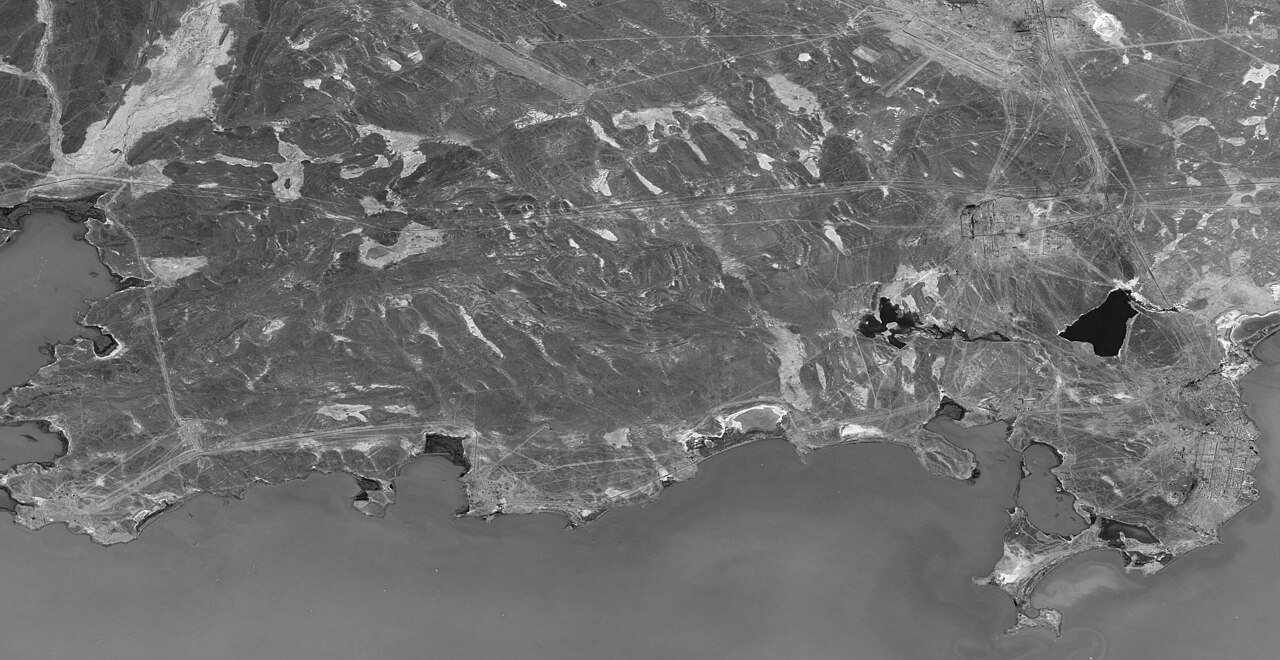
Photo: US reconnaissance satellite image, 21 April 1966, public domain, via Wikimedia Commons
At 03:40 in the morning, universal time, on 22 October 1962, a missile launched from Kapustin Yar on the lower Volga carried a 300-kiloton warhead east across the Kazakh steppe and set it off about 290 kilometers up, short of its aim point over the Sary Shagan range on Lake Balkhash. The burst came west of the mining town of Dzhezkazgan, and below it Soviet engineers had wired up a stretch of ordinary overhead telephone line, 570 kilometers long, to see what would happen.
Every fuse on the line blew and every surge protector fired. In Washington that same day, President Kennedy went on television to tell Americans there were Soviet missiles in Cuba, and nobody outside the Soviet program knew about Kazakhstan for roughly thirty years.
Five shots called K
The 22 October test was one of five in a series the Soviets called Operation K, all of them missiles fired from Kapustin Yar toward Sary Shagan. Two in October 1961 carried small warheads of 1.2 kilotons. Three in late 1962, on 22 October, 28 October and 1 November, carried 300 kilotons each, at heights from about 290 kilometers down to 59. The point was partly to see whether a nuclear burst could blind or disable the radars of an anti-ballistic missile system, the kind of thing Sary Shagan was built to test, and partly to measure everything else a burst in space would do.
The October 22 shot did the most. Later Russian accounts, published in an IEEE journal in 1998, described the telephone line as split into sections of 40 to 80 kilometers by repeater stations, each with fuses and gas-filled protectors. Currents measured on the line ran from 1,500 to 3,400 amperes. The fast first pulse fired the protectors. The slow part, a distortion of the Earth's magnetic field that induced currents in long conductors, burned out the fuses.
Why over Kazakhstan
The geography explains most of it. Kapustin Yar, east of what was then Stalingrad, was the Soviet Union's oldest missile range, and Sary Shagan, on the western shore of Lake Balkhash, was where the Soviets were building and testing their first anti-missile system, known simply as System A. A missile fired from one to the other flew over a thousand kilometers or so of steppe that the planners regarded as empty enough. It was not empty. Karaganda was a coal city of several hundred thousand people, and the region was crossed by the power lines and telephone cables that the engineers were, in part, trying to study.
The 1961 shots had been modest, 1.2 kilotons each, and one of them is listed as a test of the effects on the System A prototype. The 1962 shots were 250 times larger. They also came in the final weeks before both superpowers, frightened by how close the Cuban crisis had come, began talking seriously about a test ban.
A power station and a buried cable
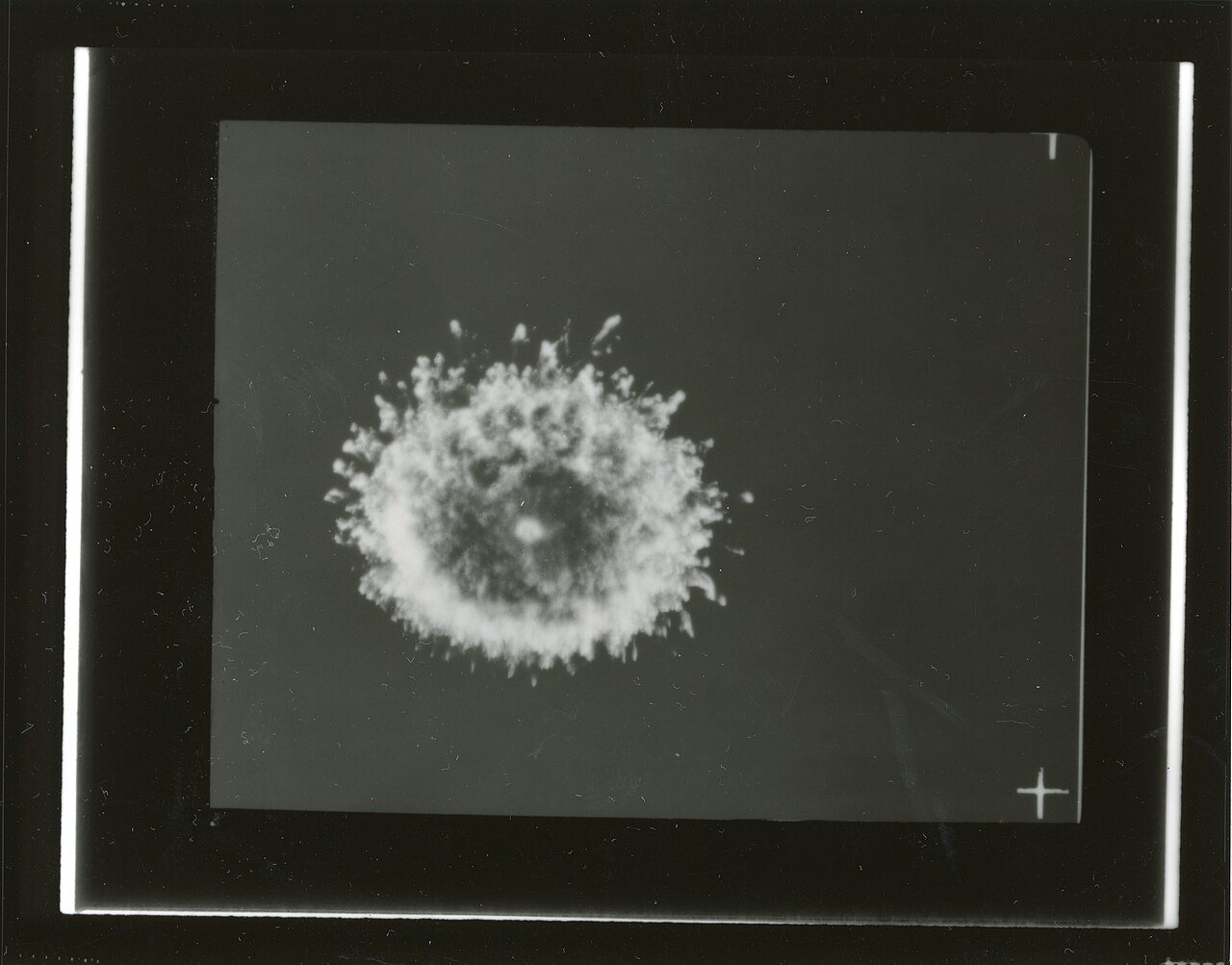
An American nuclear detonation photographed during Operation Dominic in 1962, the same year as the Soviet K tests
The more alarming claims come from a 1995 memo by the American Howard Seguine, written up from a meeting with Russian scientists and citing the Russian researcher Loborev. According to it, the pulse knocked out a power plant at Karaganda and shut down about 1,000 kilometers of shallow buried power cable between Aqmola, now Astana, and Alma-Ata. A 2010 report written for Oak Ridge National Laboratory adds that ceramic insulators on overhead power lines were damaged and some lines fell. I would treat the power plant story with some care, since it rests on a short memo and a fairly sparse literature, but nobody I know of has seriously disputed it.
The damage was worse than anything the Americans saw from Starfish Prime, their own 1.4-megaton shot over Johnston Island that July, which famously disturbed streetlights and telephones in Hawaii. The Soviet bursts were smaller, but they went off over a large inhabited land mass with a strong local magnetic field, and there was plenty of copper strung across it to soak up the current. The Partial Test Ban Treaty of 1963 stopped both countries from doing it again.
What the DIA says now
At the end of October the Defense Intelligence Agency's report "Challenges to Security in Space 2026" said Russia is developing a satellite designed to carry a nuclear weapon, "despite its obligation to comply with the 1967 Outer Space Treaty," which bans nuclear weapons in orbit. The report pointed to Cosmos 2553, launched in February 2022 into an unusual, isolated orbit that Moscow said was for testing the effect of radiation on electronics. The coverage has mostly been about satellites, since a burst in orbit would pump up the radiation belts and could cripple spacecraft that had nothing to do with any war for years afterward.
The 1962 testers could only begin to measure that, and nobody has tried it since. The ground damage in Kazakhstan was written up by Russian engineers in the 1990s, after a few years of cooperation with American colleagues, and then the cooperation stopped. How the people of Karaganda experienced that October morning, whether the lights went out and for how long, has never been told in anything I have been able to find.
Enjoyed this story?Get a new one every day on social.