Photo: Daniel R. Blume, CC BY-SA 2.0, via Wikimedia Commons
A friend came back from the British Museum last week and asked me the question everyone asks: did Harold really get the arrow in the eye? She had stood in front of the scene for a while, she said, and she honestly could not tell which of the two falling men was supposed to be him.
Nobody can, and that is roughly where the scholarship has been for two hundred years. It is a good place to start, though, because almost everything people think they know about the Bayeux Tapestry, beginning with its name, is slightly off.
Wool on linen, not a tapestry
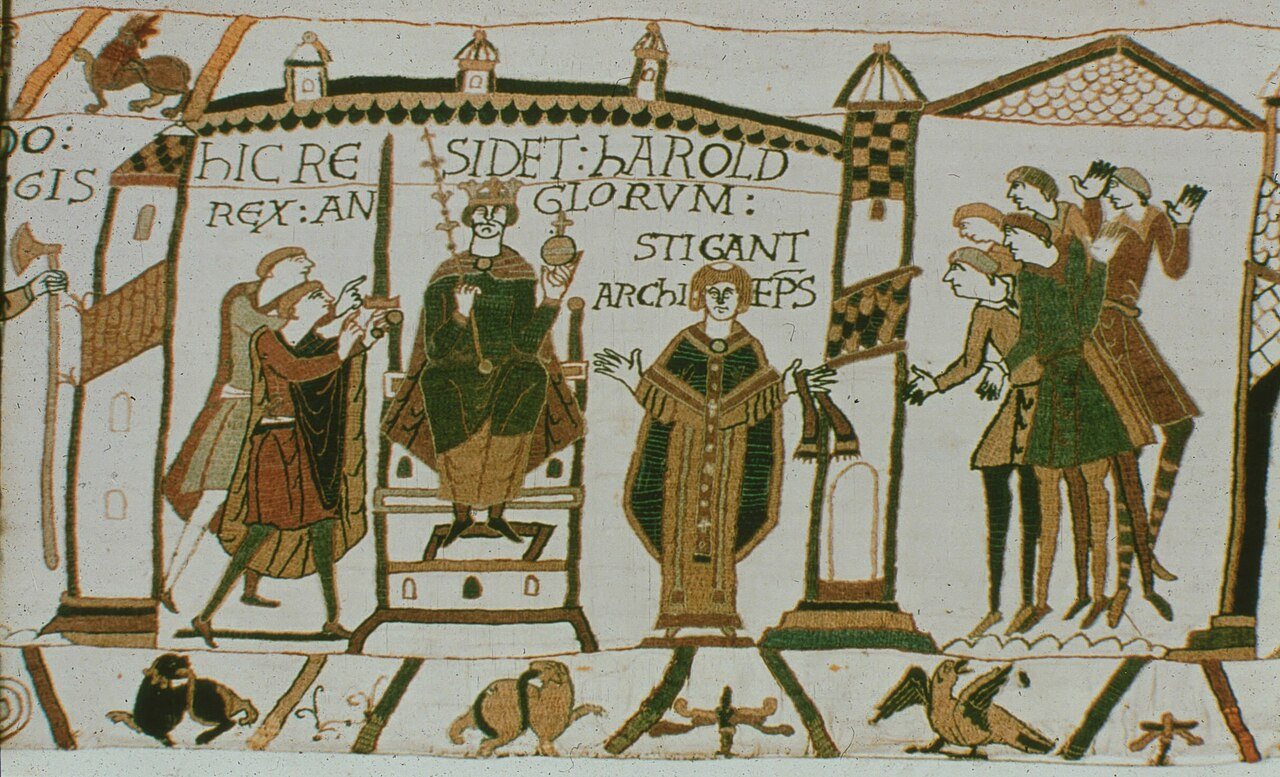
A tapestry is woven: the picture is in the cloth. The Bayeux Tapestry is embroidery, ten colours of wool thread stitched onto plain linen, which is why it looks the way it does, flat blocks of colour outlined in stem stitch like a very long cartoon. The linen is nearly seventy metres long and about half a metre high, in nine pieces joined so neatly that the seams are hard to find. The British Museum counts 58 scenes, 627 people and 737 animals, most of the animals in the borders top and bottom, where there are also fables, farm work, naked figures nobody has explained, and the occasional dead body being stripped of its mail.
The Latin captions run along the top of the main register and tell you who is who. HIC HAROLD REX INTERFECTUS EST, "here King Harold is killed", stretches across two figures: one standing, pulling at an arrow in his face, and one on the ground being cut down by a Norman horseman. The earliest written account that mentions an arrow in the eye is from about forty years after the battle, and the embroidery has been restored so many times, particularly in the 1840s, that some historians think the arrow was lengthened, or even added, by a nineteenth-century needle. Holes from earlier stitching suggest the standing figure once held a spear. I lean towards both men being Harold, in sequence, wounded and then finished off, which was a common way to show a death in medieval picture-stories. But I would not bet the house.
Probably made in Kent
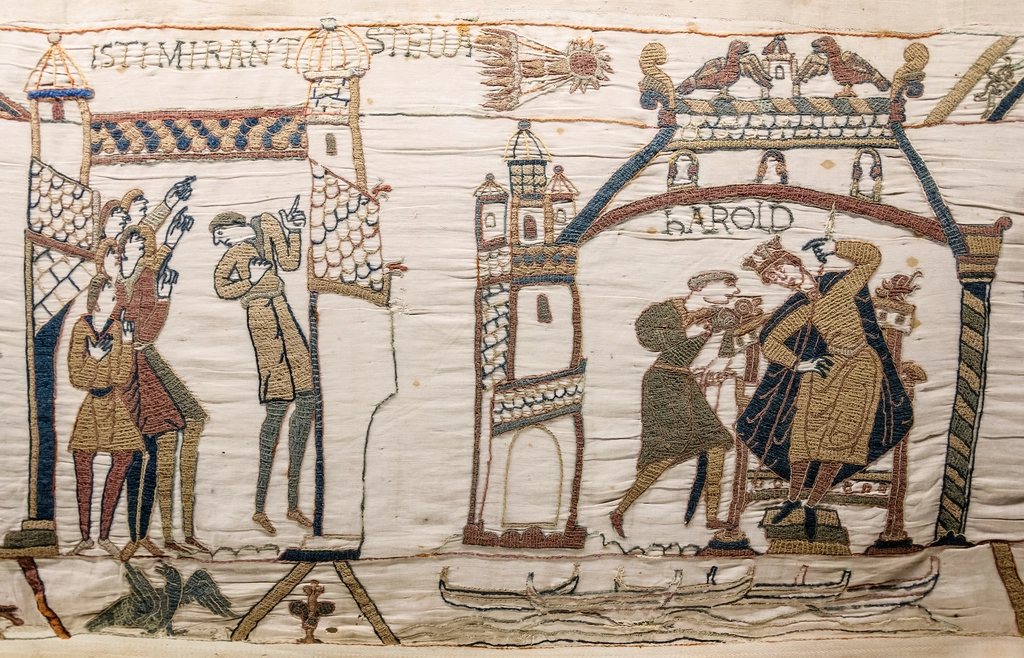
Scene 32 of the Bayeux Tapestry: men point at Halley's Comet while Harold, newly crowned, is told of it. Image via rawpixel, CC0
The other surprise is that the most famous French artefact of the Middle Ages was almost certainly made in England. The style of the lettering and drawing matches manuscripts from St Augustine's Abbey in Canterbury, and the best guess is that it was commissioned in the 1070s by Odo, Bishop of Bayeux, William the Conqueror's half-brother, who appears in it rather more prominently than he deserved and who became Earl of Kent after the conquest. English embroiderers were famous across Europe; Odo had the money and the motive, and his new cathedral at Bayeux was consecrated in 1077, which may be when it was first hung.
Then it disappears from the record for four hundred years. The first document that definitely describes it is a cathedral inventory from 1476, which lists a very long and narrow hanging of images and inscriptions showing the conquest of England, brought out once a year to hang round the nave during the feast of relics. For most of its life it was church furniture, aired annually and rolled up again.
Nearly a wagon cover, then Napoleon's exhibit
The French Revolution came close to ending it. In 1792 local militia in Bayeux requisitioned it to cover a wagon of military supplies, and it was on the cart before a lawyer on the town council, Lambert Léonard-Leforestier, talked them into taking a tarpaulin instead and locked the hanging in his office. Two years later another committee proposed cutting it up to decorate a float for a civic festival. It was saved again, and the town's arts commission took charge of it, which is more or less how it ended up belonging to Bayeux rather than to the cathedral.
Napoleon had it brought to Paris in 1803 and displayed at the Louvre, then the Musée Napoléon, while he was assembling an army at Boulogne to invade England. The scene of Halley's Comet, which appears in the embroidery over Harold's head as an omen in 1066, was much remarked on, since a new comet had conveniently appeared in the sky that winter. The invasion never sailed, and the hanging went back to Bayeux, where it spent the nineteenth century being drawn, photographed, patched, and once, in 1816, quietly clipped: the wife of an English artist copying it is said to have taken a small piece home, and a fragment turned up in a London museum and was returned in 1872.
The Victorians make a copy and add underwear
In 1885 a group of thirty-five women from the Leek Embroidery Society in Staffordshire, led by Elizabeth Wardle, made a full-size replica from photographs, in a year. It is in Reading Museum, and it is worth seeing for one reason beyond the obvious: the Victorian embroiderers put drawers on the naked men in the borders. Someone counted the genitals in the original a few years ago, an Oxford professor, properly published, and arrived at ninety-three, most of them on horses. The Leek ladies had not been prepared to stitch any.
Himmler wants it
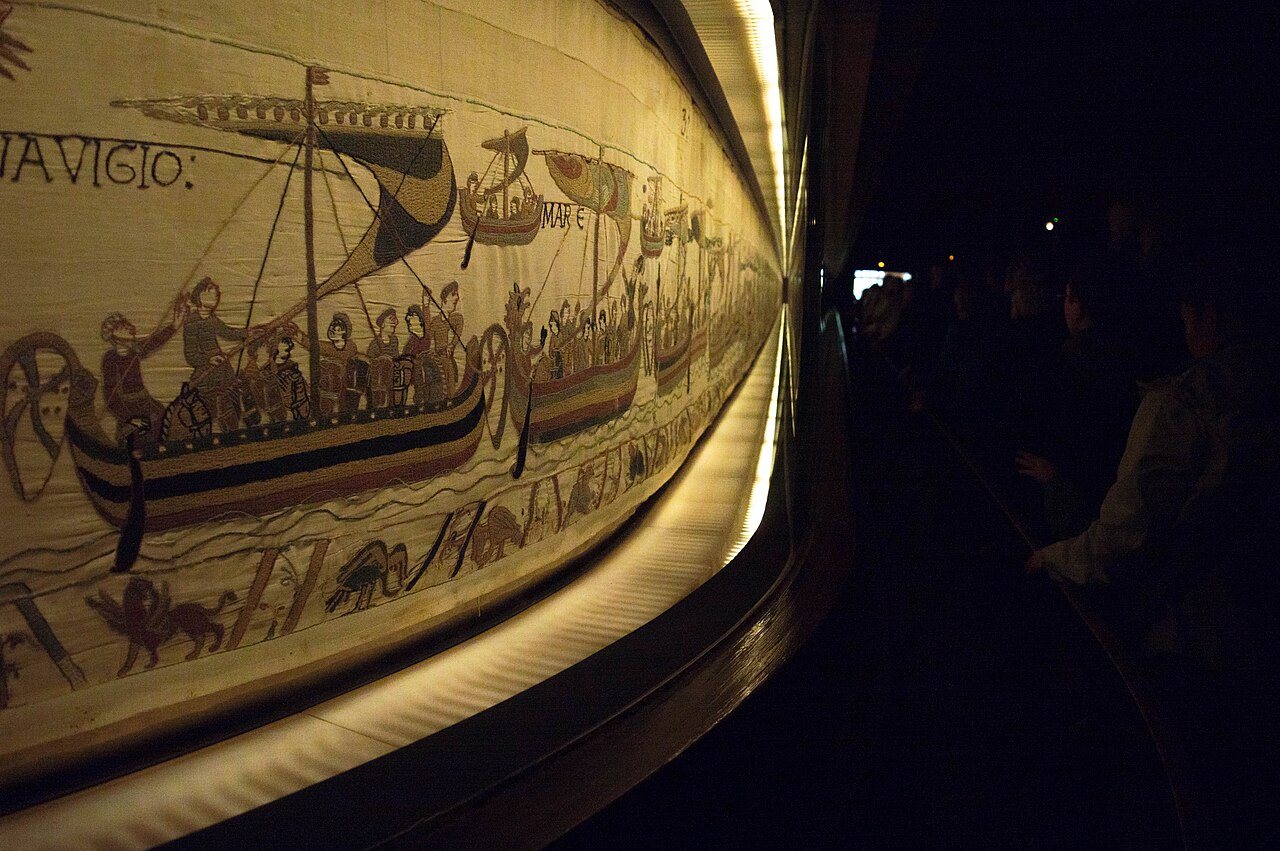
The Bayeux Tapestry in its former display case in Bayeux, 2015. Photo: Supercarwaar, CC BY-SA 4.0, via Wikimedia Commons
The Germans studied it closely during the occupation. A team from the SS research institute spent months in 1941 photographing and drawing it, interested in it as a monument to the Normans, whom they chose to see as Vikings and therefore Germanic. In 1944 it was moved for safety to the Louvre. According to the account usually given, Himmler sent a message in August 1944, as Paris was about to fall, ordering it brought to Berlin, and two SS officers arrived at the Louvre to collect it on 21 August, by which time the Resistance held the building and the officers thought better of it. It went on show at the Louvre that winter and was back in Bayeux by 1945.
Since 1983 it has hung in a former seminary in Bayeux in a long, dim, horseshoe-shaped case, with the audio guide hurrying you past at about a scene every thirty seconds. Nearly 600,000 people a year came to see it there. That building closed at the end of August last year for a 38 million euro rebuild and reopens in October 2027, in time for the thousandth anniversary of William's birth, with the embroidery laid on a sloped support in a sealed room.
Which is how, after an agreement between President Macron and Prime Minister Starmer last year, it comes to be in Room 30 of the British Museum, where it opened on 10 September and stays until 11 July 2027, laid out flat in one continuous line for the first time anyone can remember, with Edward the Confessor's charter and a hoard of Harold's and William's silver pennies beside it. Tickets are 25 to 33 pounds and the museum suggests forty minutes. Take longer. It is the only chance in most of our lifetimes to see the whole thing at once, from the Confessor on his throne to the English running away at the ragged, unfinished end, where the last panel was lost a long time ago and nobody knows what it showed.
Enjoyed this story?Get a new one every day on social.