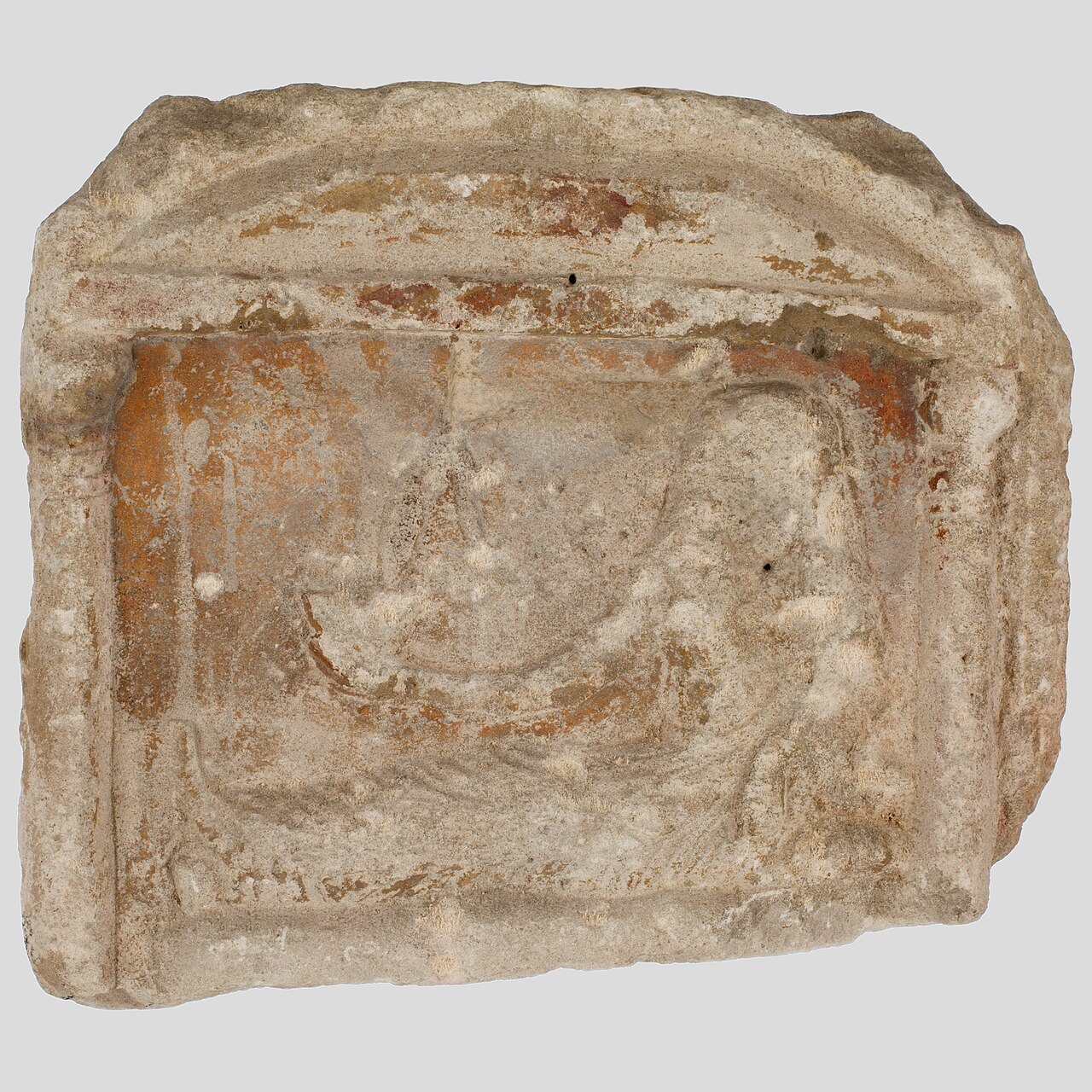
Funerary stela of a woman from Kom Abou Billou, public domain, via Wikimedia Commons
Egypt's antiquities ministry announced last week that its excavators had found a large necropolis at Kom Abu Billo, on the western edge of the Nile Delta about 70 kilometres northwest of Cairo. The list is long: hundreds of coffins in stone, pottery and wood, faience shabti figures, scarabs and amulets, terracottas of Isis-Aphrodite, two falcon burials, and gold foil, including small gold pieces shaped like tongues. The burials run from the end of the Late Period, before Alexander arrived in 332 BC, through the Ptolemies and into the early Roman centuries. Hisham el-Leithy, secretary-general of the Supreme Council of Antiquities, said the dead were probably middle-class people.
The gold tongues will get the headlines, as they always do. Similar pieces have turned up in other Graeco-Roman cemeteries in Egypt, and the usual explanation is that they were meant to let the dead speak before Osiris. That is a modern reading rather than anything the burials say for themselves, and I would hold it loosely.
For anyone who has spent time in a certain gallery in Ann Arbor, Michigan, the place name rings a bell. Kom Abu Billo was the cemetery of the Graeco-Roman town of Terenouthis, and it has been giving up its dead to archaeologists for nearly 150 years.
A town on the natron road
Terenouthis sat where the desert road from the Wadi el-Natrun met the Delta. The wadi's salt lakes produced natron, the drying salt used in mummification, and a town at the entrance to the route had something to sell. Its Greek name is usually traced to Renenutet, the cobra goddess of harvests. The modern Arabic name is more recent and more charming: according to the Kelsey Museum, it is a corruption of a Coptic phrase meaning "the hill of Father Apollos," presumably a local holy man nobody now remembers.
European visitors in the 1870s reported fragments of a Ptolemaic temple to Hathor, under her title Lady of Mafkat (turquoise), and the Swiss Egyptologist Edouard Naville described the site in a report to the Egypt Exploration Fund in 1888. Pieces from the cemetery found their way into the Cairo museum, which is what eventually brought the Americans.
Thirty-five days in 1935
In March 1935 Enoch Peterson, who was running the University of Michigan's long dig at Karanis in the Fayum (Michigan had been working there since 1924), moved a team to Kom Abu Billo. Surface exploration had started the previous October, guided by Naville's old report and by the pieces in Cairo. They worked for about 35 days. In that time, according to the Kelsey Museum's own account, they opened about 40 tombs and recovered more than 5,000 objects, including some 480 coins and somewhere between 200 and 250 carved and painted gravestones (the museum's own pages disagree, which I find rather reassuring). Under the rules of the time a share of the finds could leave Egypt, and Michigan's went to Ann Arbor, where they are still the core of the Kelsey's Roman Egypt collection.
(Somebody also filmed the excavation. The Kelsey has a ten-minute black-and-white film of it, which strikes me as remarkably modern behaviour for a 1930s dig.)
The people on the stones
The gravestones are why Terenouthis is famous. Most date from the Roman period, many from the second century AD, and they are cheerfully unlike pharaonic art. The dead are shown in one of two ways. Some stand facing us with both arms raised, in the gesture of prayer that art historians call orans, inside a little doorway framed like a temple. Others recline on a Greek dining couch, propped on an elbow, often holding a cup, as if at a dinner party that has gone on rather long. Anubis, lord of the necropolis, often turns up as well, guarding the threshold. The inscriptions are in Greek, short and blunt: a name, an age, and very often a phrase meaning "died before their time."
The Kelsey's figures put the average age at death at Kom Abu Billo at just under 33. It is a sobering number to read off a row of people who look as if they are enjoying a meal.
What the canal took, and what is left
Egyptian archaeologists returned between 1969 and 1971, when much of the cemetery faced destruction, and mapped more than 1,000 further tombs before they were lost. An irrigation canal, the El Nasseri, now runs straight through the site. Much of what the 1935 team saw is gone, and the ministry's announcement makes clear that a good deal of the necropolis was not.
Which leaves the question I would most like answered. The new burials reach further back than most of the Michigan gravestones, into the Ptolemaic centuries and before, and they come with coffins rather than carved stelae, and the ministry says more fieldwork is planned. Were these the grandparents of the reclining diners in Ann Arbor, buried by the same families in the same ground, or a different town that happened to use the same hill? Nobody has said yet.
Enjoyed this story?Get a new one every day on social.