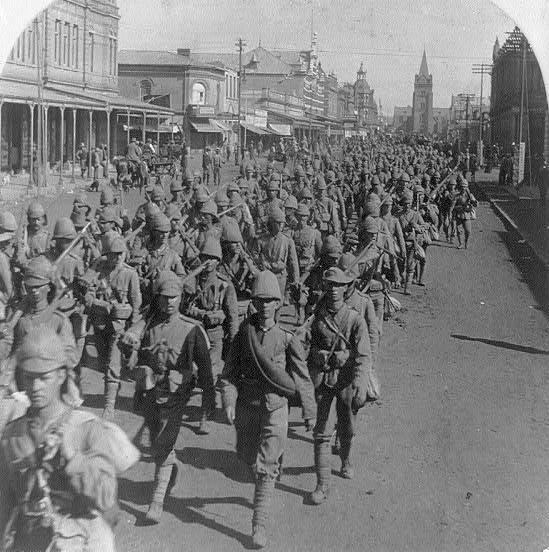
Photo: Her Majesty's Troops in Pretoria, South Africa, 1900, Library of Congress Prints & Photographs Division, no known restrictions
About 100,000 letters. That is how many the Ministry of Defence has sent to former soldiers, sailors and aircrew in the Strategic Reserve, according to reporting first carried by the Telegraph on Thursday, November 26. The letters are signed by the heads of the Royal Navy, the British Army and the Royal Air Force. They ask recipients to update their contact details, give their employment and list any civilian skills picked up since they left. Some are invited to volunteer for training, including NATO's Steadfast Defender exercise in spring 2027, where up to about 1,000 Strategic Reservists could take part for short periods.
The Strategic Reserve is made up mainly of former regulars who keep a legal liability to be recalled after they leave, under rules that cover national danger, great emergency or an attack on the United Kingdom. Defence Secretary Wes Streeting called the exercise a "sensible, necessary precaution" and said Britain was not facing an imminent war. Veterans Minister Calvin Bailey said mobilisation was "not imminent." Several outlets described it as the first outreach of its kind since the Cold War. The machinery behind them, a reserve of former soldiers who can be ordered back, was set up by the Victorians, and it was first used in full in 1899.
A reserve built in 1870
Before 1870 a British soldier typically enlisted for a long stretch of continuous service, which in practice meant most of his working life. Edward Cardwell, Gladstone's war secretary, changed that with the Army Enlistment Act of 1870. Men now signed for a shorter period with the colours and then passed into the reserve for the rest of their engagement, living as civilians, paid a small retainer, and liable to be called back when the country needed them. The official history of the Boer War, edited by Sir Frederick Maurice, put the bargain plainly: in 1899 there were 81,134 reservists "available to be called up when required for war, retained only by a small fee."
The system was tested in small pieces first. There was a partial call-out for Egypt in 1882, when 10,583 reservists joined, and another in 1885. Nobody had yet tried the whole thing.
October 1899
Paul Kruger's ultimatum to Britain expired in the second week of October 1899, and the South African Republic and the Orange Free State went to war. The government had already ordered the reserve out in the first days of the month. On September 1, on the eve of mobilisation, the Army Reserve stood at 81,244 men, according to figures George Wyndham gave the Commons on October 24.
What happened next surprised a good many officers who had expected the reservists to have scattered into civilian life and stayed there. When the War Office later added up the 1899 to 1900 call-out for Parliament, 74,379 men had reported, which was 91.67 per cent of those called. That was a higher share than in 1882 or 1885. Men left jobs on the railways and on farms, collected their kit at regimental depots and were on troopships within weeks. General Sir Redvers Buller sailed from Southampton on October 14 to take command, and the army corps that followed him was filled out with these returning men, who replaced the young and untrained soldiers left behind at the depots.
Who paid for the families
A reservist's family lost its wage the day he reported, and the state's allowances were thin. That gap produced one of the odder fundraising successes of the age. At the end of October 1899 the Daily Mail published a new poem by Rudyard Kipling, "The Absent-Minded Beggar," about the ordinary man gone to the Cape: "Cook's son, duke's son, son of a belted earl." Arthur Sullivan set it to music and it was recited in music halls up and down the country. The money went to soldiers' families. The total usually quoted is about £250,000. (Kipling reportedly disliked the poem. It is not his best, though I doubt the families who got the money minded.)
What the reserve could not do
The reservists were good soldiers, and in the disasters of "Black Week" in December 1899 they were in the firing line with everyone else. The trouble was arithmetic. The plan, drawn up in 1888, provided for two army corps and a cavalry division, a little under 82,000 men. The war eventually swallowed 448,435 troops from across the empire between 1899 and 1902. Maurice's history notes that the supplies of trained men from the reserve "only lasted for the first twelve months." After that the army fell back on militia, yeomanry, volunteers and colonial contingents, and in 1907 the whole structure was rebuilt by Richard Haldane into the Territorial Force.
The 2026 letters, read against 1899
The link here is close. The legal idea in this week's letters, a liability that follows a soldier into civilian life, is the one Cardwell wrote into law, and the practical problem is the same one the War Office met in 1899: whether a list of names on paper turns into people who answer. The Victorian army had a current address for most of its reservists because it paid them a fee each quarter. The modern MoD is writing to ask for addresses and skills precisely because it does not know them all.
The size of the force behind the reserve also matters. The regular army is about 73,000 strong, a figure commentators keep pointing out is the smallest since the Napoleonic Wars. Britain's 1899 regulars numbered around 227,000 with the colours, and the reserve still ran dry within a year. Parliament is now finishing an Armed Forces Bill that would raise the upper age for recall of former non-officers from 55 to 65 and give the defence secretary power to recall reservists when warlike operations are being prepared. The Commons considered Lords amendments on November 24. Whether the bill becomes law in its current form, and how many of the 100,000 write back, nobody can yet say.
Enjoyed this story?Get a new one every day on social.