Photo: Matson Collection, Library of Congress, public domain, via Wikimedia Commons
Eighteen pages. That is the length of the ruling Iraq's Federal Supreme Court issued on Wednesday, November 25, at the request of Prime Minister Ali al-Zaidi. It says the defence of Iraq's international borders is an exclusive federal power, including along the stretches the Kurdistan Regional Government has policed for three decades, that the federal government may deploy troops to secure them, and that Baghdad supervises every border crossing. Oil and gas, it says, are managed by the federal oil ministry "in conjunction with" the producing regions.
The ruling came a day after Zaidi ordered the Border Ports Authority to take over crossings in the Kurdish region and the oil ministry to take charge of Kurdish-secured oilfields in Kirkuk, Nineveh, Salahaddin and Diyala, following an intelligence report on oil smuggling. The court also limited the KRG's jurisdiction to the areas it ran before March 19, 2003. Nechirvan Barzani, the region's president, expressed "surprise and deep concern." The two main Kurdish parties called any erosion of the region's constitutional rights a "red line."
Baghdad says it has no intention of fighting Kurdish forces, and the government has not said how or when any takeover will actually happen. The smuggling report behind the orders, as described by Alhurra, traced oil from Kirkuk and Sulaymaniyah into Iran. A former oil ministry spokesman, Asim Jihad, has put Iraq's cumulative losses to smuggling since 2003 at somewhere between $100 billion and $300 billion, a range so wide it tells you mainly that nobody really knows.
The fight behind the ruling
The court's language is about articles 109, 110 and 112 of the 2005 constitution. Underneath them is the argument Baghdad and the Kurds have been having for most of the last century, over a map line and the oil under it. Kurdish leaders read this week's ruling as one more attempt to settle by decree what was supposed to be settled by agreement. Baghdad reads it as the state finally enforcing a constitution the Kurds signed up to.
A promise signed on March 11, 1970
The argument over where Kurdish authority ends and Baghdad's begins, and who gets the oil under the line, is older than the current Iraqi state. Its modern starting point is the agreement announced on March 11, 1970 between the Baathist government in Baghdad, with Saddam Hussein as its chief negotiator, and Mulla Mustafa Barzani, leader of the Kurdistan Democratic Party, after nearly a decade of war.
On paper it was generous. Kurdish would be an official language alongside Arabic in Kurdish-majority areas. A Kurd would be one of Iraq's vice-presidents. The constitution would say that the Iraqi people were made up of two nationalities, Arab and Kurdish. An autonomous region would be set up within four years, made of the Kurdish governorates and the neighbouring districts where a census showed a Kurdish majority.
The census that never came
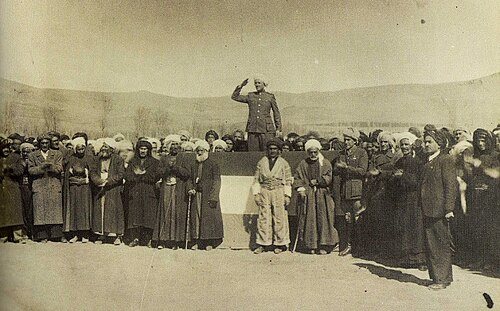
Mustafa Barzani in the Kurdish Republic of Mahabad, 1946. Photo: Foundation for Kurdish Library and Museum, public domain, via Wikimedia Commons
That census clause was the whole deal, because the district everyone was thinking about was Kirkuk, sitting on one of the largest oilfields in the Middle East. The census was postponed, then postponed again. In the meantime the government moved Arab families into Kirkuk and Khanaqin and pushed Kurds out, a policy later called Arabization. By 1973 the agreement had effectively collapsed.
In March 1974 Baghdad published its own Autonomy Law without Barzani's consent, and the region it created left Kirkuk out. Barzani rejected it and went back to war, with weapons and money from the Shah of Iran and covert help from the United States and Israel. The fighting ended abruptly a year later. On March 6, 1975, at an OPEC summit in Algiers, Saddam and the Shah signed an agreement settling their border on the Shatt al-Arab, and Iran cut off the Kurds almost overnight. The revolt fell apart within weeks. Barzani went into exile and died in the United States in 1979.
(Henry Kissinger's role in the abandonment was later aired by the Pike Committee in Congress. The report's line about covert action not being missionary work gets quoted a lot. I would rather people read the whole thing.)
From the 1991 line to the 2003 cut-off
The KRG's modern borders come from what happened next. After the 1991 Gulf War and the failed uprising, Iraqi forces pulled back from much of the north, and the Kurds set up their own administration behind a front line that became known as the Green Line. That line, not the 1970 promise, is what the court's March 19, 2003 cut-off effectively freezes. Kirkuk was on Baghdad's side of it.
Iraq's 2005 constitution tried again. Its Article 140 promised normalisation, a census and a referendum in Kirkuk and the other disputed territories by the end of 2007. None of the three happened. Kurdish forces took control of Kirkuk in 2014 when the Iraqi army fled from the Islamic State, and Baghdad's troops took it back in October 2017 after the Kurdish independence referendum. In 2022 the same Federal Supreme Court struck down the KRG's oil and gas law.
In March 2025, on the 55th anniversary of the 1970 agreement, Nechirvan Barzani wrote that Iraq "continues to pay the price for failing to uphold this agreement." This week Baghdad's military spokesman answered a different question with a line the Baathists of 1974 could have used: "The sovereignty of the state is indivisible."
The court did not say whether Kirkuk is Kurdish. The 1970 census that was meant to answer that has still not been held.
Enjoyed this story?Get a new one every day on social.