Photo: Jim van de Burgt, CC0, via Wikimedia Commons
Two Italian technicians working for the defence company Rheinmetall Italia were killed in Kuwait on Thursday, November 26, when drones struck what Foreign Minister Antonio Tajani described as an air-defence surveillance station. "Following a powerful explosion, both of our compatriots, according to information coming from Kuwait, have died," Tajani said. Kuwait's defence ministry said its army had detected drones in its airspace in an Iranian attack on a "vital facility," and that a Kuwaiti and a Pakistani national were also wounded. Tajani said the drone was Iranian-made. An Iranian military spokesman denied any responsibility and called the attack a false flag, while Foreign Minister Abbas Araghchi offered to cooperate in establishing where it came from.
The deaths come nine months into the war that began on February 28 with Iranian strikes on Kuwait, among other targets, and continued despite an April ceasefire. Italians in Kuwait have been hit before this year: in March an Iranian drone and missile strike on Ali Al Salem air base destroyed an Italian MQ-9 Reaper and damaged two Italian Eurofighters, without casualties. This time nobody was so lucky. For an older generation in Italy, though, the words "Italians" and "Kuwait" in one headline bring back a single grainy television image from January 1991.
Eight Tornados at Al Dhafra
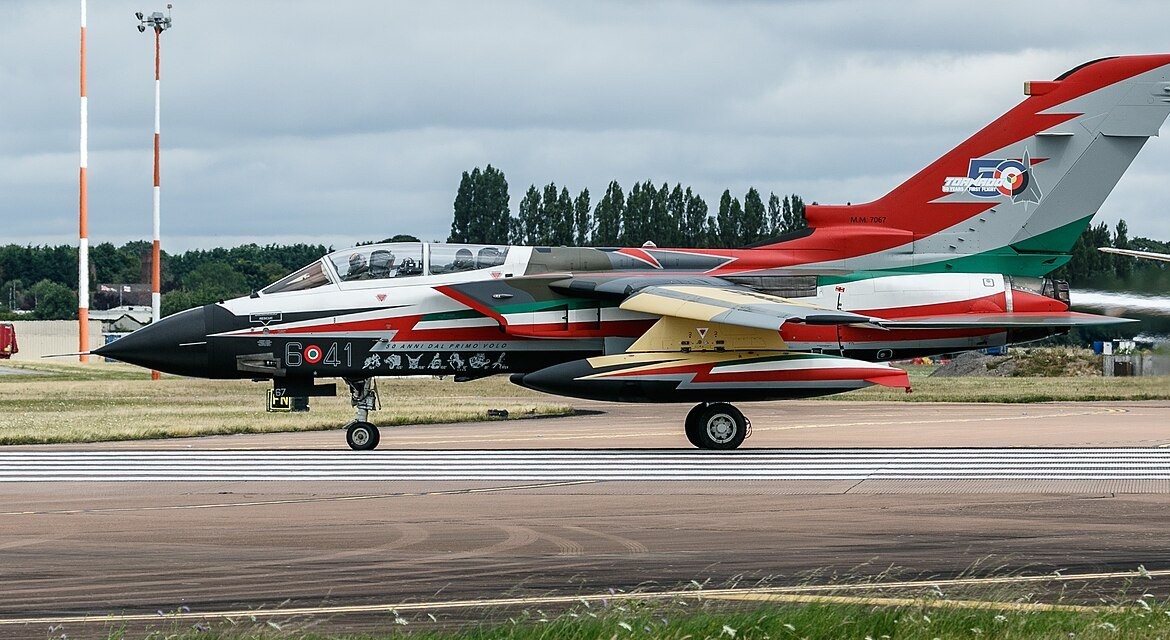
When Iraq invaded Kuwait in August 1990, Italy joined the coalition that formed to reverse it. On September 25 the Italian Air Force sent eight Tornado IDS strike aircraft, with two spares, to Al Dhafra air base near Abu Dhabi, under the name Operazione Locusta. By the time the air war began, more than 300 Italian personnel were there. It mattered at home for a reason beyond the alliance: if the jets flew, it would be the first time Italian Air Force aircraft had gone into combat since the end of the Second World War.
They flew on the first night. Eight Tornados were meant to take off on the night of January 17 to 18, 1991 to bomb an arms depot in southern Iraq, northwest of Kuwait City. One aborted straight away because its landing gear would not retract.
The tanker in the turbulence
The rest headed for a KC-135 tanker circling over the Gulf off Kuwait. The air was rough, and according to the detailed account later published by The Aviationist, out of roughly 30 allied aircraft trying to refuel in that slot, only one Italian jet managed to take on fuel: the Tornado flown by Major Gianmarco Bellini, 32, with Captain Maurizio Cocciolone, 30, as navigator. The others turned back. Bellini and Cocciolone went on alone.
They released their bombs at about 04:30. Roughly 40 seconds later Iraqi anti-aircraft fire hit the aircraft (Bellini later said it was a ZSU-23-4 battery and that much of the right aileron was torn away). Both men ejected very low, by Bellini's account about 30 feet up, and came down about 20 kilometres northwest of Kuwait City, a few hundred metres from a Republican Guard barracks. They were captured at once and separated.
The face on Iraqi television
On January 20 Iraqi television broadcast a video of Cocciolone, bruised and speaking under obvious duress, one of several captured allied airmen paraded that week. CNN carried the pictures around the world. Bellini did not appear, and for weeks his family and the air force did not know whether he was alive. I have read a good deal about this episode and still find that the most unsettling detail: one man's face became a national symbol while the other simply vanished.
Both were released on March 3, 1991, after 47 days, the only Italian prisoners of the entire war. The Italian Tornados flew 226 sorties in all, and the jet lost on the first night was the only one Italy lost. Bellini went on to command the air base at Ghedi. Cocciolone later served in Kosovo and Afghanistan.
From Locusta to an air-defence station
The line from 1991 to this week is direct. Kuwait is the country Italy first went to war for after 1945, and its return there after the Islamic State campaign of the 2010s, at Ali Al Salem, grew out of the same Gulf partnership. Thursday's dead were civilians on a defence contract rather than airmen, and they were killed on the ground in Kuwait rather than over Iraq. In 1991 the risk fell on the aircrew; this week it fell on the people who maintain the air defences.
The Italian Tornados of 1991 came home to Gioia del Colle on March 15, twelve days after Bellini and Cocciolone walked free.
Enjoyed this story?Get a new one every day on social.