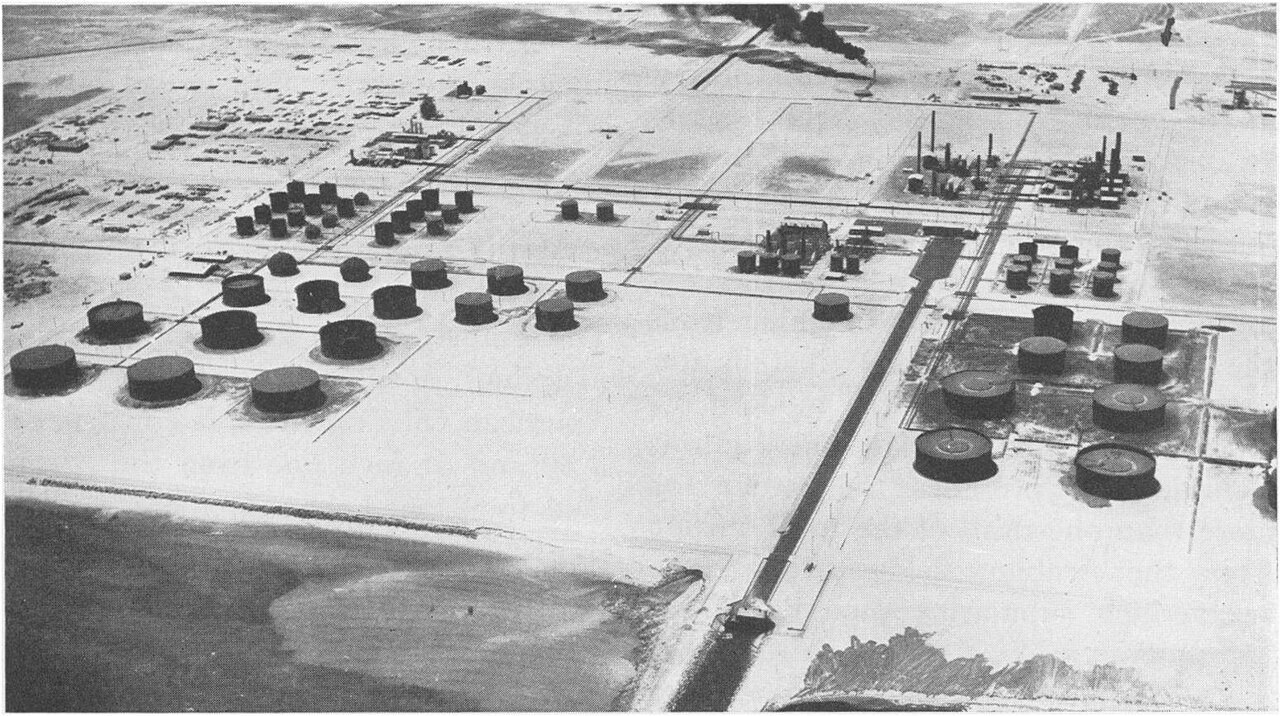
Photo: Arabian American Oil Co. (Aramco), public domain, via Wikimedia Commons
Four drones, according to the Saudi-led coalition, were intercepted and destroyed over Ras Tanura on Wednesday, November 25. The Houthis tell it differently. Their military spokesman, Yahya Saree, said the movement had struck the refinery there, the largest in Saudi Arabia, and caused fires, and that it had also hit Riyadh's financial district in three waves. Saudi Arabia has not confirmed any damage at Ras Tanura.
The Riyadh part is not in doubt. On Tuesday, Saudi Civil Defence said 11 people were wounded when a tower in the capital's financial district was hit, the second strike on the same building in under a week. The coalition's spokesman, Major General Turki al-Maliki, then told civilians to leave Yemen's port of Hodeidah, and the Houthi-run Saba agency reported a strike there soon after. The Houthis answered that every Saudi port on the Red Sea, Jeddah included, was now a target. Brent crude, which had been sliding, bounced back above $88 a barrel in European trading.
The valve at Ras Tanura
Ras Tanura is where Saudi oil first went to sea. On May 1, 1939, King Abdulaziz ibn Saud travelled to the spit of sand on the Gulf coast and turned the valve that filled the tanker D.G. Scofield with the kingdom's first crude cargo. The terminal and the refinery that grew up beside it have been the heart of the export business ever since, which is exactly why anyone at war with Riyadh puts it on a list.
The Houthis already claimed a ballistic missile against the same refinery on October 27. Neither claim has been independently confirmed. But claims like these move markets because of what happened once, seven years ago, less than 100 kilometres to the south.
Shortly before four in the morning
On Saturday, September 14, 2019, drones and cruise missiles hit the Abqaiq oil processing plant and the Khurais oilfield. Abqaiq is not a famous name outside the industry. It is the plant where most Saudi crude is cleaned of gas and sulphur before it can be shipped, and Aramco calls it the largest facility of its kind in the world. Videos posted by people nearby showed the plant in flames.
By the evening Saudi Arabia had shut in 5.7 million barrels a day, about half of its production and roughly 5 per cent of the world's oil supply. It was the largest single disruption of oil output in history, bigger than the Iraqi invasion of Kuwait or the Iranian revolution by that particular measure. When markets opened on Monday, Brent jumped by nearly a fifth in the first minutes and closed up about 14.6 per cent, the biggest one-day rise in decades.
Who fired, and from where
The Houthis claimed the attack within hours and said they had used ten drones. Washington and Riyadh did not believe them. Four days later, at a press conference in Riyadh, the same Turki al-Maliki who gave Hodeidah its warning this week laid out the wreckage of what he said were 18 drones and seven cruise missiles, and said they had come from the north, not from Yemen. The United States blamed Iran directly. Iran denied it, and a UN panel of experts on Yemen later said it doubted the weapons could have been launched from Houthi territory.
I have never seen that question settled in public, and I do not expect to. What mattered to Riyadh was the speed of the repair. Energy minister Prince Abdulaziz bin Salman promised full capacity by the end of September, and Aramco went ahead with its stock market listing in December as if nothing had happened.
Ras Tanura, Jeddah, and a truce
The Houthis came back. On March 7, 2021, Saudi Arabia said a drone launched from the sea had targeted a tank farm at Ras Tanura, and pieces of a ballistic missile fell near an Aramco housing compound in Dhahran. Brent passed $70 for the first time since before the pandemic.
On March 25, 2022, a Houthi strike set fire to Aramco's fuel depot in north Jeddah during practice for the Saudi Arabian Formula One Grand Prix, a few kilometres away. The smoke was visible from the track. After a long drivers' meeting, the race went ahead. A week later, on April 2, a UN-brokered truce began, and the attacks on Saudi soil largely stopped for years.
What Abqaiq says about this week
Abqaiq bears on Ras Tanura in two ways. It proved that one night's attack can knock out half of Saudi output, and it proved that Aramco can repair the damage much faster than traders assume: the price spike of September 2019 had mostly faded within two weeks.
It also taught me to read the Houthis' claims and the coalition's interception counts as statements each side wants heard, and to wait for pictures. Saree's statement this week mentioned fires; the coalition's mentioned only drones. Back in 2019 the gap between the two stories was filled in by satellite photographs within a day. By Wednesday evening I had not seen any published for Ras Tanura, and Hodeidah's port had been told to empty.
Enjoyed this story?Get a new one every day on social.