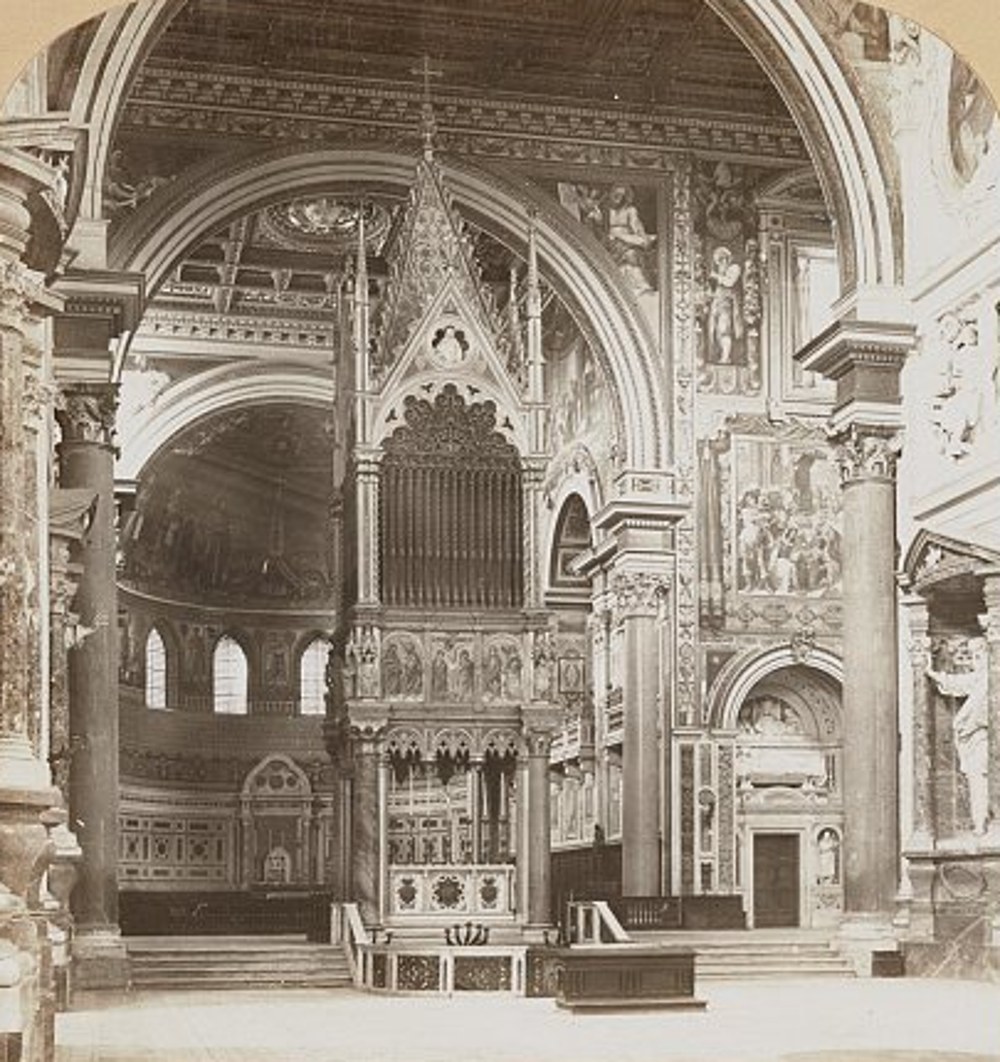
Photo: H. C. White Co., 1902, Library of Congress Prints & Photographs Division, no known restrictions
The defendant had been dead for about nine months. That did not stop the court. In January 897, in the basilica of St John Lateran in Rome, the body of Pope Formosus was lifted out of its tomb, dressed in full papal vestments and propped on a throne to face charges brought by the man who now held his office. A deacon was assigned to stand next to the corpse and answer on its behalf. Church historians call it the Cadaver Synod. I have checked it against every source I can read, because it sounds like a later slander, and it is not. The why is more interesting than the corpse.
How Formosus made the wrong friends
Formosus had been a serious man: a missionary bishop to the Bulgarians in the 860s, excommunicated by Pope John VIII in the 870s, made to swear he would never return to Rome, later forgiven, and in 891 elected pope at about seventy-five. That election already broke a rule. Canon law of the time forbade a bishop from moving from one see to another, and his move from Porto to Rome counted.
His real trouble was Italian politics. The imperial title was fought over in the 890s by local strongmen, the strongest of them the house of Spoleto. Formosus crowned the young Lambert of Spoleto co-emperor in 892, then changed his mind about the family and invited the German king Arnulf of Carinthia to come south and take the crown instead. Arnulf forced his way into Rome and was crowned by Formosus in February 896. Within weeks he had a stroke and went home. Formosus died on 4 April 896, and the Spoletans, led by Lambert and his formidable mother Ageltrude, came back to Rome with scores to settle and nobody left to settle them with.
The pope who followed, Boniface VI, lasted fifteen days. The one after him, Stephen VI, owed his position to the Spoleto party and had a grievance of his own: Formosus had made him bishop of Anagni, and if Formosus's acts could be voided, so could that appointment, which would free Stephen from the very rule about changing sees he was about to prosecute a corpse for breaking.
The trial
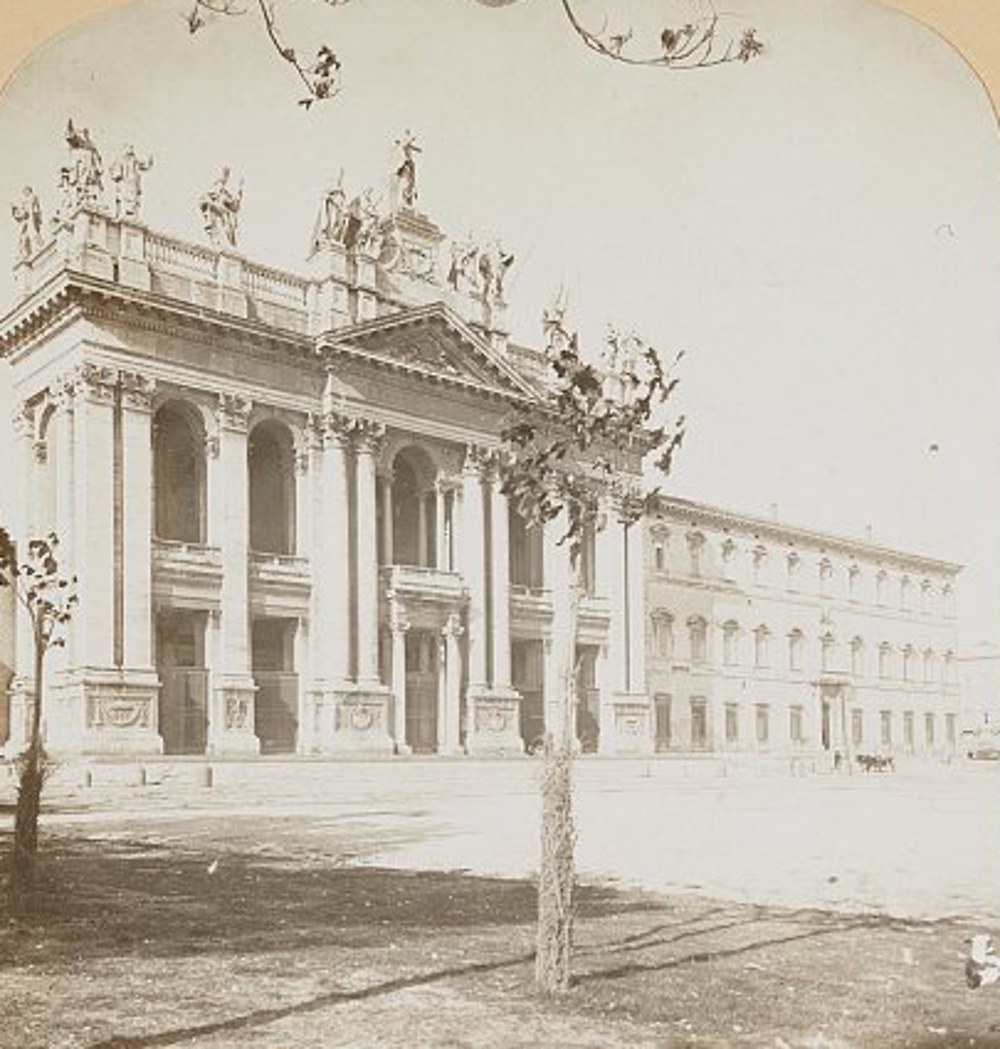
The front of the Lateran basilica and palace, photographed in 1902. The building Formosus was tried in was largely replaced after fires in the fourteenth century. Photo: H. C. White Co., Library of Congress Prints & Photographs Division, no known restrictions
Our fullest account comes from Liutprand of Cremona, a bishop writing about sixty years later who had no love for the Roman clergy and a taste for the grotesque, so I take his details with some care. The core is confirmed by writers closer to the event, including a cleric called Auxilius who had himself been ordained by Formosus and spent years defending that ordination in print.
The charges were perjury (the broken oath), ambition and unlawful translation from the see of Porto. Stephen, by Liutprand's account, shouted the questions at the body himself; the deacon gave the answers he had been told to give. Formosus was declared unfit for the office; his acts were annulled and his ordinations with them, which in one stroke put the standing of a good part of the Roman clergy in question. The three fingers of his right hand, the ones he had used to bless, were cut off. The body was stripped, reburied in a cemetery for foreigners, then dug up a second time and thrown into the Tiber.
A monk, or in some tellings fishermen, pulled the body out of the river downstream and hid it. Around the same time an earthquake brought down part of the old Lateran basilica, and Rome, already uneasy about the whole business, took that as a verdict of its own.
What it cost Stephen
Stephen VI did not survive the year. By the summer of 897 the Spoletan grip on the city had loosened, a mob turned against the pope, and he was stripped of his insignia, thrown into prison and strangled there. His successor Romanus lasted a few months. The next, Theodore II, reigned about twenty days in December 897 and spent them undoing the synod: Formosus's body was carried back to St Peter's in its vestments and reburied with honour, and the ordinations were recognised again. In 898 Pope John IX held councils that annulled the Cadaver Synod, burned its records and forbade, for the future, the trial of any dead person.
That should have been the end, and it was not. Sergius III, who became pope in 904 after years on the anti-Formosan side, reaffirmed Stephen's verdict and is said to have had the body dug up yet again, tried again and beheaded. I am less sure of that episode than of the first; it rests on hostile sources and may be a doubling of the original story. The arguments over Formosus's ordinations ran on for a generation and produced a small library of pamphlets, Auxilius's among them, which is the only reason we can reconstruct the affair at all.
A loose end that lasted eleven centuries
The painting most people have seen of the synod, the corpse slumped on its throne and Stephen pointing, is by Jean-Paul Laurens, from 1870, and hangs in Nantes. The basilica in the photographs above is not the one the trial sat in; that building burned twice in the fourteenth century.
Formosus's name was never formally cleared and never formally condemned again. The Church simply stopped talking about him. What it could not tidy up was the numbering. Because a priest called Stephen was elected pope in 752 and died before he could be consecrated, nobody has ever agreed whether the man who tried the corpse was Stephen VI or Stephen VII, and the official lists give him both, one in brackets. The only pope to prosecute a dead man is one the Church cannot quite count.
Enjoyed this story?Get a new one every day on social.