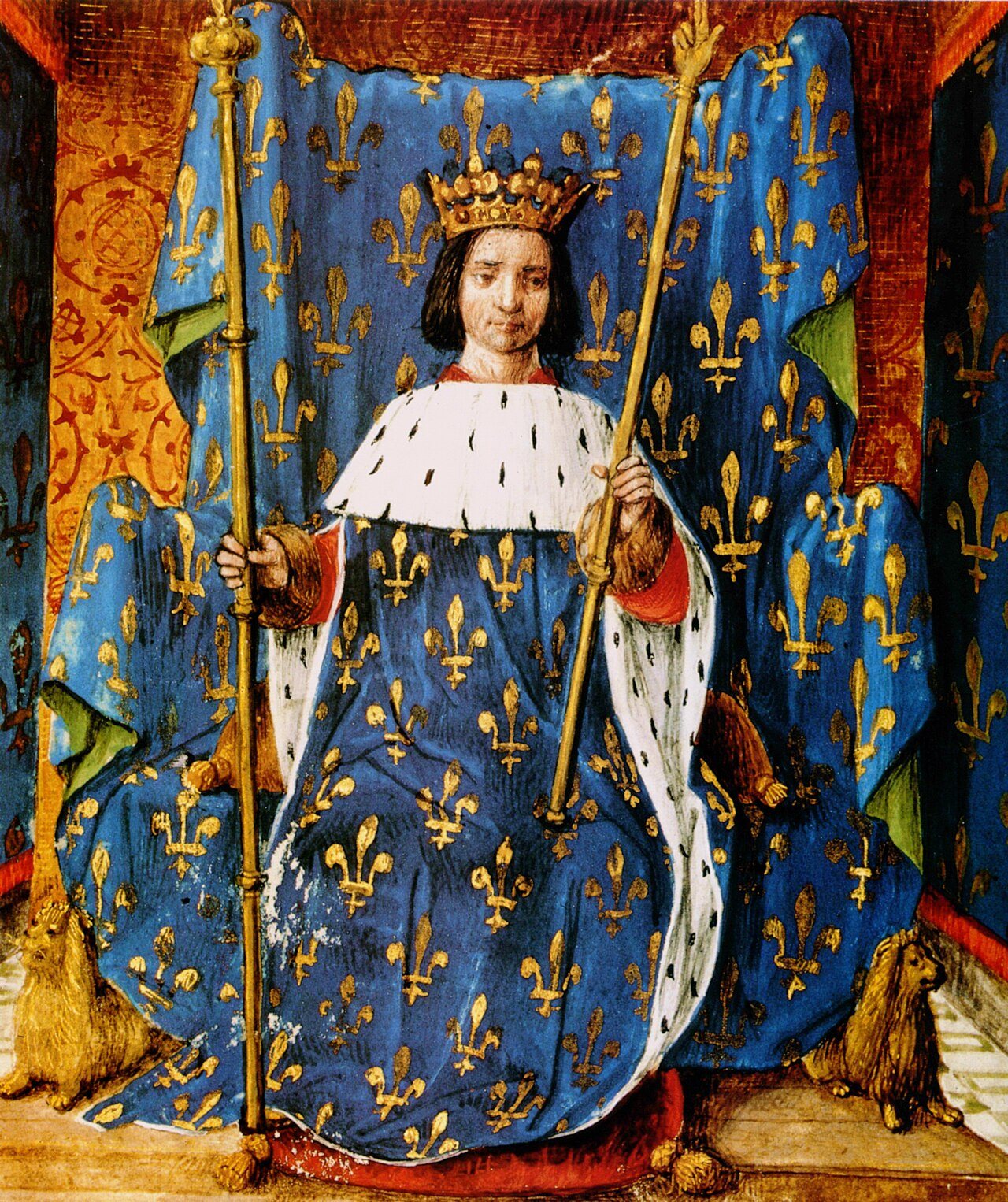
Miniature attributed to Jean Perréal, public domain, via Wikimedia Commons
It was hot on the road out of Le Mans on 5 August 1392, hot enough that the king of France, who was twenty-three and had been ill with a fever for weeks, rode in a black velvet jacket with his visor up. His army was heading into Brittany to punish a duke who had sheltered the man who had tried to murder the constable of France in a Paris street that June. Somewhere in the forest a ragged man, a leper by some accounts, ran out of the trees, grabbed the king's bridle and shouted that he should ride no further, that he was betrayed. The guards drove him off. The column rode on into the afternoon.
Then a page, dozing in the heat, let his lance fall against the steel helmet of the man in front. At the clang Charles VI drew his sword, shouted that he was being handed to his enemies, and rode at his own escort. By the time his chamberlain got hold of him from behind he had killed four men, one of them a knight known as the Bastard of Polignac. He was tied up and carried back to Le Mans in a cart, and for two days he did not open his eyes or speak.
The dancing fire
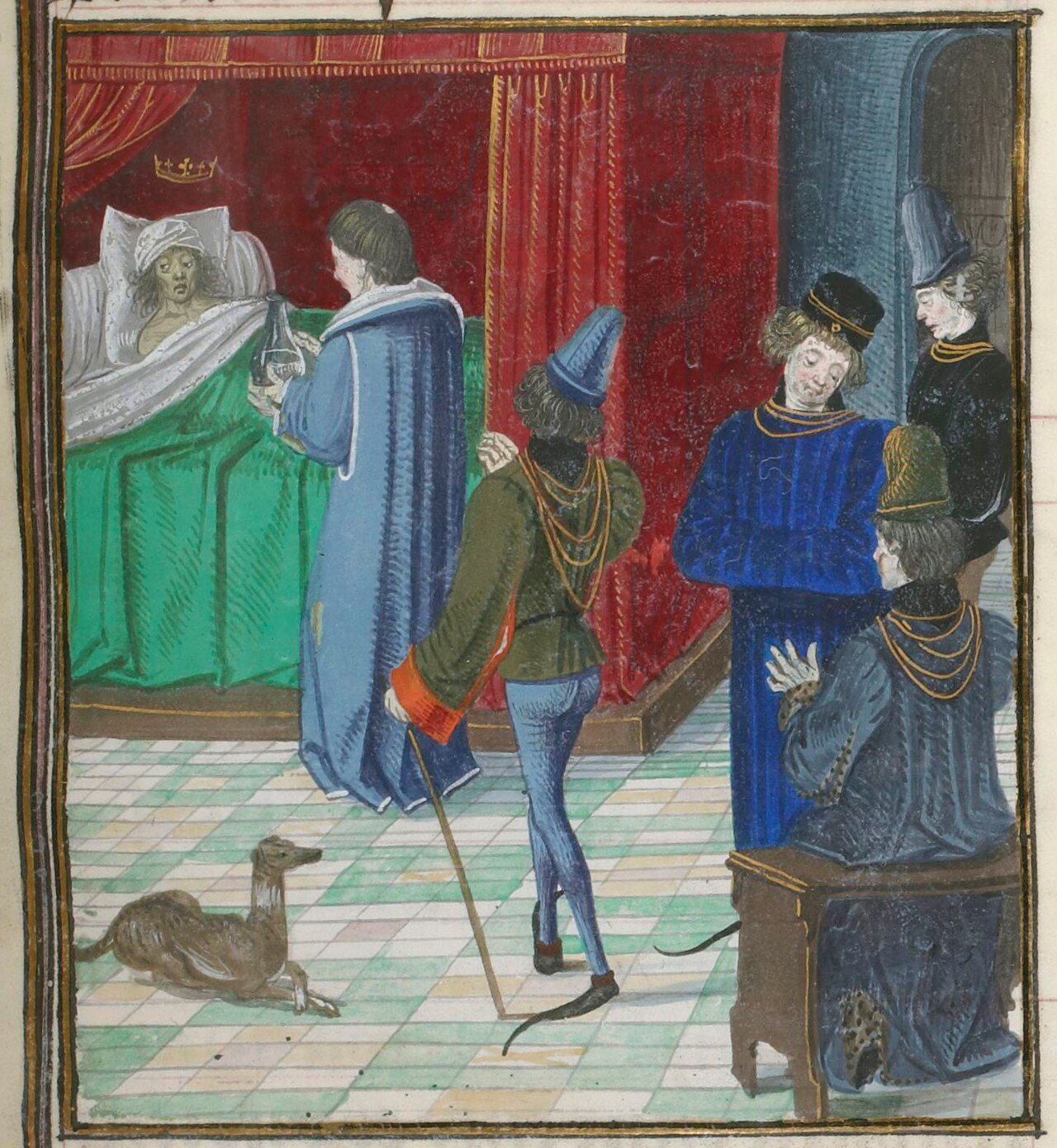
Charles VI in bed, attended by a physician and his courtiers, in a fifteenth-century manuscript. Public domain, via Wikimedia Commons
He recovered, more or less, by the autumn. The following January the queen's household gave a ball at the Hôtel Saint-Pol in Paris for the wedding of one of her ladies-in-waiting, and a courtier named Hugonin de Guisay suggested the entertainment: six young men, the king among them, would come in chained together as wild men of the woods, in costumes of linen soaked in pitch and covered in flax. Torches were banned from the hall. The king's younger brother, Louis of Orléans, arrived late from another party, took a torch from a servant to get a better look at the dancers, and leaned in.
The flax went up at once. Four of the six burned to death, two of them in the hall and two over the following days. One, the lord of Nantouillet, broke his chain and threw himself into a vat of wine. The king survived because he had wandered off to talk to his aunt, the young Duchess of Berry, who had the presence of mind to throw her heavy skirts over him and smother the sparks. Paris very nearly rioted against Orléans the next morning. The chroniclers called it the Bal des Ardents, the ball of the burning men, and dated the king's second collapse from it.
George, who was not married
From 1393 until his death in 1422 the king's illness came and went in bouts, forty or more of them by one count, some lasting months. When he was well he governed, hunted, signed treaties and fathered children, and the people of Paris, who liked him, called him Charles le Bien-Aimé. When he was not, he was somebody else. He insisted his name was George and that his coat of arms was a lion pierced by a sword. He did not recognise his wife, Isabeau of Bavaria, and once ordered the servants to find out who this woman was and send her away. For five months in 1405 he refused to wash, change his clothes or let anyone cut his hair, until his attendants blacked their faces, dressed as devils and frightened him into a bath. A mistress named Odette de Champdivers was quietly installed to keep him company in those periods, and Paris called her "the little queen".
Where the glass comes from
The glass is the detail everyone remembers, and I should say where it comes from. The chronicles of the time describe the king's violence and his terrors, but the specific belief that his body was made of glass, and that he had iron rods sewn into his clothes so that he would not shatter if he was touched, is recorded by Aeneas Silvius Piccolomini, who became Pope Pius II, writing about fifty years later. It fits what the French sources say about the king refusing to be approached and screaming when anyone came near, and nobody has a better explanation for the iron rods. But it is a secondhand report and I would not swear to it in court.
What is beyond dispute is that France had a king who could not reliably rule, with no mechanism for replacing him, for twenty-nine years.
The decision that was made for him
A king who could not rule left a vacancy, and two men moved to fill it: Louis of Orléans, the brother with the torch, and the king's cousin John, Duke of Burgundy, called the Fearless. For fourteen years they fought over the regency, the treasury and the queen, with the king signing whatever was put in front of him in his good weeks and nothing in his bad ones. On 23 November 1407 John's men ambushed Louis in the Rue Vieille du Temple as he rode home from the queen's lodgings and hacked him to death. John admitted it, hired a theologian to argue that killing a tyrant was lawful, and was pardoned by a king who probably did not understand what he was pardoning.
That murder started the Armagnac-Burgundian civil war, and the civil war is why Henry V of England could land in Normandy in August 1415 with a modest army and march across the country without meeting the one he feared. The French force that finally caught him at Agincourt on 25 October, 611 years ago tomorrow, was commanded by nobody in particular, because the king was in Rouen and the princes could not agree who should lead. The result is the one every English schoolchild knows.
Burgundy made peace with the Armagnacs in 1419 and was murdered at the meeting, on the bridge at Montereau, in front of the dauphin. His son went over to the English. And on 21 May 1420, at Troyes, Charles VI put his seal to a treaty that disinherited his own son, married his daughter Catherine to Henry V, and named Henry heir to the throne of France. The chroniclers are not sure he knew what he was sealing. His wife and the Burgundians were sure he had.
Two funerals in a season
Henry V died of dysentery at Vincennes on 31 August 1422, aged thirty-five, having never worn the French crown. Charles VI followed him on 21 October, seven weeks later, and the heir to both thrones under the treaty was a ten-month-old baby in Windsor. The disinherited dauphin held out south of the Loire, was crowned at Reims in 1429 with a peasant girl from Lorraine standing beside him, and spent the next twenty years undoing the Treaty of Troyes. He is the Charles VII in the history books. His father is the one in the footnotes, next to the word "mad".
The glass delusion outlived him by a long way. Cervantes wrote a story about a law student who believed he was made of glass; Descartes used people who thought they had glass heads as his example of a madman; a Bavarian princess in the 1840s was convinced she had swallowed a glass piano. Doctors were still reporting cases in the twentieth century, and then the delusion more or less died out. Nobody has explained why.
Enjoyed this story?Get a new one every day on social.