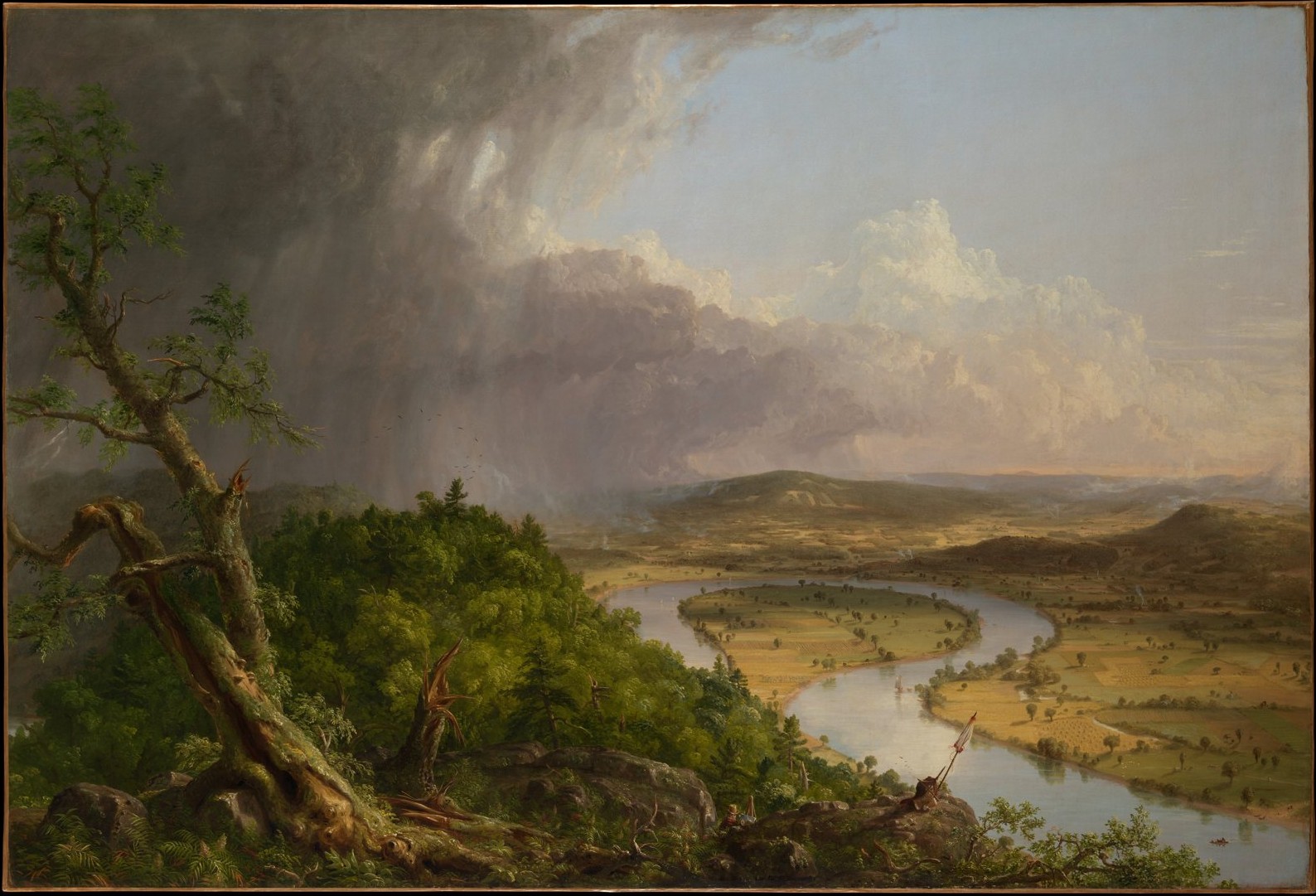
Thomas Cole, View from Mount Holyoke, Northampton, Massachusetts, after a Thunderstorm (The Oxbow), 1836, The Metropolitan Museum of Art, CC0
"I am against an adjournment. The day of judgment is either approaching, or it is not. If it is not, there is no cause for an adjournment; if it is, I choose to be found doing my duty. I wish therefore that candles may be brought."
Those are the words of Abraham Davenport, a member of the governor's council of Connecticut, as they were written down a generation later by Timothy Dwight, the president of Yale, who had them from men who were in the room. The room was the council chamber at Hartford. The date was Friday 19 May 1780, and the reason somebody had moved to adjourn was that, a little before noon, it had become too dark to see across the table.
What people saw
The darkness came in from the south-west during the morning. Accounts from across Massachusetts, New Hampshire, southern Maine, Rhode Island and Connecticut describe the same sequence: a dull, yellowish, smoky light at breakfast, then clouds that thickened until by ten or eleven o'clock it was dark enough to need a candle to read, and by noon as dark as night. People ate their midday meal by candlelight. Cocks crowed as if at dusk and chickens went to roost. Night birds came out, frogs started up, and the cattle walked in from the fields on their own.
It was darkest in north-eastern Massachusetts, southern New Hampshire and south-west Maine, and the band of darkness ran as far south as New Jersey, where George Washington, in camp at Morristown with an army that had just come through its worst winter, noted in his diary heavy and unusual clouds with a reddish light mixed into them. In Boston the darkness lasted through the afternoon. The night that followed was, by every account, the blackest anyone could remember: a sheet of white paper held up to the eyes could not be seen, and the moon, which was nearly full, did not show at all until well after midnight.
Then on Saturday morning the sun came up as normal, and people were left to decide what it had meant.
What people thought
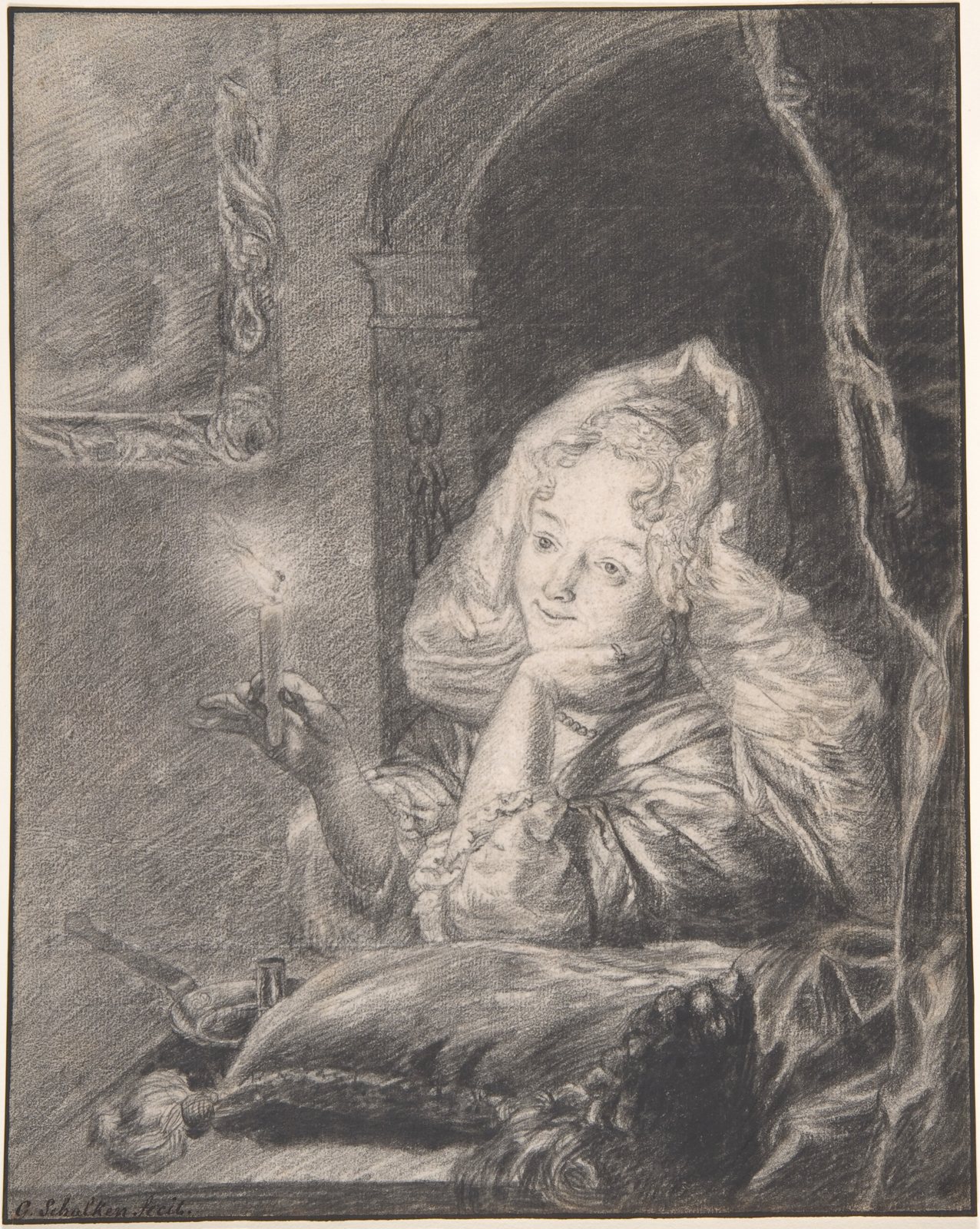
Chalk drawing of a young woman seated at a table, holding a lit candle, late 17th century. Godfried Schalcken, The Metropolitan Museum of Art, CC0
Most of them thought it was the end of the world, or a warning of it, and I do not think they were foolish for it. New England in 1780 was a Protestant society at war, with no newspapers that could tell it what was happening a hundred miles away, and the darkness looked exactly like the passage in Matthew where the sun is darkened and the moon gives no light. Ministers were called in from their fields to preach, and the taverns emptied. Davenport's reply to his colleagues was unusual precisely because he kept his head; John Greenleaf Whittier made a poem of it eighty-six years later, and Connecticut schoolchildren used to learn it.
A few people took notes instead. Samuel Williams, who taught natural philosophy at Harvard, collected reports from across the region and published them in 1785 in the first volume of the memoirs of the new American Academy of Arts and Sciences. He recorded that the rain that fell during the day left a sooty, black film on water in tubs and on the surface of the rivers, that it smelled strongly of burnt leaves, and that for several days beforehand the sun had risen and set red through a haze. There had also been reports that spring of great fires burning in the woods to the north and west. Williams was careful not to say what had caused the darkness, but he laid the evidence out in a way that a modern reader can hardly misread.
The sect that was born that day
The religious reading had the longer afterlife. The Shakers of upstate New York date the public opening of their faith to that very day, when Ann Lee's followers began preaching to the crowds who came looking for an explanation. Sixty years later the Millerite preachers who became the Seventh-day Adventists listed the Dark Day among the signs that the end was near, and you will still find it in their literature.
What the trees said
The answer came, more than two centuries later, from trees. Tree-ring researchers at the University of Missouri, led by Erin McMurry and Richard Guyette, were working through samples of old pine and oak from the Algonquin Highlands of southern Ontario, several hundred miles north-west of Boston, cataloguing the scars that forest fires leave in the growth rings of trees that survive them. Fire scars are dated to the year, and in some cases to the season, by the position of the damaged ring. The Ontario trees carried a scar from the early growing season of 1780, and so did trees from a good many other sites in the region. The researchers published the result in the International Journal of Wildland Fire in 2007: a very large fire, or set of fires, had burned across the Canadian forest that May, and the wind had carried its smoke south-east, into a layer of low cloud over New England, on the day in question.
Everything in the 1780 accounts fits. The red sun for days beforehand, the smell, the soot in the rain barrels and the darkness that was deepest where the smoke met rain and low cloud. Williams had practically said so in 1785; what the tree rings added was the proof that the fire was real and the year was right.
The thing that happened again
If you lived in New York in June 2023 you have a fair idea of what 19 May 1780 looked like, because you saw a version of it. Smoke from wildfires in Quebec turned the sky over Manhattan orange at midday, the air quality readings were the worst the city had ever recorded, and the photographs of a dim, copper-coloured Statue of Liberty went around the world. Nobody in 2023 thought it was the end of the world, because the forecasters had said the day before what was coming and where from. The sky itself was much the same as in 1780. The forecast was the difference.
I like Davenport's answer because it is the right one in both centuries. You cannot tell from inside the darkness what is causing it. What you can do is ask for candles and carry on with the business in front of you, and let the people who read tree rings sort out the rest.
Enjoyed this story?Get a new one every day on social.