Fascinating Facts About the Amish That Few People Know
There are no Amish in Europe. There have not been for almost ninety years. The movement was born in Switzerland and the Alsace, but its last European congregation, at Ixheim in Germany, merged with the local Mennonites in 1937. Every Amish family alive today lives in North America.
Most people who drive through Lancaster County know the buggies, the beards and the quilts sold at roadside stands. Fewer know how the group started or why its rules change from one road to the next. Fewer still know that geneticists have spent decades studying a few Amish settlements, with some surprising results.
They are named after one stubborn elder
The Amish come out of the Anabaptist movement, which began in Zurich in 1525 when a handful of reformers decided that baptism should be for adults who chose it, not for infants. That was a capital offense in much of Europe at the time, and a great many early Anabaptists were drowned, burned or beheaded for it.
By the 1690s the Swiss Anabaptists had settled into a quieter life. Then Jakob Ammann, an elder in the Alsace, began pushing for stricter discipline. He wanted members who broke church rules to be shunned socially, not just barred from communion, and he wanted communion held twice a year and foot washing added to the service. In 1693 the argument split the movement. Ammann's followers became known as the Amish. The people who stayed behind are, broadly, the ancestors of today's Mennonites.
(Ammann is sometimes described as a tailor. I have seen that in several places and never with a source I would bet on, so treat it as a maybe.)
Their hymnal was written in a castle prison
The Amish still sing from the Ausbund, a German hymnal first printed in 1564. It is often called the oldest Protestant hymnbook still in regular use. Many of its hymns were composed by Anabaptists held in the dungeon of the castle at Passau, in Bavaria, in the late 1530s.
The second hymn at every Amish church service is the Loblied, a song of praise from the Ausbund. It is sung so slowly, with each syllable stretched across several notes, that it can take close to twenty minutes. There is no written music. The tunes have been passed down by ear for centuries.
Services themselves rotate between members' homes (or barns, or basements) every other Sunday and usually run around three hours, followed by a shared meal.
The rules nobody writes down
Each Amish church district, usually somewhere between twenty and forty households, follows an Ordnung, a set of rules for how members live. It is almost never written down. Children absorb it, and the district's bishop and ministers interpret it.
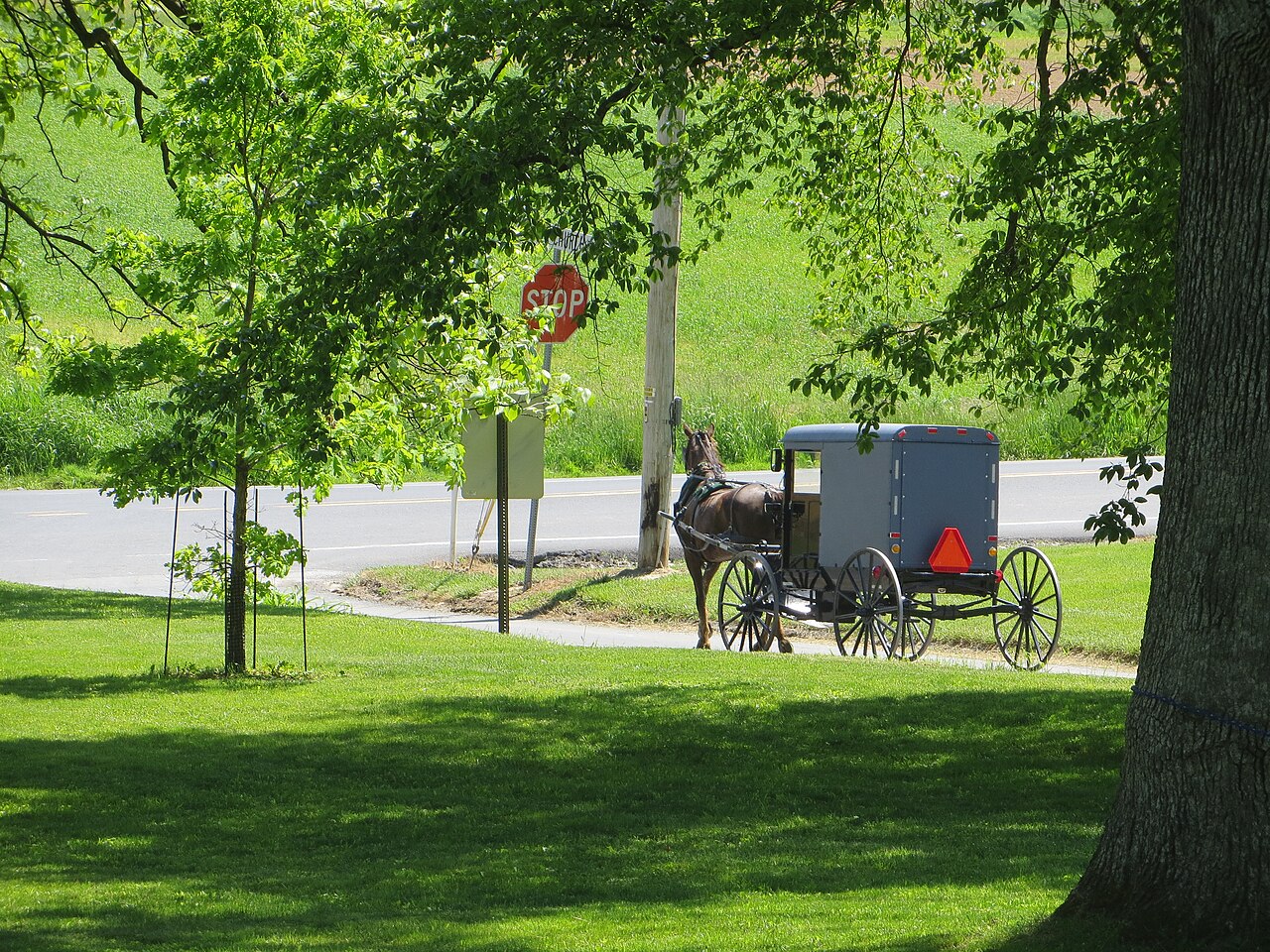
That is why outsiders get confused. One district allows gas-powered refrigerators and diesel engines in the workshop; the next one over does not. Some groups allow rubber tires on farm equipment, some insist on steel wheels. The strictest groups, such as the Swartzentruber Amish, have gone to court rather than put the orange reflective triangle on their buggies, while most Amish use them without complaint.
The logic is not that technology is evil. The question asked is what a thing does to the family and the community. A telephone in the house, the reasoning goes, pulls people away from the people sitting in front of them. So many districts allow a shared phone in a small shanty at the end of a lane. The same thinking explains cars: most Amish will ride in one, and hire a driver for long trips, but owning one would make it too easy to drift away from home.
Taxes, school and the Supreme Court
A common belief is that the Amish pay no taxes. They pay income, property and sales taxes like anyone else. What they do not take part in is Social Security. A provision in the 1965 Medicare law allowed self-employed people whose religion forbids accepting public insurance to opt out, and the Amish, who look after their own elderly and sick, were the main reason it was written.
Education reached the Supreme Court. In Wisconsin v. Yoder, decided in 1972, the justices ruled that Amish parents could not be forced to keep their children in school past the eighth grade. Amish children today mostly attend one-room schools run by the community, usually taught by young unmarried women who themselves left school at fourteen.
Rumspringa is less wild than television suggests
Rumspringa, roughly "running around," begins at about sixteen, when young people start socializing in youth groups and are given some slack on the rules, since they have not yet been baptized. A minority push it hard, with cars, phones and parties. Most do not. The reality in many communities is closer to Sunday-evening singings and volleyball.
What matters is what happens next. The large majority choose baptism, usually somewhere between eighteen and their early twenties. Researchers at the Young Center at Elizabethtown College, who track these things, put retention at well over eighty percent in most settlements.
What their DNA has taught medicine
Most of today's Amish descend from a few hundred eighteenth-century immigrants. Geneticists call this a founder population, and it means some rare inherited conditions turn up far more often than in the general public. Ellis-van Creveld syndrome, a form of dwarfism with extra fingers, is the textbook example among the Lancaster County Amish.
In 1989 a pediatrician named D. Holmes Morton opened the Clinic for Special Children in Strasburg, Pennsylvania, to diagnose and treat these disorders in Amish and Mennonite children at low cost. Amish families helped raise the money and build it.
The same history has also turned up good news. In 2017 researchers at Northwestern University reported that members of an Amish community in Berne, Indiana, who carry a rare variant of the SERPINE1 gene live, on average, around ten years longer than relatives without it. And a 2016 study comparing Amish and Hutterite children found the Amish had far lower rates of asthma, which the researchers linked to growing up around farm animals and barn dust.
A small church that keeps getting bigger
The usual picture of the Amish is of a group frozen in place. The numbers say otherwise. The Young Center counted more than 400,000 Amish in the United States and Canada in recent years, and the population has been roughly doubling every twenty years, thanks to large families and that high retention rate. Pennsylvania, Ohio and Indiana have the largest communities, but new settlements open every year, in places from Maine to Montana, often because farmland near Lancaster has become too expensive.
So the group that disappeared from Europe in 1937 is, by most measures, one of the fastest-growing religious communities in America. Not bad for people who still sing a twenty-minute hymn with no sheet music.