Photo: Phil Roeder, CC BY 2.0, via Wikimedia Commons
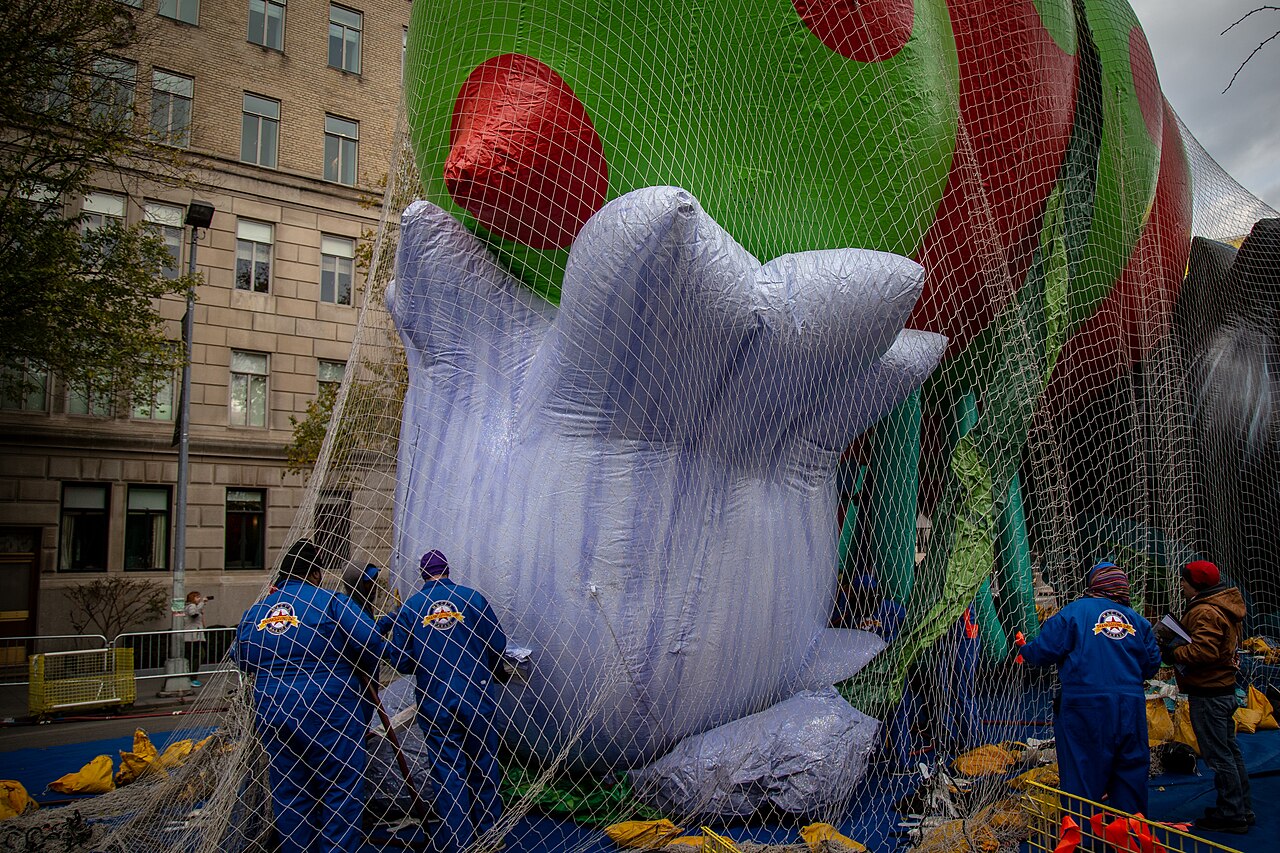
On Wednesday afternoon, November 25, the giant balloons for the 100th Macy's Thanksgiving Day Parade were lying under their nets on the streets beside the American Museum of Natural History, filled with helium and ready for Thursday morning. By the evening they were being emptied again. Macy's had announced that, for the first time in the parade's history, it was moving the whole event because of the weather. The company said it had made "the decision to move the celebration due to expected severe weather" and that the safety of participants and spectators was its top priority.
The storm that forced the call was a powerful coastal system. Mayor Zohran Mamdani warned of a "heavy storm" with "wind gusts up to 65 mph possible," along with flash flooding, and Governor Kathy Hochul declared a state of emergency for New York City and Nassau, Suffolk and Westchester counties on Wednesday night. The parade now steps off at 8:30 a.m. on Saturday, November 28, with more than 1,000 police officers on duty, according to Police Commissioner Jessica Tisch. Executive producer Will Coss said the balloon preparation would have to be "condensed to about 24 hours." The parade has been cancelled before, during the Second World War, and it has gone ahead without balloons before. It had never been moved to another day.
Felix, the zoo animals and the balloons that flew away
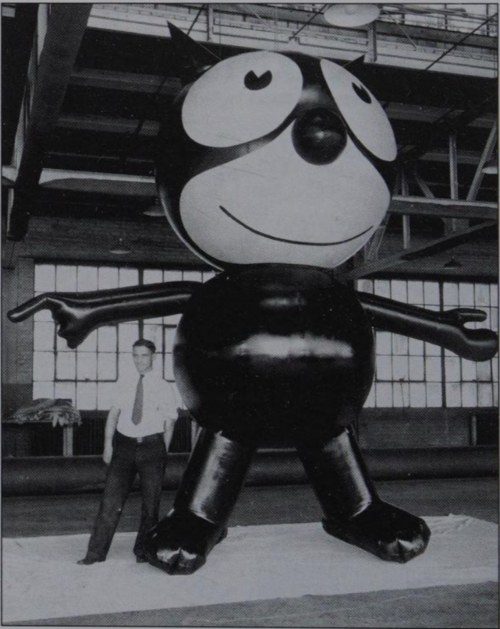
The Felix the Cat balloon built for the 1927 parade, photographed indoors before the march. Photo: public domain, via Wikimedia Commons
The first parade, in 1924, was a Macy's Christmas parade with floats, bands and animals borrowed from the Central Park Zoo. The balloons came three years later, in 1927, when Felix the Cat went up the route as the first of the giant character figures, built with help from the puppeteer Tony Sarg. They replaced the animals, which by most accounts had scared some of the children they were meant to entertain.
For a few years Macy's simply let the balloons go at the end of the parade. They floated off over the city and the company offered a reward to anyone who returned one. That practice ended after 1932, when a released balloon came down on the wing of a small plane flying over Queens and the pilot had to recover from a spin. I have read several versions of the details of that flight, and they do not all agree, but every one of them ends with Macy's deciding to keep its balloons on a leash.
The war stopped the parade entirely. From 1942 to 1944 there was no march, because rubber and helium were needed for the war effort, and Macy's handed its deflated balloons over to the government's rubber drive. The parade returned in 1945.
The first time the balloons stayed down
Wind has always been the balloons' problem. In 1971 strong winds and heavy rain made the route unsafe, and for the first time the organisers kept every giant balloon on the ground; the parade went ahead with floats, bands and performers. In 1993 the Sonic the Hedgehog and Dudley the Dragon balloons struck lampposts. Neither episode changed the rules much. Balloon handling in those years was largely a matter of experience, volunteers and the judgment of the people on the lines.
Thanksgiving 1997 at 72nd Street
That changed on November 27, 1997. The parade went ahead in winds that gusted above 40 mph, after the police and Macy's discussed scrapping the balloons and decided the wind was easing. It was not. The Pink Panther balloon veered out of control near Broadway and 42nd Street and had to be cut open by a police officer with a knife. Barney the dinosaur was punctured on a lamppost at 51st Street and collapsed onto his handlers, and officers stabbed and stamped on him to let the helium out.
The worst came near the end of the route. The Cat in the Hat, six storeys tall, was blown into the arm of a lamppost at 72nd Street and Central Park West. The arm broke and fell into the crowd. Four people were hurt, and one woman suffered a fractured skull and spent 24 days in a coma. She later sued Macy's, the city and the lamppost maker, and the case was settled in 2001.
Mayor Rudolph Giuliani set up a task force within days.
What the task force wrote down
The rules were announced at a press conference on Central Park West on November 25, 1998, the day before that year's parade, by Giuliani, Police Commissioner Howard Safir and Transportation Commissioner Wilbur Chapman. No balloon could be longer than 78 feet, wider than 40 feet or taller than 70 feet, which retired the Cat in the Hat, the Pink Panther and Woody Woodpecker. Large balloons could not fly in sustained winds above 23 mph or gusts above 34 mph. A meteorologist would be at the start line, a pilot with a hand-held wind meter would walk with each balloon, windsocks would go up at intersections, and every large balloon would carry a rip panel so it could be deflated quickly. Each balloon got two heavy vehicles to anchor it and a police official to walk alongside. The city also replaced the lampposts on the route with arms that run parallel to the street.
The release also gave the police the final say on public safety. The thresholds are still the ones quoted every year when the forecast turns windy. In 2005 an M&M's balloon hit a streetlight near Times Square and two sisters were injured, and the rules were reviewed again, but the 23 and 34 mph limits stayed.
Why Saturday rather than Thursday
The 1998 rules explain the decision taken on Wednesday. Before 1997, a windy forecast would have meant arguing on the morning about whether the balloons could fly, as the organisers did that year. Since 1998 the numbers have been written down, and a forecast of 65 mph gusts is nearly double the 34 mph limit. The balloons were never going to fly on Thursday. The real choice was between a parade without them, which is what happened in 1971, and moving the date, which had never been done.
For a 100th parade, a march without its balloons was evidently not something Macy's wanted to put on television. There is also the matter of the floats, the bands and three and a half million or so spectators standing in flood warnings, which the 1971 organisers did not have to think about in quite the same way.
Coss said on Wednesday that he was "optimistic" about delivering "the most spectacular 100th Macy's Thanksgiving Day Parade." It will be, at least, the first one held on a Saturday, which seems a fair price to pay for keeping the lampposts out of the story.
Enjoyed this story?Get a new one every day on social.