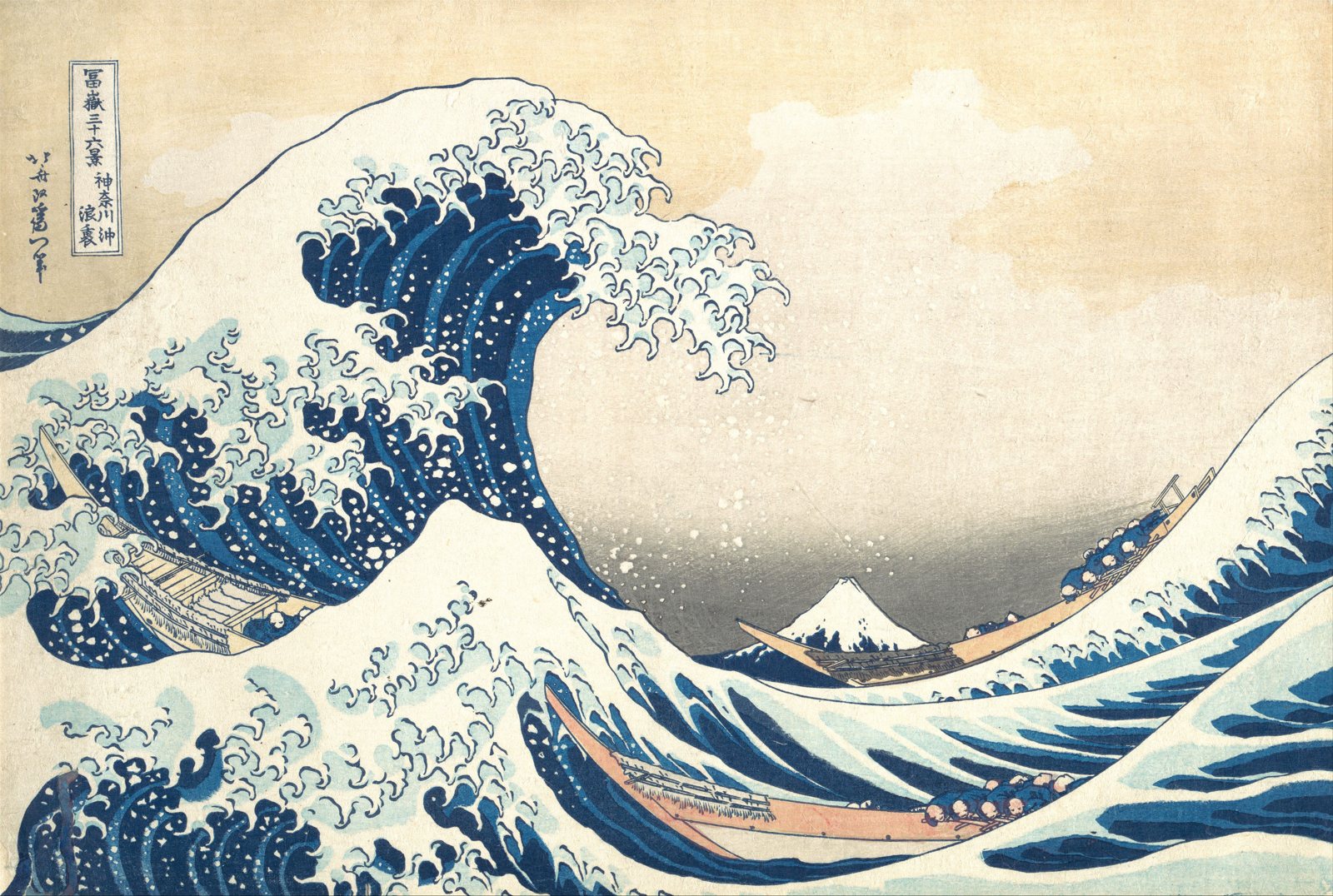
Katsushika Hokusai, Under the Wave off Kanagawa (The Great Wave), c. 1830 to 1832, The Metropolitan Museum of Art, CC0
Something like eight thousand. That is one specialist's estimate of how many impressions of Under the Wave off Kanagawa could have been pulled from a single set of woodblocks before the fine lines wore down, and nobody knows how many were. Several hundred survive. One of them sold at Christie's in New York in March 2023 for 2.76 million dollars, the most ever paid for a Japanese print, after thirteen minutes of bidding. In the shop where it first went on sale, in Edo in 1831, it cost about as much as a generous helping of soba noodles.
I think that gap is the most interesting thing about the most reproduced image in the history of art. The Great Wave was not made to be art in the sense that a painting in a temple was art. It was made to be bought on a whim, carried home rolled in paper, and pinned up.
A print shop in Edo, 1831
The publisher was Nishimuraya Yohachi, who traded as Eijudō from a shop in Edo, the city we call Tokyo, then one of the largest cities in the world, with around a million people. Publishers, not artists, ran the ukiyo-e business. Nishimuraya commissioned the designs, paid the block carvers and the printers, kept the blocks and took the risk. The artist drew the picture on thin paper, handed it over, and was paid a fee. His drawing was pasted face down on a cherry-wood block and carved away in the cutting, so no original drawing of the Great Wave exists.
Katsushika Hokusai was about seventy when he drew it, and in the middle of a comeback. He had been famous for decades, had changed his professional name some thirty times, and by his own account had moved house more than ninety. The series the Wave belongs to, Thirty-six Views of Mount Fuji, was advertised around 1830 as a set of landscapes in a new imported pigment, and it sold so well that Nishimuraya added ten more views, so that there are forty-six Thirty-six Views. (Nobody in the trade seems to have found this odd.)
The pigment was the point. Prussian blue, a chemical colour invented in Berlin around 1706, had begun arriving in Japan cheaply through Chinese and Dutch traders in the late 1820s. The Japanese called it bero, from Berlin. Unlike the native indigo and dayflower blues, it did not fade to grey in a few years, and it could be printed dense and dark. The Wave is a Prussian blue advertisement. The deep colour at the heart of the water and the pale, almost translucent blue of the foam are the same pigment, printed from separate blocks at different strengths.
Three fishing boats and a commute
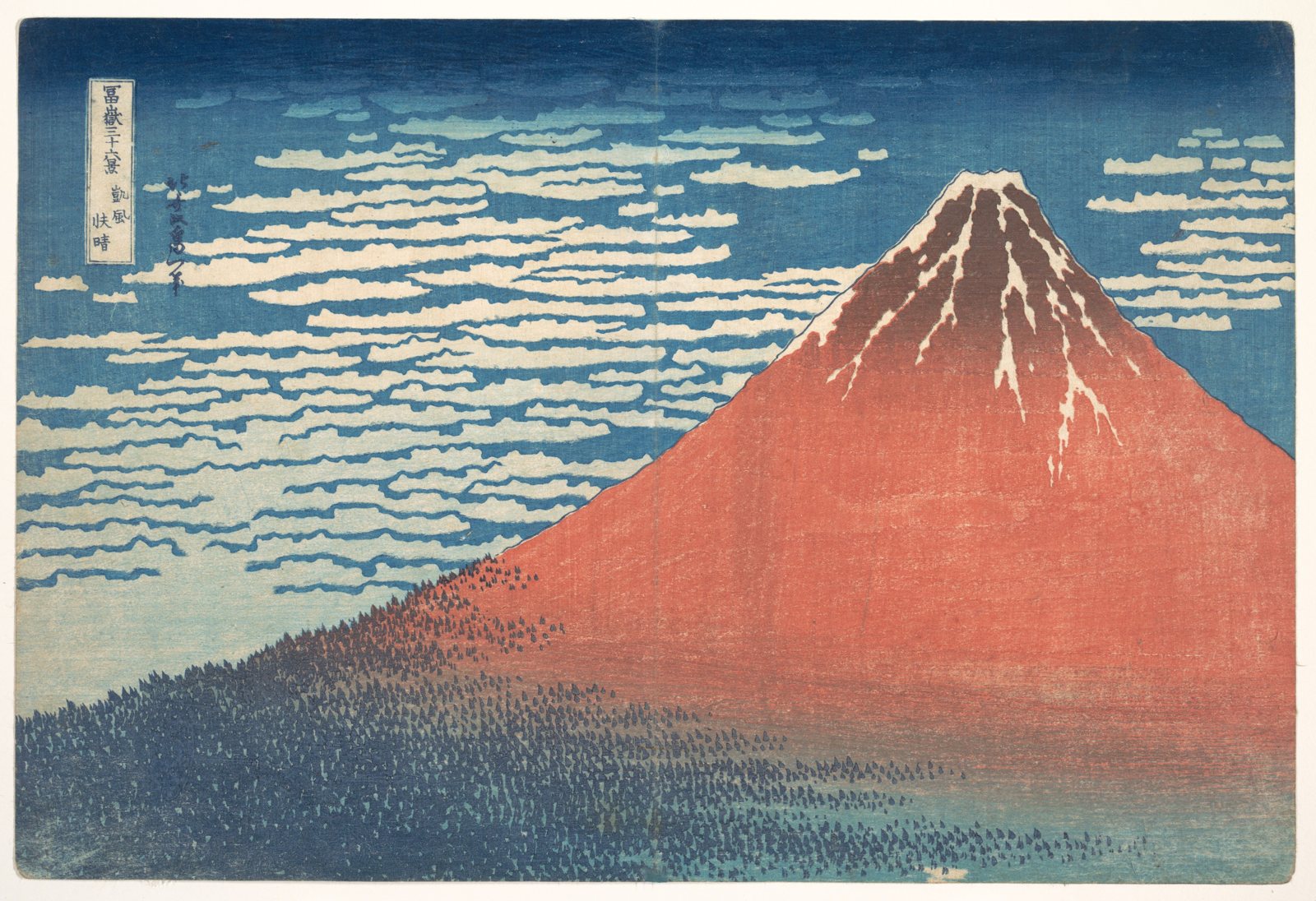
Katsushika Hokusai, South Wind, Clear Sky (Red Fuji), from the same series, c. 1830 to 1832, The Metropolitan Museum of Art, CC0
Look past the wave and there are three long boats with upturned prows and eight or so oarsmen each, bent flat over their oars. These are oshiokuri-bune, fast boats that carried fresh fish from the villages of the Bōsō peninsula across the bay to the Edo market before dawn. The men in them are commuting. The title tells you where you are, off Kanagawa, a post station on the Tōkaidō road just south of the city, and the small triangle of Fuji sits exactly where the wave's foam would land if it fell.
Hokusai had been drawing waves for thirty years and his earlier ones look like decorations. This one has fingers. Vincent van Gogh, who owned hundreds of Japanese prints, wrote to his brother in 1888 that the waves were claws and the boat was caught in them, and that you could feel it. The wave is enormous only by implication; measure it against the boats and it is perhaps ten to twelve metres, a rogue wave rather than a tsunami, which is what fishermen in Sagami Bay would have feared.
How Edo lived with pictures
Ukiyo-e, pictures of the floating world, were the mass media of the city. The same shops sold portraits of kabuki actors in their latest roles, courtesans in this season's robes, sumo wrestlers, views of famous places, and sheets of patterns for kimono. Prices were low because volume was high, and there was a sliding scale: a cheap sheet of fashion gossip for a few coins, a full-colour landscape for a bit more, a privately commissioned New Year print on thick paper with metallic pigments for people with money.
People did not frame them. Prints were pasted on walls and sliding screens, tucked into albums, given as souvenirs by travellers back from the Tōkaidō, and used as wrapping. Sunlight did the rest. Many early impressions of the Wave have a faint pink wash across the sky above Fuji, and in most of the survivors it has faded to nothing, so that the image people know is slightly different from the one Nishimuraya sold. The blocks themselves were recut as they wore out, and later impressions have a heavier outline and lose the gradation in the clouds.
Hokusai, meanwhile, kept drawing. In the afterword to a later Fuji book he wrote that nothing he had made before seventy was worth much, that at eighty he might begin to understand the structure of things, and that by 110 every dot and line would be alive. He died in 1849, aged eighty-eight by Western reckoning, asking for another ten years, or failing that, five.
From packing paper to the thousand yen note
Japan was almost closed to foreign trade until the 1850s. When it opened, ukiyo-e went west in bulk, some as art and a good deal as wrapping around porcelain and lacquer. The story that the French etcher Félix Bracquemond discovered Hokusai in 1856 in a crate of packing paper is repeated in every book, and I have never found a source for it that does not trace back to Bracquemond. Whatever the route, by the 1870s Monet, Degas and Whistler owned Japanese prints, Debussy put the Wave on the cover of the score of La Mer in 1905, and the Great Wave had become the one Japanese picture the rest of the world could name.
It is now on the money. On 3 July 2024 the Bank of Japan issued a new 1,000 yen note with the bacteriologist Kitasato Shibasaburō on the front and the Great Wave on the back, replacing a photograph of Fuji and cherry blossoms. The Metropolitan Museum in New York holds several impressions, the British Museum several more, and most of the world's great print collections have at least one. In a good early impression the sky is still faintly pink along the top edge, and the outline of the small boats is thin and clean. In most, the sky has gone grey, the way it does in Kanagawa in late autumn, and the wave looks exactly as it did in 1831.
Enjoyed this story?Get a new one every day on social.