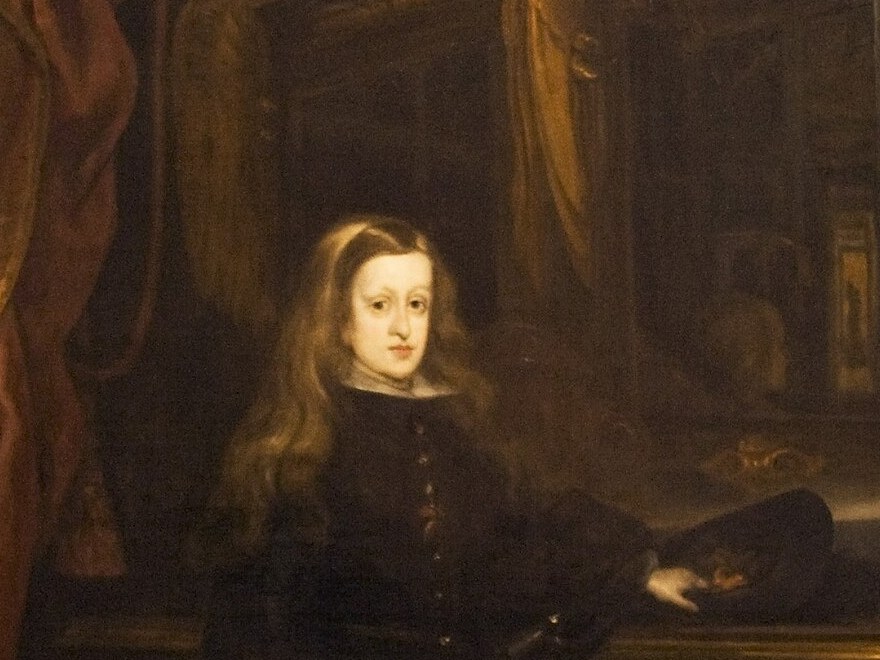
Charles II of Spain as a boy, painted by Juan Carreño de Miranda (detail). Public domain, via Wikimedia Commons
At the 1964 Winter Olympics in Innsbruck, a Finnish border guard named Eero Mäntyranta won both the 15 and 30 kilometer cross-country races. Over his career he collected seven Olympic medals, three of them gold, and for years rival teams muttered that something about him was not quite natural.
They were right, though not in the way they meant. Nearly thirty years later, geneticists studying his extended family found the reason, and it had nothing to do with a syringe. Mäntyranta belongs to a small, odd club of people whose DNA does something the rest of ours does not, and several of them ended up changing medicine.
The skier whose blood was born doped
In 1993 a team led by the Finnish geneticist Albert de la Chapelle reported a mutation in the EPOR gene, the receptor for erythropoietin, the hormone that tells the body to make red blood cells. In Mäntyranta and a number of his relatives the receptor was stuck partly "on." Their blood carried far more red cells than normal, which means more oxygen to the muscles.
That is exactly what endurance athletes later tried to fake with synthetic EPO. Mäntyranta came by it honestly, through his grandparents. (The condition, primary familial polycythemia, is not always a gift. Thick blood carries its own risks.)
The jaw that ended a dynasty
Some genetic traits made history in a darker way. The Habsburgs, who ruled Spain and much of central Europe, married cousins, uncles and nieces for generations to keep land and power in the family. Their portraits show the result: a long lower jaw, a thick lower lip and, often, a drooping nose.
It reached its extreme in Charles II of Spain, born in 1661. His parents were uncle and niece. Genealogists have estimated his inbreeding coefficient at about 0.25, roughly what you would expect from the child of a brother and sister. He struggled to chew, was sickly all his life and died in 1700 with no children, ending the Spanish Habsburg line and setting off the War of the Spanish Succession.
In 2019 a group of researchers at the University of Santiago de Compostela asked ten maxillofacial surgeons to examine 66 portraits of 15 Habsburgs. The more inbred the subject, the more pronounced the jaw. It was the first time anyone had put numbers on what the portrait painters had been politely recording for two centuries.
The man HIV could not infect
Stephen Crohn, a New York artist, watched dozens of friends die of AIDS in the 1980s, including his partner. He had been exposed to the virus again and again and never got sick. Eventually he offered himself to researchers at the Aaron Diamond AIDS Research Center in Manhattan.
When the scientists exposed his white blood cells to HIV in the lab, the virus could not get in. In 1996 they found out why. Crohn carried two copies of a mutation called CCR5-delta 32, which removes the doorway most strains of HIV use to enter cells. Around one percent of people of northern European descent have two copies, though most never find out.
The discovery went further than Crohn could have imagined. In 2007 an American living in Berlin, Timothy Ray Brown, needed a stem cell transplant for leukemia. His doctor, Gero Hütter, chose a donor with two copies of the same mutation. Brown, who was also HIV-positive, became the first person considered cured of HIV. Crohn died in 2013 and Brown in 2020, but drugs that block the CCR5 doorway are now part of HIV treatment.
Bones too dense to break
In 2002 a team at Yale described a family whose bones were so dense that, according to the researchers, one member walked away from a serious car crash without a single fracture. Their skeletons were otherwise normal, if unusually heavy. The cause was a change in the LRP5 gene, which helps control how much bone the body builds.
The finding sent drug companies looking for ways to copy the effect. That line of work fed directly into newer osteoporosis drugs that target the same pathway, which is a fairly good return on one family's lucky accident.
Golden blood and no pain at all
Some traits are so rare that the people who carry them are counted, not estimated. Rh-null blood, which lacks every antigen in the Rh system, was first reported in 1961 in an Aboriginal Australian woman. Fewer than fifty people are known to have it. Doctors sometimes call it golden blood because it can be given to people with rare Rh types, while those who have it can only receive the same thing.
Then there is the retired teacher in Scotland who, at 65, told an anesthetist that she would not need painkillers after hand surgery. She meant it. Researchers at University College London traced her near-total lack of pain, and her unusually low anxiety, to a deletion near the FAAH gene, which they named FAAH-OUT. Their report appeared in the British Journal of Anaesthesia in 2019. Her burns healed quickly, and she said she often noticed one only when she smelled it.
I will admit to finding that last detail more unsettling than impressive.
Where these stories have led
Each of these people was, in a sense, a natural experiment that nobody could have designed. A boy born in Germany with unusually large muscles, described in a medical journal in 2004, gave researchers a working example of what happens when the myostatin gene is switched off. Families with extra-short sleep needs have done the same for the study of sleep.
They have also shown how quickly the knowledge can be misused. In 2018 the Chinese scientist He Jiankui announced that he had edited the CCR5 gene in twin baby girls, trying to give them Stephen Crohn's protection. The work was condemned by scientists around the world, and a Chinese court later sentenced him to three years in prison. Crohn had volunteered his blood because he wanted to know why he had survived. It is hard to think he would have recognized what was done with the answer.
Enjoyed this story?Get a new one every day on social.