Photo: Radhadwibedi, CC BY-SA 4.0, via Wikimedia Commons
"The first spaceflight of a Pakistani astronaut to China's space station" is how President Asif Ali Zardari put it in his letter to Xi Jinping, and he called it a historic milestone. The flight in question left the Jiuquan launch centre in the Gobi Desert at 8:18 a.m. Beijing time on Wednesday, November 25, on a Long March 2F rocket. Shenzhou-24 docked with Tiangong 3 hours and 38 minutes later, according to China's crewed space agency.
Aboard were the commander, Tang Hongbo, his crewmate Wu Yi, and Muhammad Zeeshan Ali, a 40-year-old Pakistani military pilot flying as payload specialist. He is the first Pakistani in orbit and the first foreigner to board China's station. He will stay about a week, grow microalgae and test what spaceflight does to quinoa seeds, then ride home in the older Shenzhou-23 capsule with two departing Chinese astronauts. "I'm not flying for myself," he said before launch. "I carry the name of Pakistan on my shoulder."
A guest seat, by treaty
The deal behind the seat was signed in February 2025. Pakistan's space agency, SUPARCO, put forward candidates; two of them, Ali and Khurram Daud, went to the Astronaut Centre of China in Beijing in April for about seven months of training, which by Reuters' account included Chinese lessons, calligraphy and table tennis. Only one could fly. Foreign Minister Ishaq Dar tied the mission to 75 years of diplomatic relations between the two countries, and Prime Minister Shehbaz Sharif wrote that the friendship was now "surpassing the heights of the Himalayas."
Readers in Delhi will recognise the arrangement, because India went through almost the same thing with Moscow in 1984.
Intercosmos and its passengers
The Soviet Union started flying foreign guests in 1978, under a programme called Intercosmos. The first was a Czechoslovak pilot, Vladimír Remek, and over the next decade the seats went to allies and friends: Poland, East Germany, Bulgaria, Hungary, Vietnam, Cuba, Mongolia, Romania, France, India, Syria and, in 1988, Afghanistan, whose air force pilot Abdul Ahad Mohmand flew while Soviet troops were still pulling out of his country. Vietnam's Pham Tuan, in 1980, was the first Asian in space.
The format hardly changed. A visiting crew of two Soviets and one guest flew up in a fresh Soyuz, spent about a week aboard the Salyut station doing experiments the guest country had proposed, then came home in the older Soyuz already docked there, leaving the new one for the long-stay crew. That is, almost to the detail, what Shenzhou-24 and Shenzhou-23 are doing this week.
Squadron Leader Sharma goes up
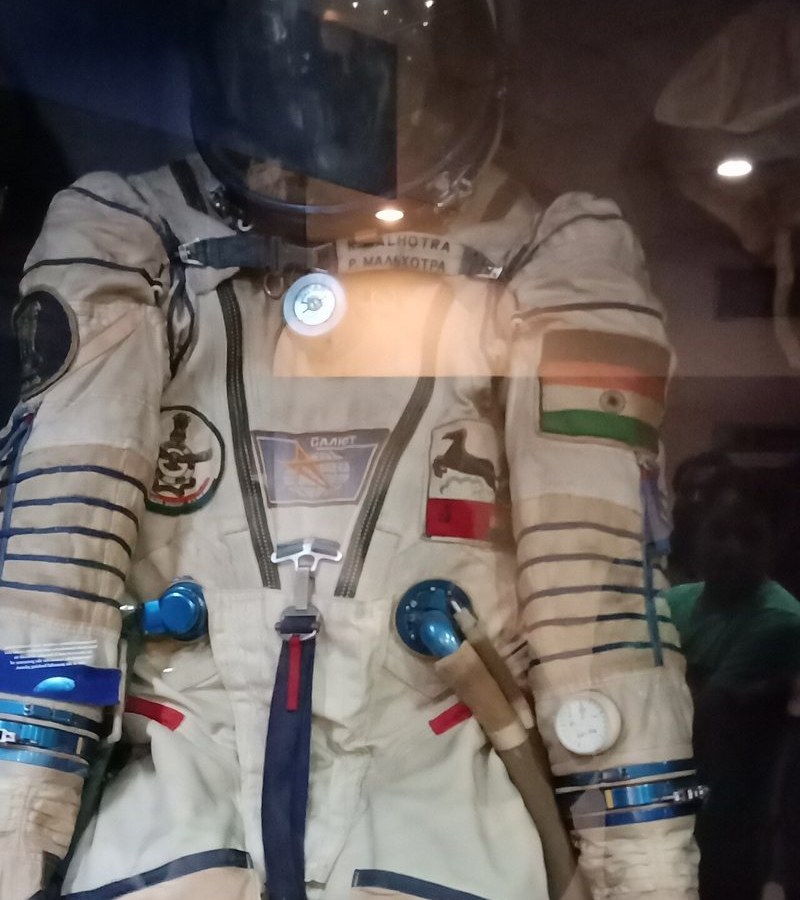
The Sokol spacesuit of Ravish Malhotra, Sharma's backup, on display at the Nehru Planetarium. Photo: Radhadwibedi, CC BY-SA 4.0, via Wikimedia Commons
India took up the Soviet offer, and in 1982 the Indian Air Force picked two test pilots, Squadron Leader Rakesh Sharma and Wing Commander Ravish Malhotra, to train at Star City outside Moscow. Sharma got the flight. Malhotra was his backup and never flew.
Soyuz T-11 lifted off from Baikonur on April 3, 1984, with Yuri Malyshev in command, Gennady Strekalov as flight engineer and Sharma in the third seat. They docked with Salyut 7, where three cosmonauts were partway through what became an eight-month stay. Sharma photographed India from orbit for mapping and resource surveys and ran a set of experiments on how the body copes with weightlessness, some of them built around yoga exercises, which got more press at home than anything else he did.
The moment everyone in India remembers came on a live link with Prime Minister Indira Gandhi. She asked him how India looked from up there. He answered with the first line of Muhammad Iqbal's patriotic song: "Saare jahan se achcha," better than the whole world. (Iqbal, it is worth adding, is also Pakistan's national poet, which makes this a slightly awkward detail for a story about the two countries' firsts. I have decided to leave it in anyway.)
Sharma landed on April 11 in the older Soyuz T-10 capsule, after seven days, 21 hours and 40 minutes in space. He was made a Hero of the Soviet Union and given India's Ashoka Chakra.
What the parallel shows
The 1984 flight was a gift from a superpower to a friend, timed for maximum political warmth, and it was not followed by anything. India did not send another person into space for 41 years, until Group Captain Shubhanshu Shukla flew to the International Space Station on the commercial Axiom-4 mission in June 2025. Its own capsule, Gaganyaan, has still not carried a crew; ISRO now says the first crewed flight is due in the first quarter of 2027.
That is the part of the comparison Islamabad should worry about. A seat on someone else's rocket says a lot about a friendship and very little about whether a country will ever fly its own people, and Moscow never pretended otherwise. China and Pakistan are talking about more than one seat: a Pakistani rover is due to ride on a Chinese moon mission later this decade, and Ali's four experiments were picked from more than 300 proposals sent in by Pakistani researchers. Whether that turns into a second Pakistani flight, or a Pakistani rocket, is a decision for budgets in Islamabad, not for the crew on Tiangong.
Pakistan, for the record, was early to this game once before. SUPARCO was founded in 1961 at the urging of the physicist Abdus Salam, and in June 1962 it launched the Rehbar-I sounding rocket from Sonmiani beach, which Pakistani accounts like to call one of the first rocket launches in Asia (I have never found a count that settles the exact ranking). The programme stalled for decades after that, which is part of why Wednesday's launch was watched so closely in Pakistan.
A capsule in a Delhi planetarium
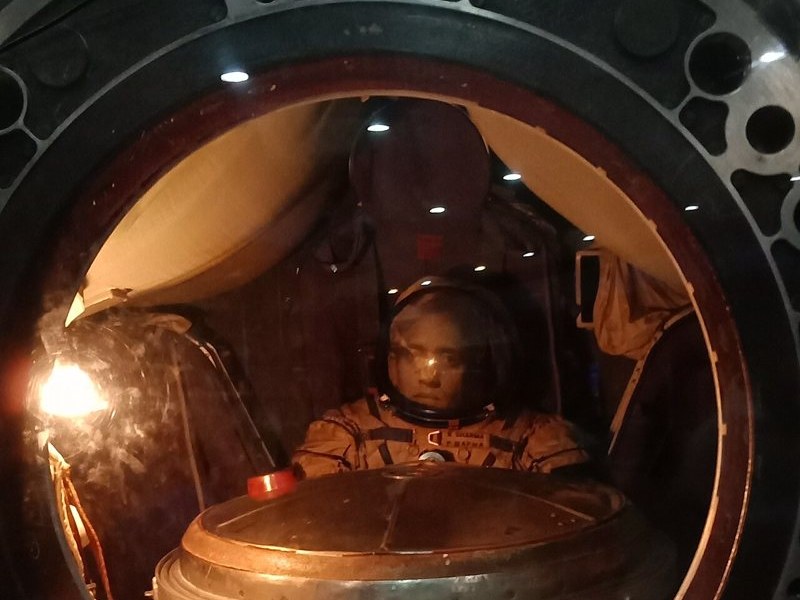
The Nehru Planetarium in New Delhi has a Soyuz descent module on display, with a mannequin of Sharma sitting inside it, visor up, behind the hatch. Nearby, in a glass case, stands a Sokol pressure suit that visitors photograph as Sharma's, and the picture on Wikimedia Commons is filed under his name. Look at the name tag on the chest and it reads "R. Malhotra," in Latin and Cyrillic letters. The backup's suit made it into the museum, even if he never got to wear it to orbit.
Enjoyed this story?Get a new one every day on social.