Photo: Don Koralewski, public domain, via Wikimedia Commons
Mohammad Bagher Ghalibaf, the speaker of Iran's parliament and Tehran's chief negotiator, stood up in the chamber on Tuesday, November 24, and said there would be "no action or negotiation" with the United States before Iran's seven conditions are implemented. Iranian officials have never published one agreed list. The version reported from his speech includes lifting the US naval blockade of Iranian ports, safe passage for shipping through the Strait of Hormuz, an end to unilateral sanctions, a waiver for oil exports, the release of frozen assets, and a formal end to the war on every front.
He was answering Donald Trump, who has said he is inclined to resume strikes after the New Year if there is no deal, and the US Treasury, which sanctioned more than two dozen Iranian exchange houses and front companies on Monday. The same day, Iran's Revolutionary Guard navy said three tankers hit mines in the strait and caught fire. Qatar's prime minister was in Washington trying to restart talks. Nobody reported an understanding.
Anyone who covered the Iran hostage crisis will recognise the shape of this. In the autumn of 1980 Tehran also refused to talk until Washington accepted a numbered list. There were four items, not seven, and it took eleven weeks, an Algerian foreign minister and a lot of gold, but the list became a treaty.
Khomeini's list, read out in September 1980
By September 1980, 52 American diplomats and staff had been held in Tehran since the embassy was seized on November 4, 1979. A rescue mission had ended in the desert that April. On September 12, Ayatollah Ruhollah Khomeini set out what Iran wanted: the return of the late Shah's wealth, the cancellation of American claims against Iran, the unfreezing of Iranian assets held in the United States, and a US guarantee not to interfere in Iran's internal affairs.
Ten days later Iraq invaded Iran. That matters more than it usually gets credit for. A country fighting for Khuzestan had less use for 52 hostages and much more use for its frozen billions.
The Majlis votes, two days before an American election
On November 2, 1980, Iran's parliament formally approved Khomeini's four conditions. The timing was not subtle: Americans voted on November 4, and Jimmy Carter's re-election had become, among other things, a referendum on the hostages. The next day Algeria passed Washington a diplomatic note saying Iran was ready to negotiate on the four points.
Carter lost to Ronald Reagan. Iran's leadership had no interest in waiting to see what Reagan would offer, and Carter had about ten weeks left to finish what he had started.
Warren Christopher and the Algerians
The two governments never sat at one table. Deputy Secretary of State Warren Christopher led the American side and dealt mainly with Algeria's foreign minister, Mohammed Benyahia, whose team carried texts between Washington and Tehran. Algeria had diplomatic credit with both, which is a rarer thing than it sounds.
What came out of it, the Algiers Accords, was signed on January 19, 1981. Read the text and you can find each of Khomeini's four conditions translated into something Washington could live with. Point I said: "it is and from now on will be the policy of the United States not to intervene, directly or indirectly, politically or militarily, in Iran's internal affairs." American claims were not cancelled; they were moved into a new body, the Iran-United States Claims Tribunal in The Hague, which went on to receive about 4,700 private claims. The Shah's wealth got a clause and very little else.
$7.98 billion and a night of escrow paperwork
The frozen money was what actually mattered. About $7.9 billion in Iranian assets, much of it sitting in overseas branches of a dozen American banks, had to be moved through the Bank of England with the Algerian central bank certifying it. Iran wanted part of it in gold, so the United States shipped 50 tonnes to Iran and took ownership of an equal amount of Iranian gold in the vaults of the New York Fed. Iran also left $1 billion in escrow to pay future tribunal awards.
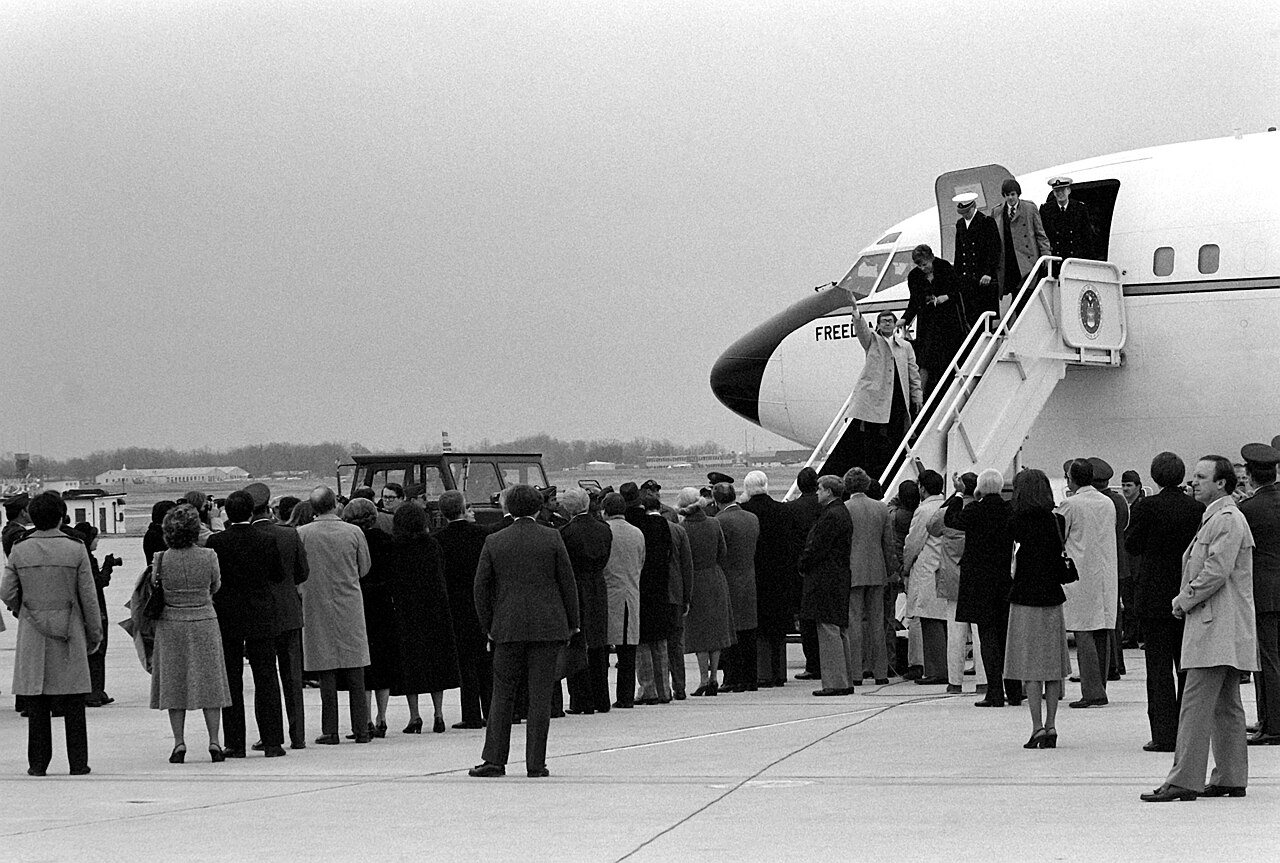
The last night of Carter's presidency was spent on paper. According to the record of those hours, the escrows were signed at 6:18 a.m. on January 20, and at 6:35 Christopher reported that the Bank of England had certified it held "$7.98 billion, the correct amount." Iran still waited. The planes left Tehran only after Reagan had taken the oath at noon in Washington. I have never found any reason to doubt that the delay was deliberate. The hostages had been held for 444 days.
What 1981 says about the seven conditions
The comparison is not perfect, and the differences are where the interest lies. In 1980 Iran held something the United States wanted back, physically, in a compound in Tehran. In 2026 the bargaining chip is the strait itself. Ghalibaf's list puts Hormuz shipping and the US blockade side by side, which is a trade offer whether or not anyone calls it one.
The 1980 list also turned out to be softer than it sounded. "Return the Shah's wealth" became a promise to help Iran pursue it in American courts. "Cancel US claims" became a tribunal that ended up ordering Iran to pay American nationals more than $2.5 billion. Tehran accepted that because the assets and the non-intervention pledge were what it needed. The seven items now include several that look negotiable in the same way, such as an oil waiver rather than an end to all sanctions.
Timing worked the same way, too. In 1980 Tehran pushed its list through parliament two days before an American election and then let the clock run down on a president it disliked. This time the clock is Trump's: he has talked about resuming strikes after the New Year, and Ghalibaf answered with a warning that Iran could "change the geography of the battle" if Washington miscalculates. Both sides are setting deadlines, which in 1980 turned out to be a sign that a deal was closer than either admitted.
And there was a broker both sides trusted. Qatar is trying to be that broker now, and Doha has more practice at it than Algiers had in 1980.
The tribunal is still sitting
The Claims Tribunal set up in January 1981 never fully closed. Its biggest cases, the ones between the two governments themselves, have dragged on in The Hague for decades, long after the private claims were settled. My guess is that if a deal on Ghalibaf's seven conditions ever comes, it will look like Algiers: a list nobody fully meets, rewritten clause by clause into something both capitals can call a win.
Enjoyed this story?Get a new one every day on social.