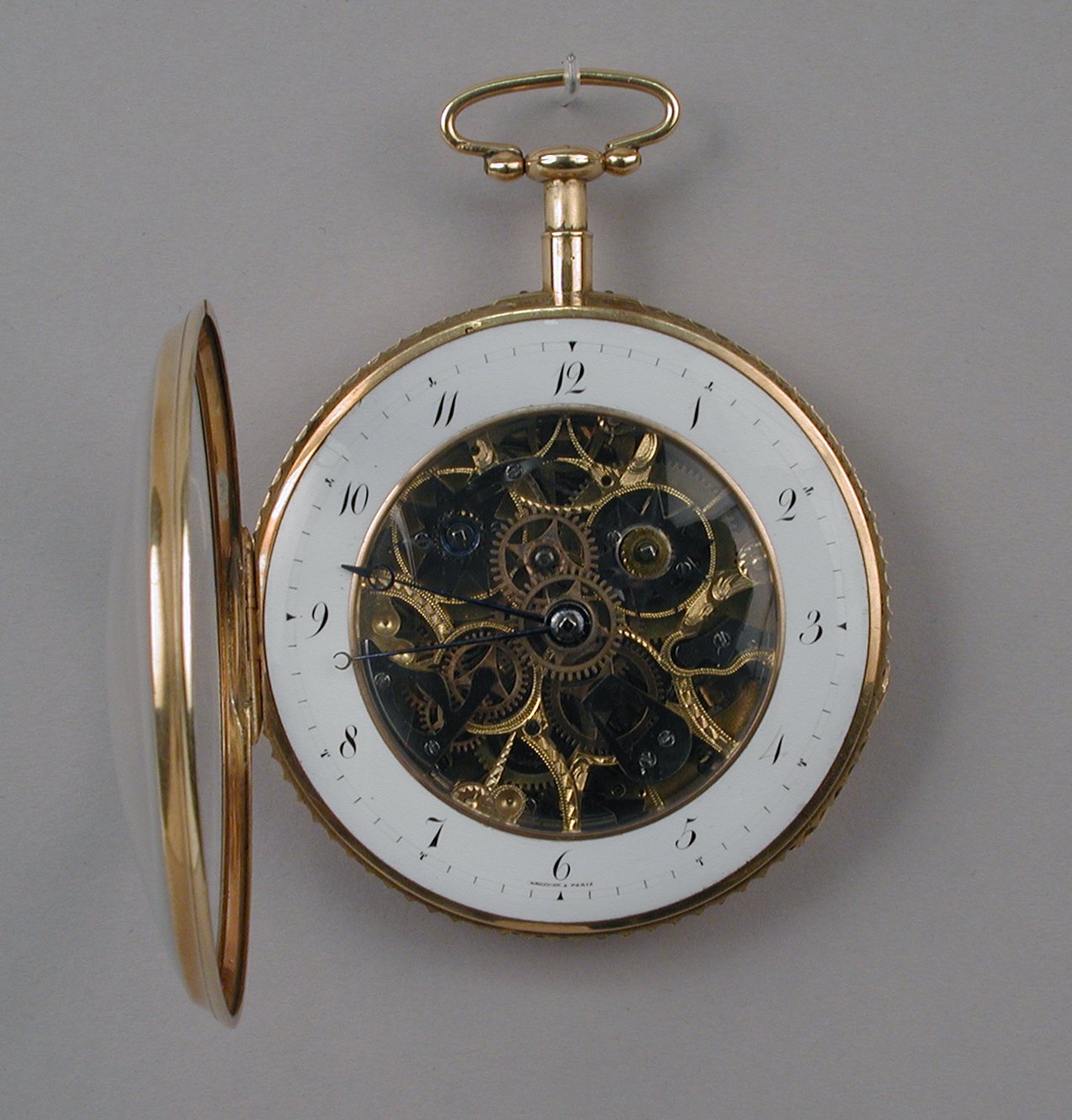
Breguet, Skeleton watch (ca. 1810), The Metropolitan Museum of Art, CC0
Sometime in 1815 a Frenchman named Louis Moinet moved to Paris. He was in his late forties, a painter and sculptor as well as a watchmaker, a friend of Abraham-Louis Breguet, and by his own account he came for a single job. "I came to Paris in 1815," he wrote in a letter in 1823, "with the sole purpose of devising and making a compteur de tierces."
A compteur de tierces is a counter of sixtieths of a second. He built one in 1816. It then disappeared from history for almost two hundred years, and the credit for inventing the chronograph went to somebody else.
The prize that brought it up again
On Saturday night in Geneva the Grand Prix d'Horlogerie de Genève, the closest thing the watch industry has to the Oscars, gave its top award, the Aiguille d'Or, to a chronograph. The winner was the RRCHF Chronograph Flyback made by Rexhep Rexhepi, a Swiss-Kosovan independent watchmaker based in Geneva, and the first chronograph his own brand has made. It was picked from 84 finalists across 14 categories, and the jury singled out a movement that had to be rethought from scratch to fit the watch's proportions.
A flyback chronograph is a stopwatch that resets and starts again with one push, a feature long associated with pilots timing the legs of a flight. It is also one of the oldest complications in the trade, and the question of who built the first one turns out to be a good deal messier than the industry used to say.
The man with the inkpot
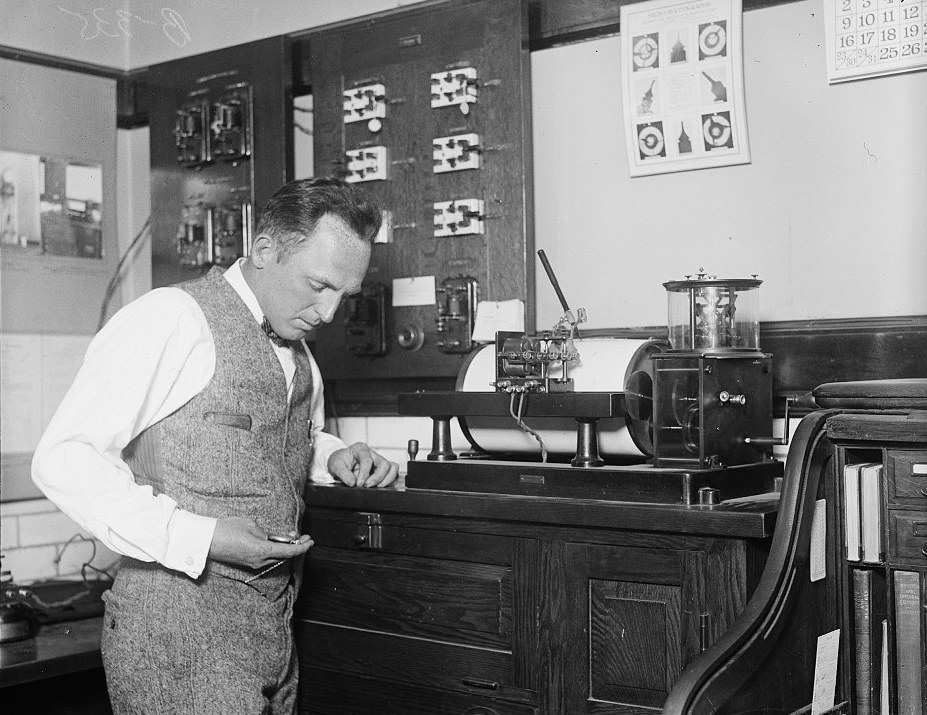
A recording chronograph at the U.S. Bureau of Standards in 1926, still writing time onto a paper drum a century after Rieussec. Photo: Harris & Ewing, Library of Congress, no known restrictions
For most of the 20th century, the textbook answer was Nicolas Rieussec. In 1821 Rieussec timed horse races on the Champ de Mars in Paris with a device of his own design, a box about the size of a hardback book, in mahogany, with rotating dials. When the operator pressed a lever, a small pen dropped a dot of ink on the dial, and the gap between dots showed how long a horse had taken. It was accurate to about a second.
Rieussec named it a chronograph, from the Greek for "time" and "to write", which was a literal description, and he received a patent for it in 1822. Other makers picked up the idea quickly. Frederick Louis Fatton, a watchmaker in London, made a pocket version with an inking hand, and Breguet's own workshop experimented along the same lines. Through the 19th century the ink went away and the modern design took shape; the layout most collectors would recognise is usually traced to a patent registered by the Swiss watchmaker Adolphe Nicole in 1862.
That was the history as written, and nobody was arguing about it; Montblanc, which owns an old Swiss chronograph maker, even named a collection after Rieussec.
The lot at Christie's
In May 2012 Christie's sold a small instrument that turned out to be Moinet's compteur de tierces of 1816. In 2013 Jean-Marie Schaller, who runs a modern watch company that took Moinet's name, presented it at the old observatory in Neuchâtel and announced that it was the earliest known chronograph.
The thing is startling even now. It ran at 30 hertz, which watchmakers express as 216,000 vibrations an hour. Most good mechanical watches today run at 28,800. Moinet's central hand counted sixtieths of a second, and three subdials recorded elapsed seconds, minutes and hours, up to 24. It had a reset, two pushers and a power reserve of about 30 hours. He built it for astronomy, to time the passage of stars across a telescope's field of view, not for racing.
He had not exactly hidden it, either. Moinet described his counter in his Traité d'horlogerie, a long treatise on watchmaking published in 1848, five years before he died. The instrument itself, though, could not be found, and a description in a treatise does not win priority arguments the way a patent and a crowd at a horse race do.
Who gets to say "first"
I should say plainly that the main promoter of Moinet's claim is a company selling watches under his name, and that a company with that interest is exactly who you would expect to make it. That does not make the claim wrong. Specialist writers who have looked at the piece generally accept the 1816 date, and in 2016 Guinness World Records recognised it as the first chronograph. (One of the published photographs is captioned 1817, which tells you something about how tidy this field is.)
There is also a purist objection, which I rather like. Moinet's counter did not write anything. It showed elapsed time on its dials, which would make it a chronoscope, "time" and "to see", rather than a chronograph. By that strict standard Rieussec invented the chronograph and Moinet invented the thing everyone actually means by the word. Nobody in the watch trade uses the strict standard.
Two hundred years later
Rexhepi's prize-winning watch has no ink, a blue Grand Feu enamel dial modelled on old pocket-watch chronographs, and two pushers, which is to say it owes more to Moinet's silent counter than to Rieussec's inkpot. Moinet's own instrument survives, and its first public outing in two centuries came at an auction house, which in the watch business is about as natural a resting place as a museum.
The man with the inkpot still has the better name, though. Nobody has ever walked into a shop and asked for a compteur de tierces.
Enjoyed this story?Get a new one every day on social.