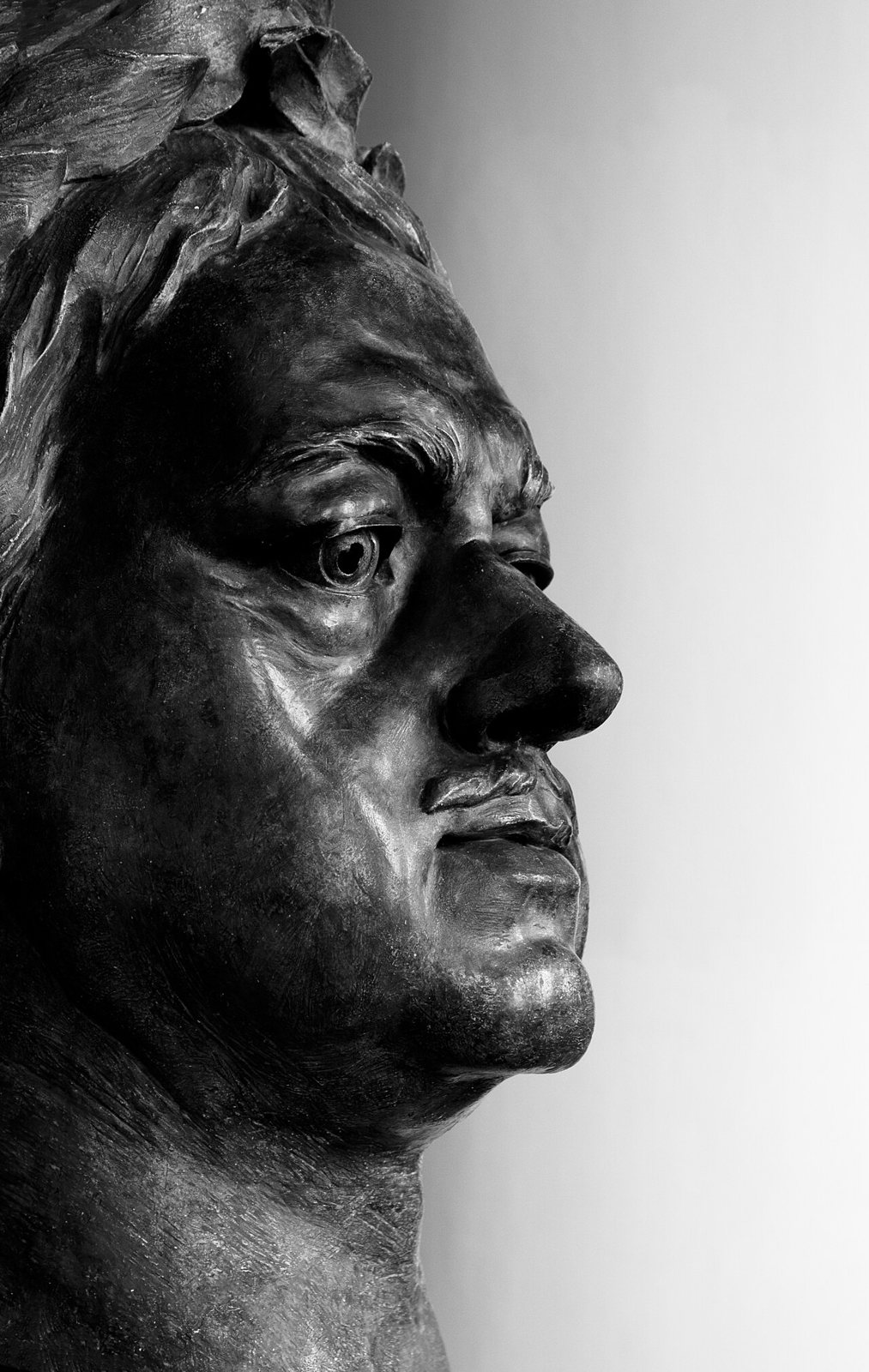
Photo: Dmitry L. Medvedev, CC BY-SA 4.0, via Wikimedia Commons (bust after Marie-Anne Collot)
The day after he got back to Moscow, Peter the Great held a reception and shaved his guests. It was the 26th of August 1698 by the old Russian calendar, at his country house at Preobrazhenskoye, and the men who came to welcome the twenty-six-year-old tsar home from eighteen months in Western Europe were the senior boyars of the realm, bearded to the chest as their fathers and grandfathers had been. Peter greeted them, produced a razor and began on the commander-in-chief, Aleksei Shein, then moved on to the general Fyodor Romodanovsky and whoever was standing next to him.
We know this because Johann Georg Korb, a secretary to the Austrian embassy, was in Moscow that year and wrote it down in his diary, and because several Russian sources tell the same story with minor variations. Within a week the tsar's court jester had been appointed barber and was working through the lower ranks at banquets. Within a few years, keeping your beard in Russia required a licence, an annual fee and a copper token to prove you had paid.
What the beard meant
To understand why anyone minded, you need to know what a beard was in Muscovy. The Orthodox Church taught that man was made in God's image and that the image had a beard; shaving it was a mutilation, and some clergy taught that a shaven man could not be sure of resurrection in the proper form. A church council in 1551 had formally condemned shaving. Ivan the Terrible is supposed to have said that to shave the beard was a sin the blood of all the martyrs could not wash away. Whether or not he said it, people believed it.
So a beard was not fashion. It was a statement that you belonged to Holy Russia rather than to the clean-shaven, tobacco-smoking, Catholic and Protestant West.
What Peter had seen
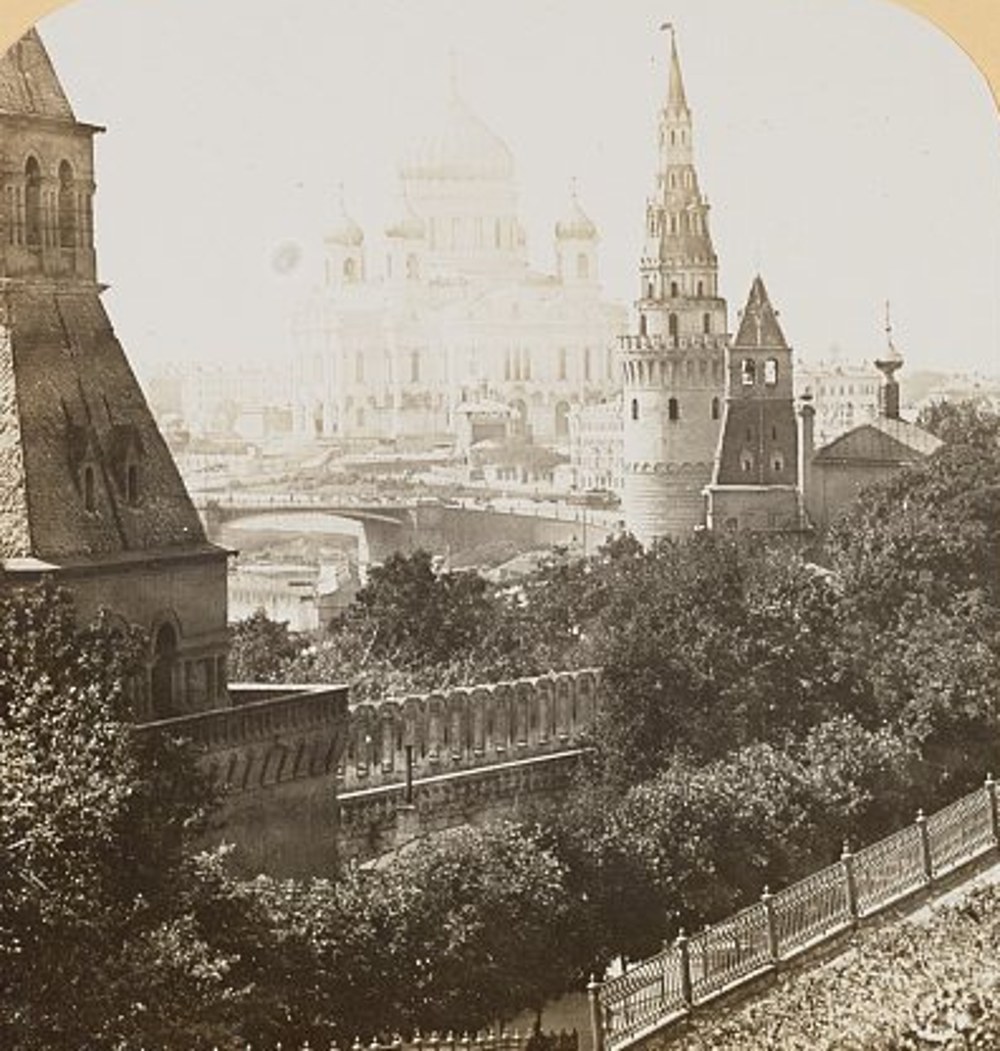
Stereograph view of the Kremlin, Moscow, in 1901. Library of Congress Prints & Photographs Division, no known restrictions
Peter had just spent a year and a half in exactly that West. His "Grand Embassy" of 1697 and 1698 took him through the Baltic, Prussia, Holland and England, travelling in theory incognito as a ship's carpenter named Pyotr Mikhailov, which fooled nobody, since he was six foot eight and accompanied by 250 people. He worked in the shipyards at Zaandam and Deptford, visited the Royal Society and the Mint, drank a great deal, and came back convinced that Russia's backwardness was a matter of habit and could be legislated away.
The Streltsy, Moscow's old musketeer corps, had revolted while he was abroad, which is why he hurried home. He dealt with the revolt with mass executions that autumn. The beards came first, though, and I think the order tells you something: the revolt threatened his throne, but the beards offended his idea of what his country should be.
The decree and the price list
The shaving at Preobrazhenskoye was followed by a decree, and in 1705 by a more careful law that turned the ban into a tax. The rate depended on who you were. Courtiers, officials and officers of the army paid, by most accounts, sixty rubles a year; wealthy merchants paid a hundred; ordinary townsmen, coachmen and servants paid thirty. A peasant could keep his beard free of charge in his village but owed a kopek, sometimes stated as half a kopek, each time he passed through a town gate with it. The clergy were exempt, which was the one concession to the Church.
Sixty rubles was a serious sum, roughly a year's pay for a junior officer, so the schedule was designed to make the beard a rich man's eccentricity. (I have seen different figures in different books, and the law was revised more than once, so take the exact amounts as a guide rather than gospel.)
A receipt you could wear
The payment got you a token: a round copper disc, about the size of a large coin, stamped on one side with a nose, a moustache and a beard, and on the other with the year and the words "money taken". Later issues added a line around the edge that reads, roughly, "the beard is a needless burden". A bearded man was expected to carry his token and produce it on demand, and a man without one could be shaved on the spot.
The tokens survive in some numbers; the Hermitage in St Petersburg and the British Museum both have them, and they turn up at coin auctions, though many of those on the market are later restrikes. They are, as far as I know, the only tax receipts in history that depict the thing being taxed on the face of the receipt.
Who kept paying
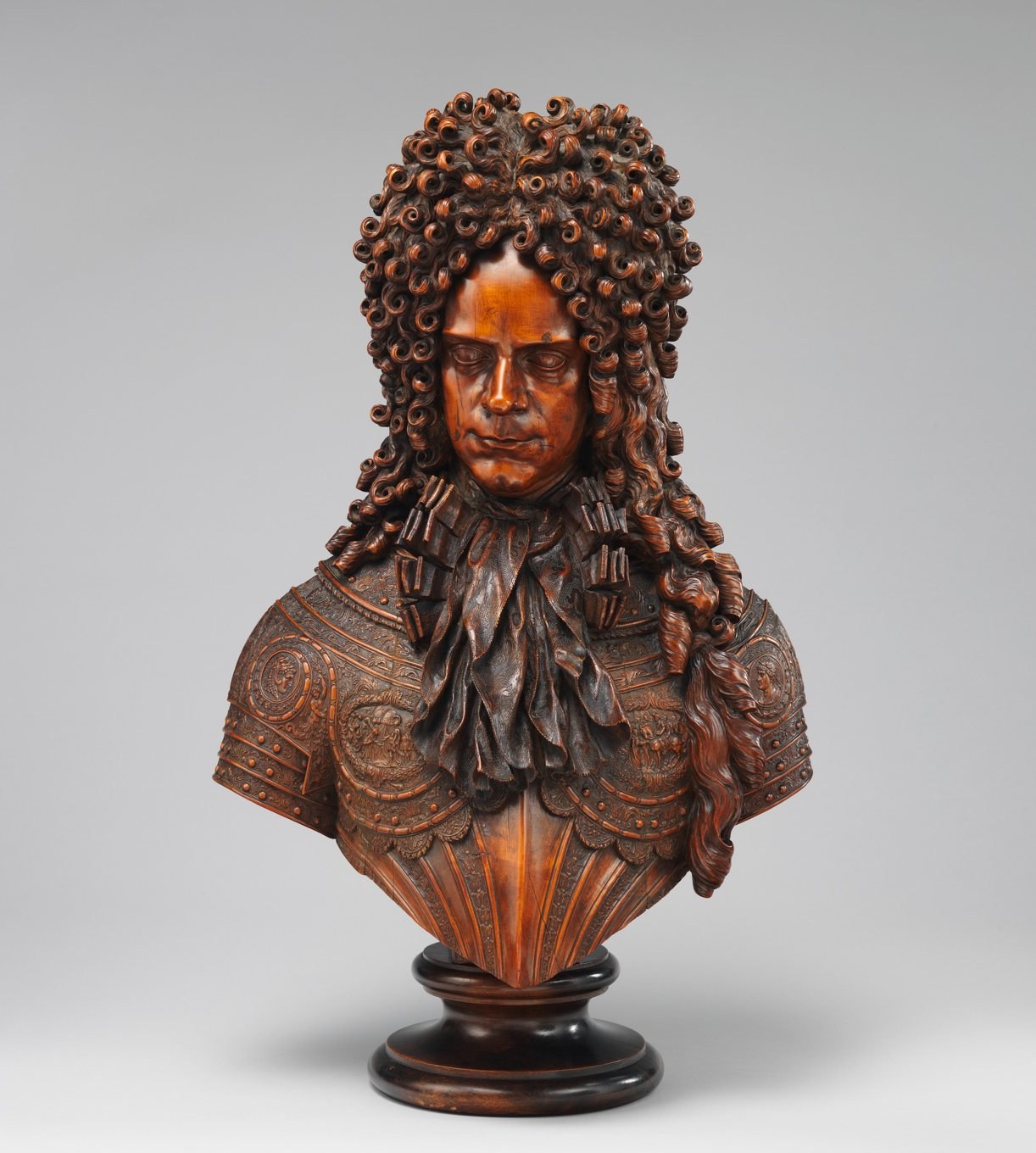
Carved wooden bust of Alexander Menshikov, Peter's closest ally, clean-shaven and in a Western wig, made shortly before 1704. The Metropolitan Museum of Art, CC0
The people who refused to shave were, above all, the Old Believers, the religious dissenters who had already broken with the official Church over earlier reforms and who regarded Peter as something close to the Antichrist. For them the beard tax was one more proof. Many paid the double rates Peter later imposed on them; others moved to the forests of the north and the Urals, where the tax collectors did not go. Merchants, who could afford it, often paid up too, and the barber chasing a bearded merchant became a stock scene in the cheap woodcut prints of the day.
The nobility, by contrast, shaved almost at once. Within a generation a bearded nobleman in St Petersburg looked as odd as a clean-shaven one had in Moscow in 1690. Peter had also ordered Western dress, shortened coats and, from January 1700, a calendar that counted years from the birth of Christ instead of the creation of the world, so the beard was one piece of a larger wardrobe change.
The tax outlives the tsar
Peter died in 1725. The tax did not. It was reaffirmed under his successors, who found it a convenient small revenue and an easy marker of loyalty, and it was not abolished until 1772, under Catherine the Great, who had other ways of telling who was on her side. By then nobody in the governing class had worn a beard for seventy years.
The beard came back in the nineteenth century, when the Slavophiles made it a patriotic statement again, and Alexander III, in the 1880s, was the first tsar since Peter's father to wear a full one, and nobody thought to tax it.
A country that spent seventy-four years charging men for their chins now has, as far as my unscientific observation goes, no shortage of beards on the streets of Moscow and no copper tokens at all.
Enjoyed this story?Get a new one every day on social.