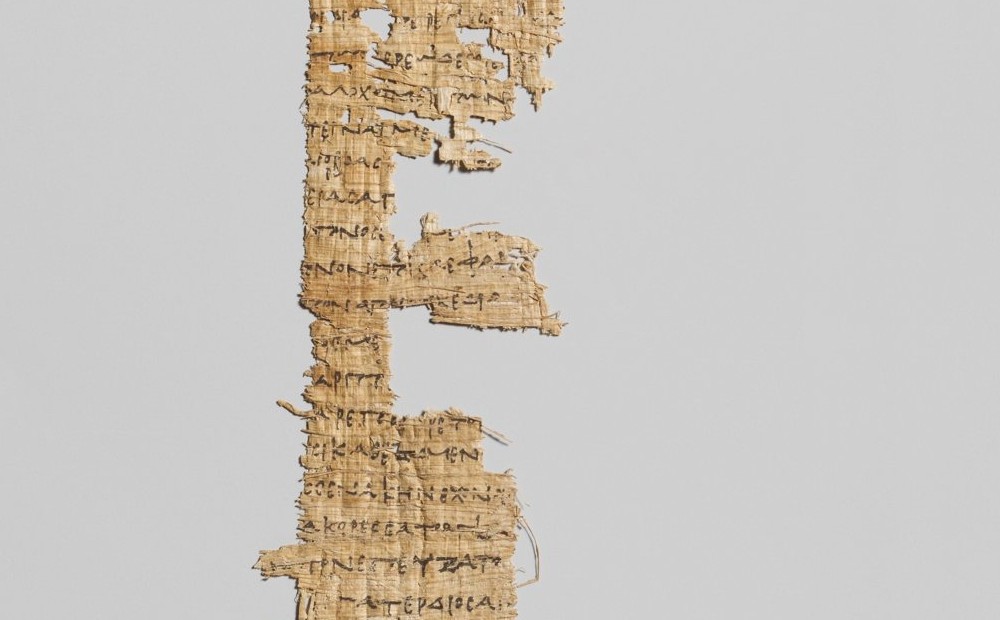
Photo: Papyrus fragment with lines from Homer's Odyssey (about 285 to 250 BC), The Metropolitan Museum of Art, CC0
"Someone, I tell you, will remember us, even in another time." That line of Sappho has come down to us in the most literal sense possible: a single sentence quoted by a Greek grammarian centuries after her death to illustrate a point about dialect. The poem it belonged to is gone. We have the boast and nothing it was attached to.
When the Swedish Academy gave the Nobel Prize in Literature to Anne Carson on 8 October, the citation spoke of her "playful dialogue with the classical tradition". For most readers that dialogue has one address: If Not, Winter, her 2002 translation of everything that survives of Sappho, with square brackets printed wherever the papyrus is torn. It taught a generation to read the holes as part of the poem. How the holes got there is an older, stranger and dirtier story than most of those readers know.
Nine books on a shelf in Alexandria
Sappho lived on Lesbos, in or near Mytilene, around 600 BC. Almost everything else said about her life is later gossip, including the exile to Sicily (possible), the brother who spent a fortune on an Egyptian courtesan (attested, oddly, by Herodotus) and the leap from a cliff for love of a ferryman (invented, probably by comic playwrights). What is certain is that the Greeks ranked her with Homer. An epigram attributed to Plato calls her the tenth Muse.
The scholars of the Library of Alexandria collected her songs into nine books, sorted mostly by metre. The first book alone ran to some 1,320 lines, and a reasonable guess at the whole is around 10,000. What we have today is roughly 650 lines, a great many of them single words. Only one poem is complete, the hymn to Aphrodite, and we have it because a critic named Dionysius of Halicarnassus copied the whole thing into an essay on prose style in the first century BC. The second-best preserved, the poem with the man sitting opposite a woman and the speaker's tongue breaking, survives because the author of a treatise on the sublime quoted it to show how physical symptoms can be stacked. If ancient critics had been less fond of long quotations we would have almost nothing.
What actually happened to the rest
The usual villain is the Church. A story that Pope Gregory VII had her books burned in 1073 turns up in the sixteenth century and has no source I have ever been able to trace before that. The truth is less dramatic and more thorough. Sappho wrote in the Aeolic dialect of Lesbos, which by the Roman period was a scholar's language, hard going for ordinary readers. When books moved from papyrus roll to bound parchment codex between the third and sixth centuries AD, somebody had to decide what was worth recopying, and difficult lyric poetry in an odd dialect mostly was not. Nobody burned Sappho, as far as the evidence goes. She was left on the shelf until the shelf rotted.
A few parchment copies were made. The Berlin parchment, bought in Egypt in the late nineteenth century, is a leaf from a sixth- or seventh-century book and carries three poems, one of them the farewell in which a departing girl is reminded of garlands and soft beds. That was nearly the last Sappho anyone copied until the printing press.
The rubbish heaps at Oxyrhynchus
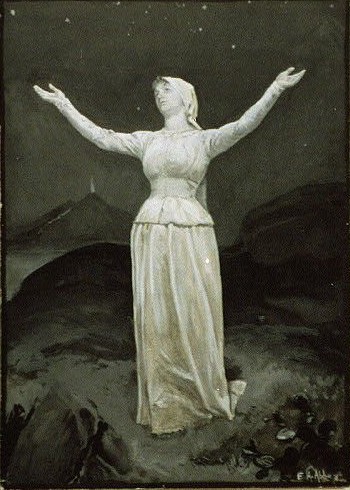
Pen and ink drawing of Sappho standing on a hillside at night with her arms raised to the stars, by the American illustrator Edwin Austin Abbey. Library of Congress Prints & Photographs Division, no known restrictions
The rest came out of the ground, and specifically out of the rubbish. In the winter of 1896 two young Oxford papyrologists, Bernard Grenfell and Arthur Hunt, began digging the mounds on the edge of el-Bahnasa, a village about 160 kilometres south-west of Cairo on the site of the Greco-Roman town of Oxyrhynchus. For centuries the townspeople had carted their waste paper out to the desert and dumped it, and the desert, being dry, had kept it. Grenfell and Hunt pulled out tax receipts, horoscopes, private letters, a lost gospel, and, mixed in with all of it, torn strips of literary rolls thrown away when they wore out.
Hunt was still publishing the Sappho pieces in 1914, in the tenth volume of the Oxyrhynchus series, and more have been identified since from the half-million fragments the two men brought back. They are not pretty. Papyrus tears along the fibres, so what survives is often the left-hand ends of a column of lines, or the middle of each line with both ends gone. This is where the brackets come from. A Sappho papyrus looks like a poem that has been fed to a shredder and partly reassembled, and an honest edition has to show how much is missing.
A poem inside a mummy
Oxyrhynchus was not the only grave. Egyptian embalmers of the Ptolemaic period made mummy cases out of a kind of papier-mâché called cartonnage, built up from scrap papyrus glued in layers and plastered over, and when the plaster is carefully dissolved the scrap comes out with its writing intact. In 2004 two scholars at the University of Cologne, Michael Gronewald and Robert Daniel, published a papyrus recovered this way that carried a poem about old age, Tithonus and the dawn goddess. Part of it was already known from an Oxyrhynchus strip. Together the two gave the first nearly complete new Sappho poem in a century, on a manuscript from the third century BC, the oldest copy of her work there is.
Carson, whose translation had come out two years earlier, published a version of the new poem almost at once.
The one that got complicated
Then in 2014 came the Brothers Poem. An Oxford papyrologist, Dirk Obbink, announced a papyrus in private hands carrying five stanzas in which the speaker frets about a brother's return by sea. It was front-page news. It also had no clear history. Obbink's accounts of where it came from changed over the following years, from mummy cartonnage to a named old collection sold at auction, and colleagues who checked the auction records could not make them fit. In 2021 the publisher Brill withdrew his chapter on the find, citing the "tainted" provenance. Related fragments sold to the American collection behind the Museum of the Bible were returned to Egypt in 2020. The main papyrus sat in storage at Christie's for years and has been reported as seized by police in 2022; who legally owns it is, as far as I can find, still unsettled. Most scholars accept the poem as Sappho's. Fewer are prepared to say how it reached London.
The translator who kept the holes
Carson is a classicist by training, which is easy to forget given the range of what she writes, and If Not, Winter is a scholar's book disguised as a slim volume of verse. She prints the Greek facing the English, numbers the fragments by the standard edition, and refuses to fill gaps. Where earlier translators smoothed the fragments into finished lyrics, or quietly dropped the hopeless ones, she gives you fragment 38 in full: "you burn me". Some fragments are a bracket, one word and another bracket, and she lets them stand.
My own view, for what it is worth, is that the brackets are why the book worked, and why a poet from a small island 2,600 years ago has readers who have never opened another Greek text. If we had all nine books she would be a classic, read in the way classics are read, which is to say dutifully. What we have instead asks the reader to supply the missing half, and people turn out to like being asked. She said someone would remember her in another time. She did not say they would have the whole poem.
Enjoyed this story?Get a new one every day on social.