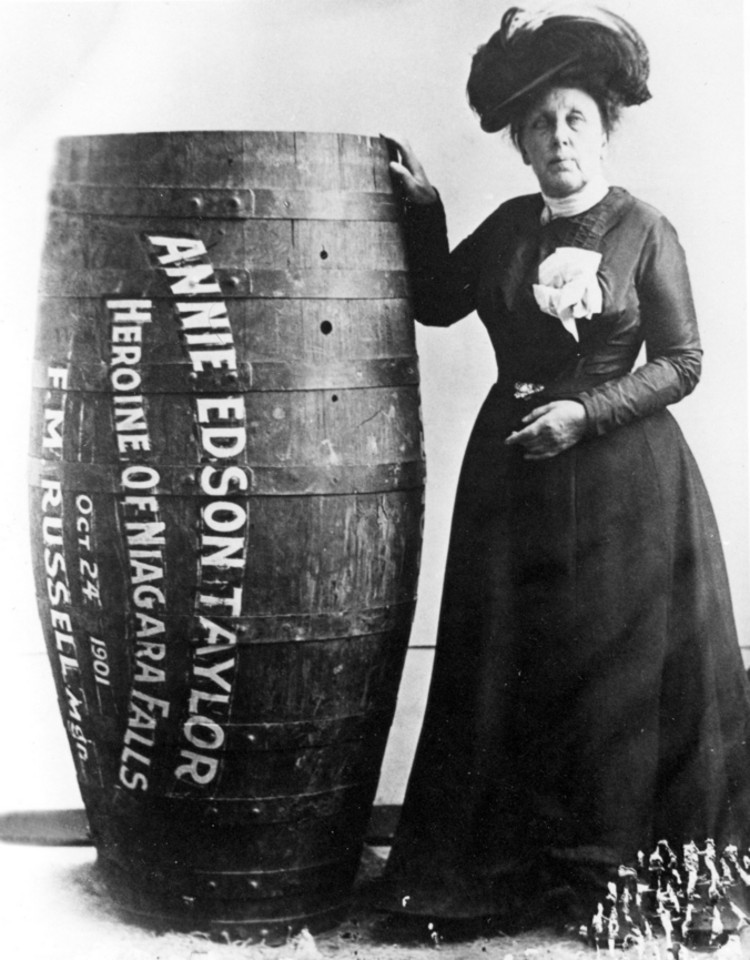
Francis J. Petrie Photograph Collection, 1901. Public domain, via Wikimedia Commons
The barrel was oak, bound with iron hoops, four and a half feet tall and about three feet across at the widest point. Inside it was a mattress, a leather harness, and, bolted to the bottom, a hundred-pound anvil so that it would float upright. On the outside somebody had painted the words "Queen of the Mist". On the afternoon of 24 October 1901 a 63-year-old widow from Bay City, Michigan, climbed in, had the lid screwed down, and was towed out into the Niagara River above the Horseshoe Falls.
Annie Edson Taylor had told the newspapers she was 43. She had, as far as anyone could tell, never done anything remotely like this before. Her reasoning, which she explained to anyone who asked, was that she was running out of money and this seemed like the quickest way to get some.
A woman with a lot of addresses
Taylor was born in Auburn, New York, in October 1838, one of eight children of a flour-mill owner who died when she was twelve. She trained as a teacher, married a man named David Taylor while still young, lost their only child in infancy and then lost her husband too (the usual story says he died in the Civil War, though the records I have seen are thin). From there her life became a long list of places. She taught school in Michigan, ran a dance studio in Bay City, tried Texas, tried Mexico City, tried Alabama and Tennessee, went back to Bay City, and gave music lessons.
She was, by her own account, used to a certain standard of living and had no intention of ending up in a poorhouse. By 1901 she was in her sixties with no family money and a dwindling amount of her own. That summer she read about the Pan-American Exposition in Buffalo, twenty miles from the falls, which was drawing enormous crowds (it is remembered now mostly as the place where President McKinley was shot, in September). A person who did something spectacular at Niagara that autumn, she reasoned, could charge admission to tell the story for the rest of her life.
Nobody had ever gone over the falls in a barrel. Several people had gone through the rapids below the falls in barrels, and a few had died doing it. Going over the top, a drop of about 170 feet onto rocks, was generally considered to be a way of killing yourself.
Testing it on a cat
Taylor designed the barrel herself, had a cooper in Bay City build it, shipped it to the falls and hired a promoter named Frank Russell as her manager. Two days before her own attempt, on 19 October, the barrel went over the Horseshoe Falls with a domestic cat inside as a test. Reports differ on the state of the cat afterwards. Some papers printed that it had died; Taylor was later photographed holding what she said was the same cat, apparently in reasonable health, and the photograph is the better evidence. Either way the barrel came through intact, which was the point.
On the 24th, which was her birthday, a crowd gathered on both banks. Taylor was rowed out from Grass Island on the American side to a point above the Canadian falls, got into the barrel in a long black dress, and had the lid fastened. A bicycle pump was used to put extra air in through a hole, which was then plugged with a cork. At about four in the afternoon the rowboat cut her loose.
Seventeen minutes
The barrel drifted, picked up speed in the rapids, and went over the edge of the Horseshoe Falls a little after 4:30. Spectators saw it vanish into the spray and then bob up, still upright, in the pool below. It took the rescue boat around seventeen minutes to get a line on it and tow it to the Canadian shore, and some time more to get the lid off.
Taylor climbed out dazed, with a cut on her head where she had struck the barrel's rim, and otherwise unhurt. She had been shut inside it for the better part of an hour. Her first recorded words, to the reporters pressing round, were that nobody ought ever to do that again. She repeated the point for the rest of her life in increasingly strong terms, and the version that is usually quoted has her saying she would rather walk up to the mouth of a cannon and be blown to pieces than go over the falls a second time.
She was the first person to go over Niagara Falls in any sort of container and live. A hundred and twenty-five years later she is still the oldest.
Where the money went
The money did not come. Taylor's plan had depended on a lecture tour and on exhibiting the barrel, and the barrel was the first thing to go. Frank Russell, her manager, took it on the road without her and eventually disappeared with it. She spent what savings she had on private detectives trying to get it back, and never did. A second manager did the same with a replacement.
She tried the lecture circuit anyway and found that audiences did not much want to hear a sixty-year-old woman talk about her finances. She tried writing a memoir. For most of the next twenty years she could be found at a stand near the falls on the New York side, beside a replica barrel, selling signed photographs of herself and copies of her story to tourists for a few cents each. Later she tried clairvoyance and a "magnetic therapy" practice. By the end she was going blind.
She died on 29 April 1921 in the Niagara County infirmary at Lockport, which was precisely the kind of institution she had gone over the falls to avoid. She was 82. The people of Niagara Falls paid for her burial in Oakwood Cemetery, in a section that came to be known as Stunters' Rest.
The second man, and the orange peel
Her record for being first could not be taken, but ten years later, in 1911, an Englishman named Bobby Leach became the second person to survive the drop, in a steel barrel. He broke both kneecaps and his jaw and spent six months in hospital. He then spent fifteen years touring as a celebrity daredevil, which was exactly the career Taylor had wanted, and in 1926, while on a tour of New Zealand, he slipped on a piece of orange peel in the street and hurt his leg so badly that it had to be amputated. He died of the complications. (I have read that sentence several times and it does not get any less absurd.)
Going over the falls is now illegal on both sides of the border, with fines running into the thousands of dollars. Somewhere around sixteen people have done it deliberately since 1901, in barrels, kayaks, a jet ski, an inflatable ball and, in one case in 2003, nothing at all. A little over half of them survived. Several of the survivors said afterwards that it had not been worth it.
A birthday she lied about
What stays with me about Annie Taylor is not the barrel. It is the twenty years that came after it, in which a woman who had done something nobody on earth had done sat on a folding chair near the falls selling postcards of herself and watching other people make money out of the spectacle. She lied about her age to the press because she thought a woman of 63 would not be taken seriously as a daredevil. As it turned out, the public did not take her seriously at 43 either.
The barrel was never found. The cat, as far as I can tell, was never heard of again.
Enjoyed this story?Get a new one every day on social.