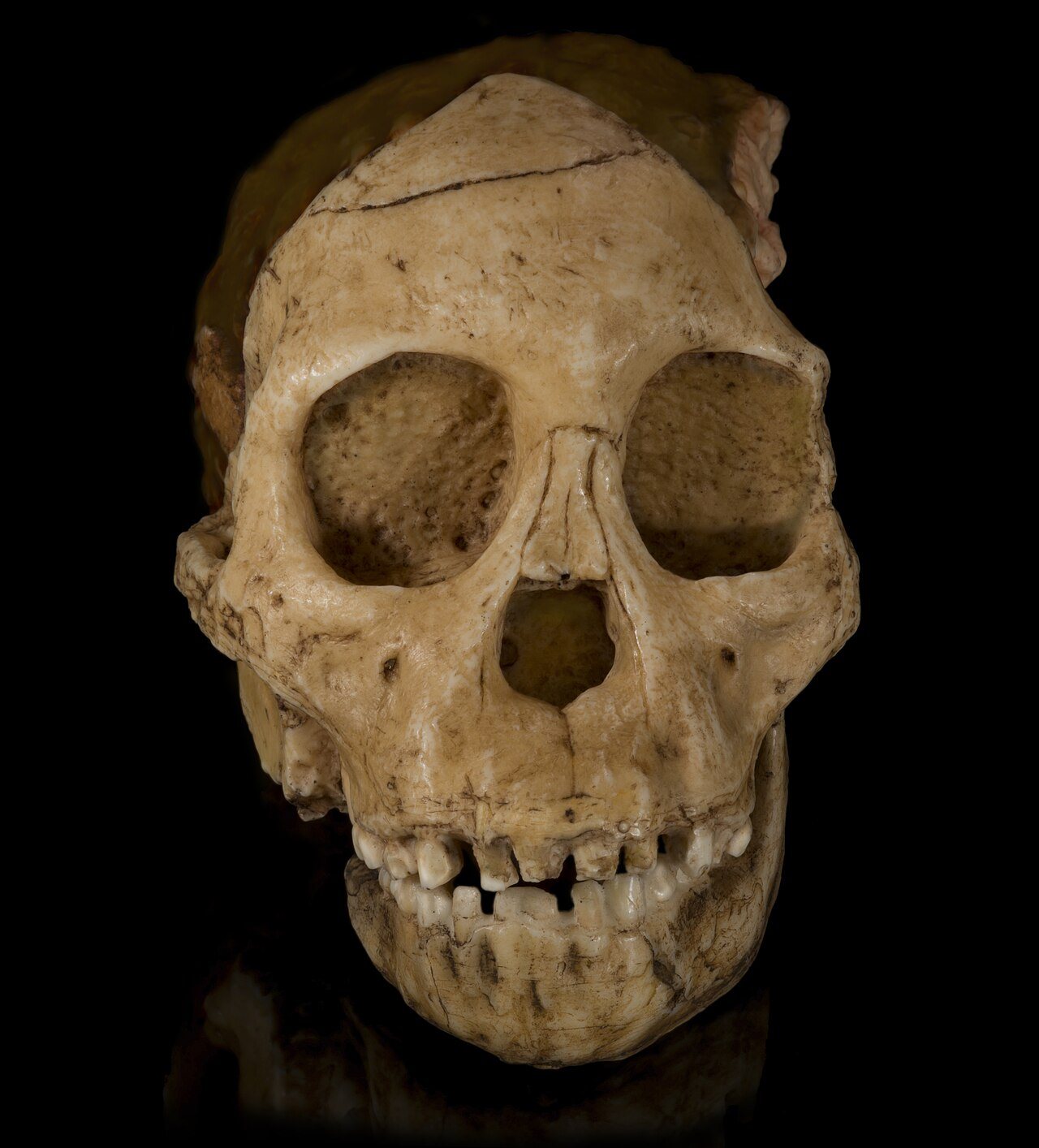
Photo: Didier Descouens, cast of the Taung Child, CC BY-SA 3.0, via Wikimedia Commons
A study published this week moves the Taung Child back in time again. The team led by Gabriele Macho of the Vrije Universiteit Brussel puts the little skull at between 2.96 and 3.03 million years old, working from the growth of its teeth and brain and from fossil pollen that points to a wetter, more wooded landscape than the dry country around Taung today. As recently as 2024, another study had it at about 2.58 million. The new paper also suggests that several kinds of early human relative were living in the region at the same time, which would make the old family tree look more like a thicket.
That is a lot of attention for a fossil that the leading anatomists of the 1920s dismissed as a baby ape. It took them about twenty years to change their minds, and most of that delay came from a skull in England that turned out to be fake.
Two boxes from a lime quarry
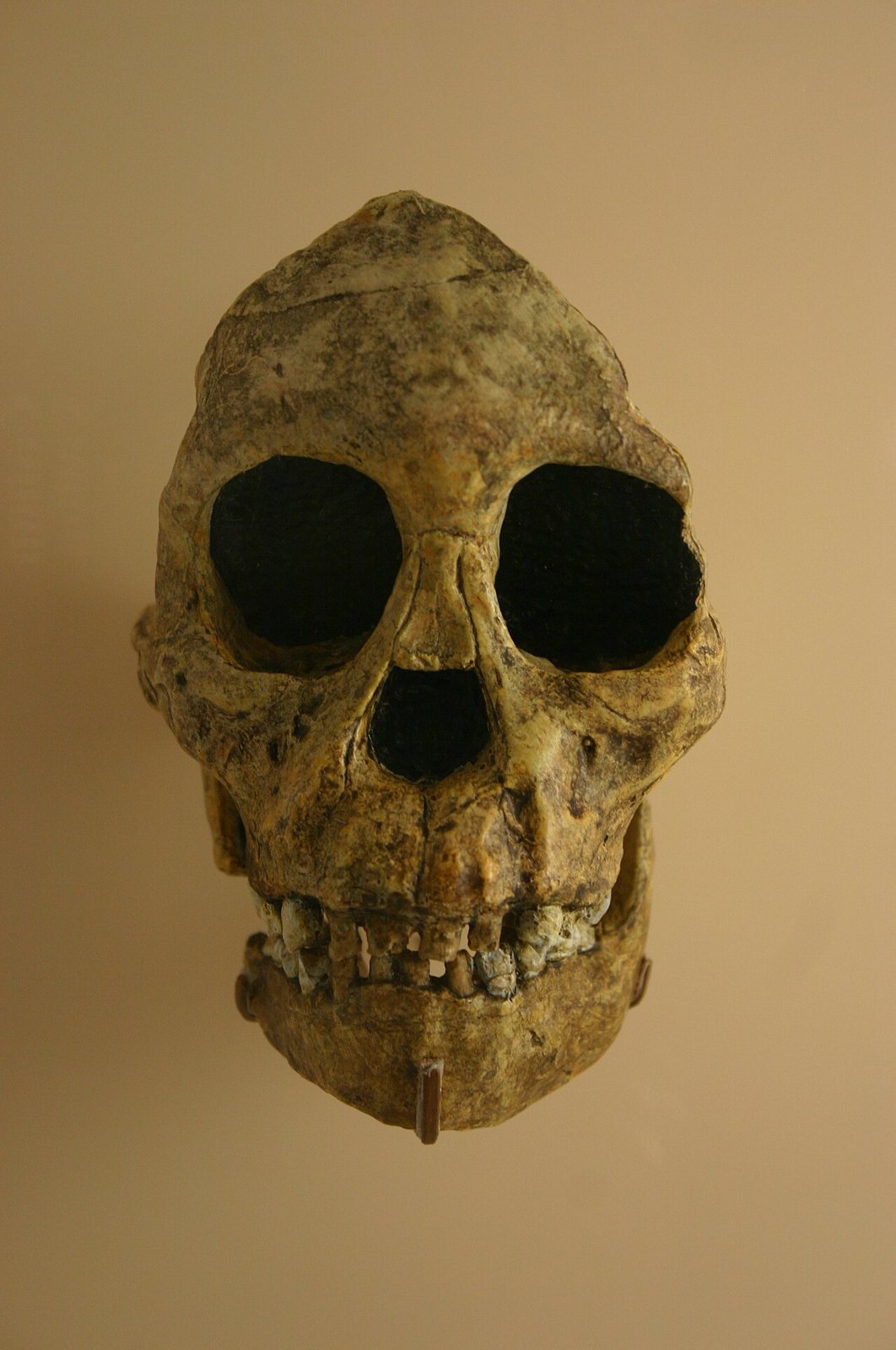
A museum display of an Australopithecus africanus skull, which the photographer titled 'Child with eagle talon marks in eye sockets'. Photo: Ryan Somma, CC BY-SA 2.0, via Wikimedia Commons
The story starts with a baboon skull on a mantelpiece. Josephine Salmons, a student and demonstrator in anatomy at the University of the Witwatersrand in Johannesburg, saw it at the home of a friend, Pat Izod, whose father was connected with the Buxton limeworks near Taung, a few hundred kilometres to the south-west. She took it to her professor, a young Australian called Raymond Dart. Dart asked the quarry to send him anything else that turned up.
At the quarry, a worker named M. de Bruyn had been putting aside fossils as the blasting exposed them, and he had noticed that some of them did not look like baboons. The geologist Robert Young crated a batch and sent it by train to Johannesburg. It reached Dart in late November 1924.
Dart's own version, which he told for the rest of his life, has the boxes arriving at his house just as he was dressing to be best man at a wedding there. He opened them in his collar and tails, found a natural stone cast of a brain, and then found the piece of rock it fitted into, which held a face. The groom is supposed to have come and dragged him away. I have no reason to doubt the wedding, though it is the sort of scene a man improves with each telling.
Knitting needles and a paper in Nature
The face was locked in hard limestone breccia. Dart worked it free over the following weeks, partly, the legend goes, with his wife Dora's steel knitting needles. By his account it came out a few days before Christmas. What he had was a child, with a full set of milk teeth and its first permanent molars just coming through, and a few features that bothered him in the best way. The face was short. The opening at the base of the skull, where the spinal cord leaves it, sat further forward than in an ape, which suggested to him that the creature had walked upright.
He wrote it up fast. His paper appeared in Nature on 7 February 1925 under the title "Australopithecus africanus: The Man-Ape of South Africa." He was 32.
London says no
The reply from London was polite and crushing. Sir Arthur Keith, the most influential anatomist in Britain, thought it was a young ape, probably related to the chimpanzee or the gorilla. Others complained that juveniles were hard to judge, which was fair, and that the name mixed Latin and Greek, which was petty. There was a good deal of the second kind of objection.
There were two bigger problems. One was geography: the expected cradle of humanity was Asia, where Eugène Dubois had found his Java fossils in the 1890s. The other was Piltdown. Since 1912 the British establishment had had its own "earliest Englishman," a skull from a gravel pit in Sussex with a large human braincase and an ape-like jaw. If Piltdown was right, the brain had grown big first and the face had followed. The Taung Child had a small brain and a near-human face and teeth. They could not both be ancestors, and London had already chosen.
In 1931 Dart took the skull to London to make his case at the Zoological Society, and it fell flat. That trip also gave us the best scene in the whole affair. Dora was carrying the fossil, and after a dinner with Grafton Elliot Smith she left it in a taxi. The driver handed it in to the police, and she and Elliot Smith collected it in the small hours of the morning. That, at least, is how the history kept at the Taung site tells it.
The long way round to being right
What changed opinion was more fossils. Robert Broom, a Scottish doctor and palaeontologist who had backed Dart from the start, began finding adult australopiths at Sterkfontein and other caves near Johannesburg from 1936. In 1947 Wilfrid Le Gros Clark of Oxford went to see them and came home convinced, and Keith conceded in print that Dart had been right. Six years later, in 1953, Piltdown was shown to be a forgery made from a medieval human skull and an orangutan jaw, stained to look old. Nobody has ever proved who made it.
In 2006 Lee Berger of Wits published a study arguing that the Taung Child had been killed by a large eagle, on the evidence of damage to the floors of its eye sockets similar to that made by crowned eagles on monkeys today. That would make the most famous child in human evolution, quite possibly, the leftovers of a bird's lunch.
Who else was there
The new date matters because of what it places the Taung Child next to. At three million years it sits much closer in time to Little Foot at Sterkfontein, and far enough back that, if Macho's team is right, more than one kind of hominin was living in the same part of South Africa. Which of those lines, if any, led towards us is the question everyone in the field would like answered. The paper does not settle it, and I would be surprised if the next one does.
Enjoyed this story?Get a new one every day on social.