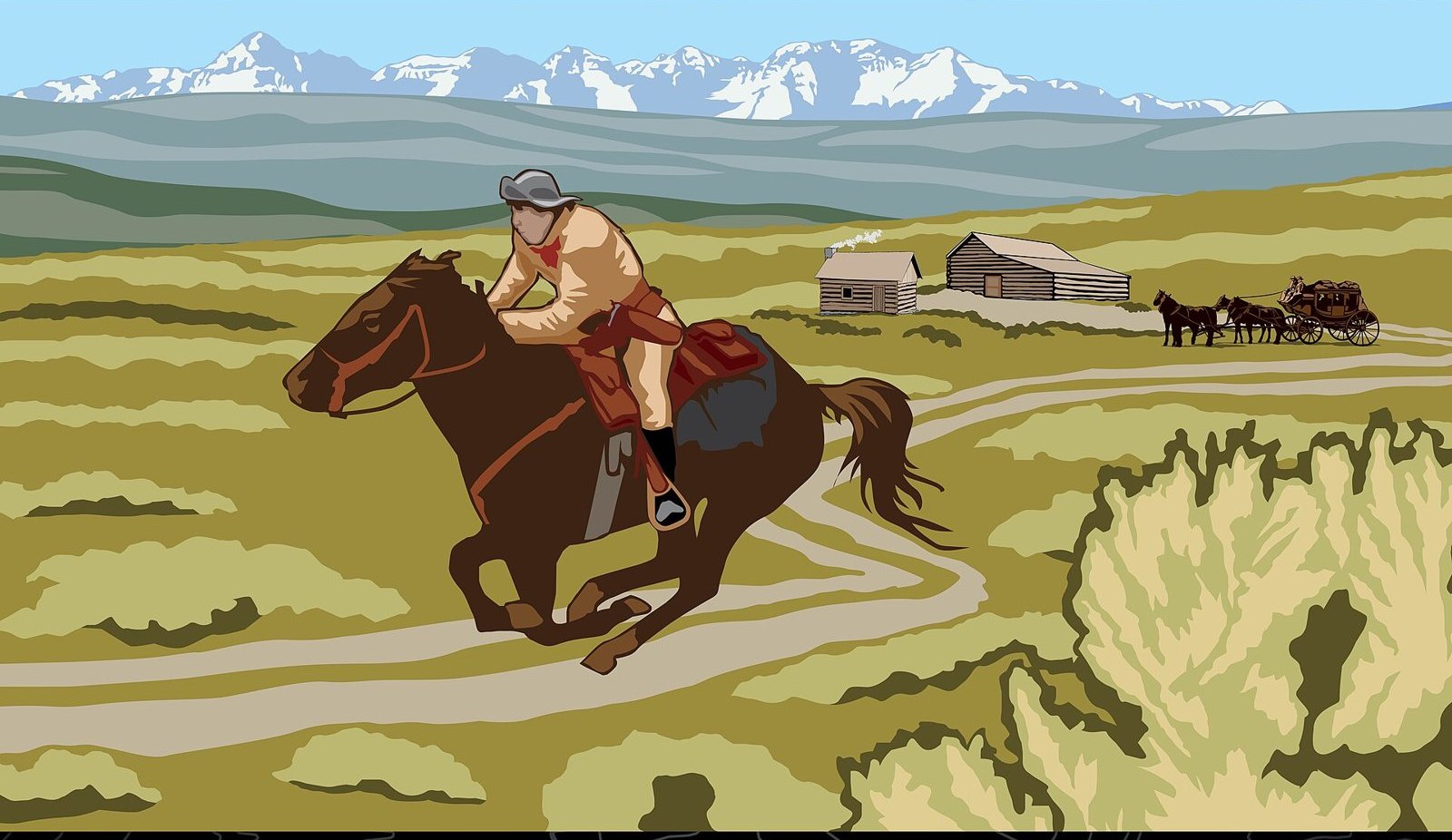
Illustration: Bureau of Land Management, public domain, via Wikimedia Commons
On the afternoon of 24 October 1861, in a telegraph office in Salt Lake City, a crew working east from California spliced its wire to the one a rival crew had strung west from Nebraska. For the first time, a message could travel from the Atlantic to the Pacific in minutes. The first official telegram went that evening from Stephen Field, chief justice of California, to President Lincoln, pledging the state's loyalty to the Union in a civil war then six months old.
Two days later the Pony Express announced it was closing. The most famous mail service in American history, the one that still turns up on stamps and in westerns, had lasted eighteen months and lost its owners a fortune. What finished it was not raiders or winter. It was a copper wire on wooden poles, and the men stringing it had been working the same trail as the riders all summer.
Ten days from Missouri to California
When the Pony Express opened on 3 April 1860, the fastest mail between the East and California took three to four weeks by stagecoach on a southern route through Texas, or longer by ship via Panama. The new service promised ten days. It worked by relay: around 150 stations spaced ten to fifteen miles apart across almost 2,000 miles from St. Joseph, Missouri, to Sacramento, with a fresh horse at each one and a fresh rider every 75 to 100 miles.
Riders were light, usually young, and paid well for the time, somewhere around a hundred dollars a month. They carried the mail in a leather mochila thrown over the saddle, with locked pockets at each corner, and were instructed to protect the mail before themselves. The best-remembered run came in March 1861, when Lincoln's inaugural address was carried from the telegraph terminus in Nebraska to California in seven days and seventeen hours.
The service belonged to the freighting firm Russell, Majors and Waddell, which wanted the government mail contract for the central route and needed to prove the trail through Salt Lake City could be used all year. It was a demonstration dressed up as a business, and an expensive one.
A business losing money from the first day
Postage on the Pony Express started at five dollars per half-ounce, roughly a week's wages for a labourer, and even at that price the company lost money on every letter. The route needed hundreds of horses, dozens of station keepers, and constant supplies hauled into some of the emptiest country in North America. Conflict with the Paiute in Nevada in the summer of 1860 destroyed several stations and halted service for weeks.
The founders had gambled on the mail contract. In March 1861 Congress awarded the central route to the Overland Mail Company instead, and the Pony Express became a subcontractor on a shrinking stretch of trail. By then William Russell was also entangled in a scandal over Indian trust bonds that had been improperly used as collateral for the company's debts. The firm was bankrupt in everything but name. The riders kept going anyway.
The wire that was already coming
The same month the Pony Express opened, Congress passed the Pacific Telegraph Act, offering a subsidy to whoever would string a line from the existing network in the Midwest to California. Hiram Sibley's Western Union took the contract and split the work. Edward Creighton built west from Omaha across Nebraska and Wyoming; James Gamble built east from Carson City, Nevada, across the Great Basin.
The construction was its own frontier epic. Poles had to be hauled hundreds of miles across treeless plains and desert. Wire and insulators came around Cape Horn by ship. Crews worked through the summer of 1861 at a pace of several miles a day, racing each other to reach Salt Lake City first. Creighton's crew won by a week, arriving on 17 October; Gamble's arrived on 24 October and the circuit was closed.
Through that summer the Pony Express carried messages across the gap between the two advancing ends of the wire, and the gap got shorter every week. By October the riders were covering a few hundred miles of desert between two telegraph offices. Everyone involved could see where it was heading.
Two days' notice
The closure was announced on 26 October 1861, though the last letters already in transit were delivered into November. There was no farewell run and no ceremony. The horses and stations were sold off or absorbed by the stage lines. Russell, Majors and Waddell dissolved amid lawsuits, and Alexander Majors, who had insisted every rider swear an oath against drinking and swearing, ended his life nearly penniless, remembered mainly thanks to a memoir sponsored by a former employee named William Cody, better known as Buffalo Bill.
In all, the Pony Express carried something under 35,000 pieces of mail and never made a dollar. It did do the one thing it was built to do. It proved the central route could be ridden in winter, and that route is roughly where the transcontinental railroad went eight years later.
From riders to Buffalo Bill's arena
The Pony Express owes its afterlife to showmanship. Buffalo Bill Cody, who claimed to have ridden for the service as a teenager, made a Pony Express relay a centrepiece of his Wild West show from 1883 onwards, performing it for audiences across America and Europe, including for Queen Victoria. By the time the last real riders were dying in the early twentieth century, the legend had outgrown the facts, and it has been retold in films, novels and television ever since.
The telegraph, by contrast, became invisible almost as soon as it was finished. Western Union's monopoly made it one of the first great American corporations. The line that killed the Pony Express carried news of Civil War battles to the West Coast the day they happened, and bound California to the Union at a moment when its loyalty was in question.
What is left of it
The telegraph had its own turn at being obsolete. The telephone overtook it, and Western Union sent its last telegram in 2006, which got a few nostalgic headlines and not much else. The copper that joined the coasts in 1861 has given way to fibre and satellites, and a message now crosses the continent in a few thousandths of a second. Nobody puts that on a stamp.
What survives of the Pony Express is the trail. Congress made it a National Historic Trail in 1992, and long stretches of it, through Nevada and Utah especially, look much as they did when a rider came through with the mochila bouncing behind the saddle and a telegraph crew somewhere behind him, raising another pole.
Enjoyed this story?Get a new one every day on social.