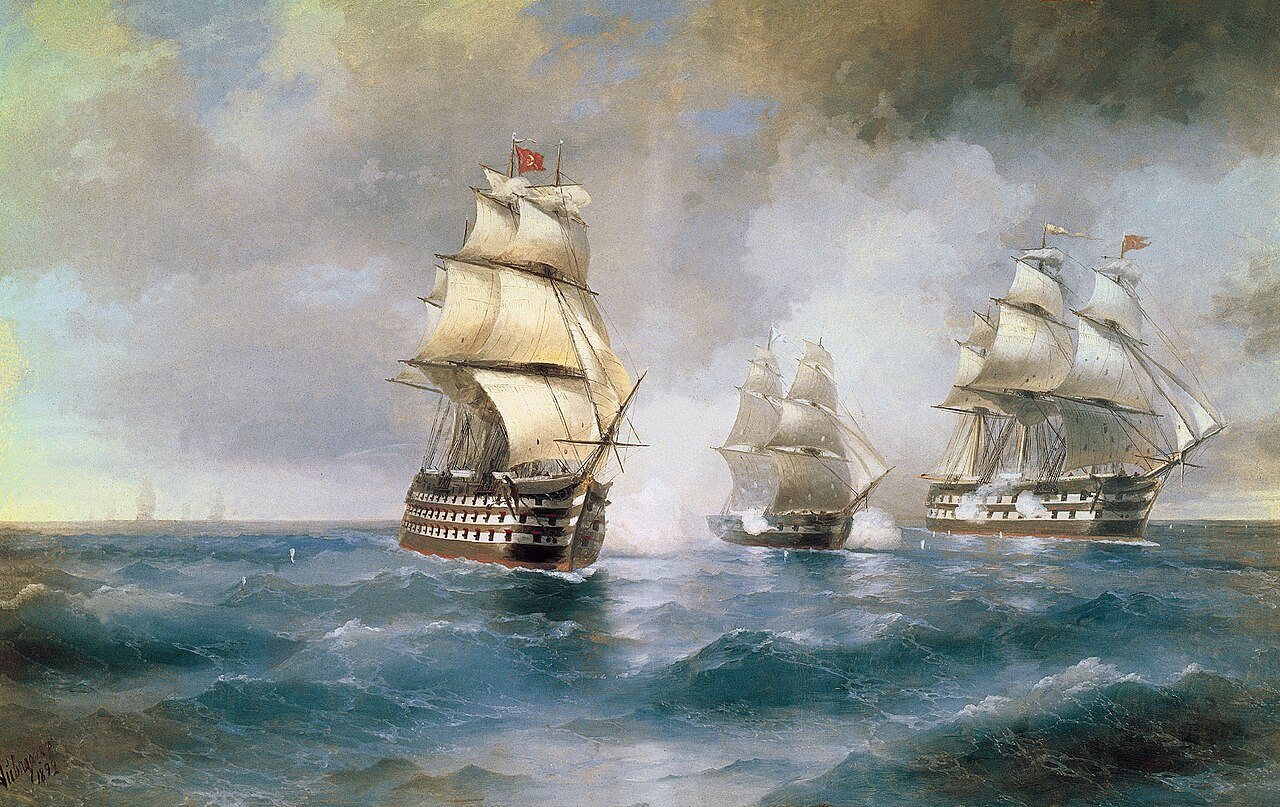
Ivan Aivazovsky, Brig Mercury Attacked by Two Turkish Ships (1892), public domain, via Wikimedia Commons
At dawn on 14 May 1829 (the old Russian calendar; 26 May by ours), three Russian ships cruising off the Anatolian coast east of the Bosporus saw sails on the horizon. There were a lot of them. It was the main Ottoman fleet, coming out to sea in the middle of a war, and the Russians did the sensible thing and ran.
Two of the three got away. The frigate Shtandart and the brig Orfey were fast. The third, the brig Mercury, was not, and by the early afternoon two Ottoman ships of the line had run her down: the three-decker Selimiye, usually listed with 110 guns, and the 74-gun Real Bey. Mercury carried 18.
That is the name the Russian navy gave, in 2021, to the corvette that Ukraine says it sank in the Libyan port of Benghazi on Sunday.
The council in the cabin
Mercury's commander was Lieutenant-Commander Alexander Kazarsky, a junior officer by the standards of the fight he was about to have. By custom, as the story is usually told, the youngest officer spoke first at a council of war, so that his seniors could not cow him. The story the navy later told, and repeated in every account I have read, is that the youngest, a navigator named Ivan Prokofiev, proposed fighting and then blowing the ship up rather than surrendering. The others agreed. A loaded pistol was left at the entrance to the powder magazine, for whichever officer was last standing.
The reason surrender was unthinkable had happened three days earlier. On 11 May the 44-gun frigate Raphael, caught by the same Ottoman fleet, had struck her colours without a fight. Her captain, Semyon Stroynikov, would be stripped of rank, and Tsar Nicholas I ordered that if Raphael was ever recaptured she should be burned. (She was burned, a quarter of a century later, at Sinop in 1853, when Admiral Nakhimov destroyed the Ottoman squadron in which she was still serving.) Kazarsky's officers knew all of this when they voted.
Shooting at the rigging
What followed was less a slugging match than a long piece of seamanship. A brig could not survive a full broadside from a three-decker, so Kazarsky spent the afternoon keeping Mercury out of the Ottoman ships' line of fire, using oars when the wind dropped and turning so that the big ships had to fire at an angle. The Russian gunners aimed high, at masts and rigging, because a ship of the line that cannot set sail cannot chase anything.
It worked, though not elegantly. Mercury took 22 holes in her hull and far more in her sails, according to the figures usually cited from Kazarsky's report. Four men were killed and six wounded. Kazarsky himself was hit in the head. But first Selimiye and then Real Bey lost enough spars and rigging that they could no longer keep up, and by evening the brig was limping away towards the Russian fleet. She found it the next day.
A name that had to stay at sea
Nicholas I was delighted, and he had reason to be after Raphael. Kazarsky was promoted to captain and given the Order of St George. Mercury was awarded a St George ensign, a rare honour for a ship. The tsar also ordered that the Black Sea Fleet should always have a ship called Mercury, or Memory of Mercury, so that the name would never leave the navy list. Several ships have carried it since.
The war itself did not last much longer. It had begun in the spring of 1828, in the bad blood left by the destruction of the Ottoman-Egyptian fleet at Navarino the previous October and by the Greek war of independence. Russian armies crossed the Balkans in the summer of 1829 and reached Adrianople (now Edirne), close enough to Constantinople to frighten everybody, and the Treaty of Adrianople that September gave Russia the mouths of the Danube and more of the Black Sea's eastern coast. In the long run Mercury's escape mattered far less than any of that. It is still the part Russians remember.
Kazarsky did not enjoy his fame for long. He died in Nikolaev in 1833, aged about 35, while inspecting naval supply offices. Rumours that he had been poisoned by officials whose accounts he was checking went round at once and have never quite gone away. I have never seen a source that settles it either way, and I would treat anyone who claims certainty with suspicion.
Aivazovsky's version
Most people who know the battle know it from paintings, chiefly those of Ivan Aivazovsky, the Crimean marine painter who returned to the subject in 1892, more than 60 years after the event. In his picture the brig sits small and dark between the two great Ottoman hulls, sails shot through, smoke everywhere. It is not a documentary record (Aivazovsky was a child of 11 when the battle was fought), but it is the version that went into Russian schoolbooks, and it is the one used at the top of this page.
From Retivy to Merkury
The ship hit at Benghazi was a Project 20380 corvette of the Steregushchiy class, built at the Severnaya Verf yard in St Petersburg. She was laid down in 2015 as Retivy, renamed Merkury in 2021, and commissioned in May 2023, at a time when the Black Sea Fleet badly needed new hulls. She displaces about 1,800 tonnes, many times the brig that gave her the name.
According to the eastern Libyan authorities, she had stopped at Benghazi on her way home to Russia to refuel and take on supplies. On Sunday something exploded against her hull. On Monday President Volodymyr Zelenskyy said Ukraine had done it, with seven Ukrainian-made naval drones, and called it "an exemplary Ukrainian operation." Ukraine's security service said the drones were launched from a mother ship. Kyiv also claimed a Ka-27 helicopter destroyed and a Russian cargo ship, the Angara, hit. None of that has been independently verified, and no casualty figures have been published. Pictures from the port show the corvette mostly underwater, with her bow above the surface.
The monument in Sevastopol
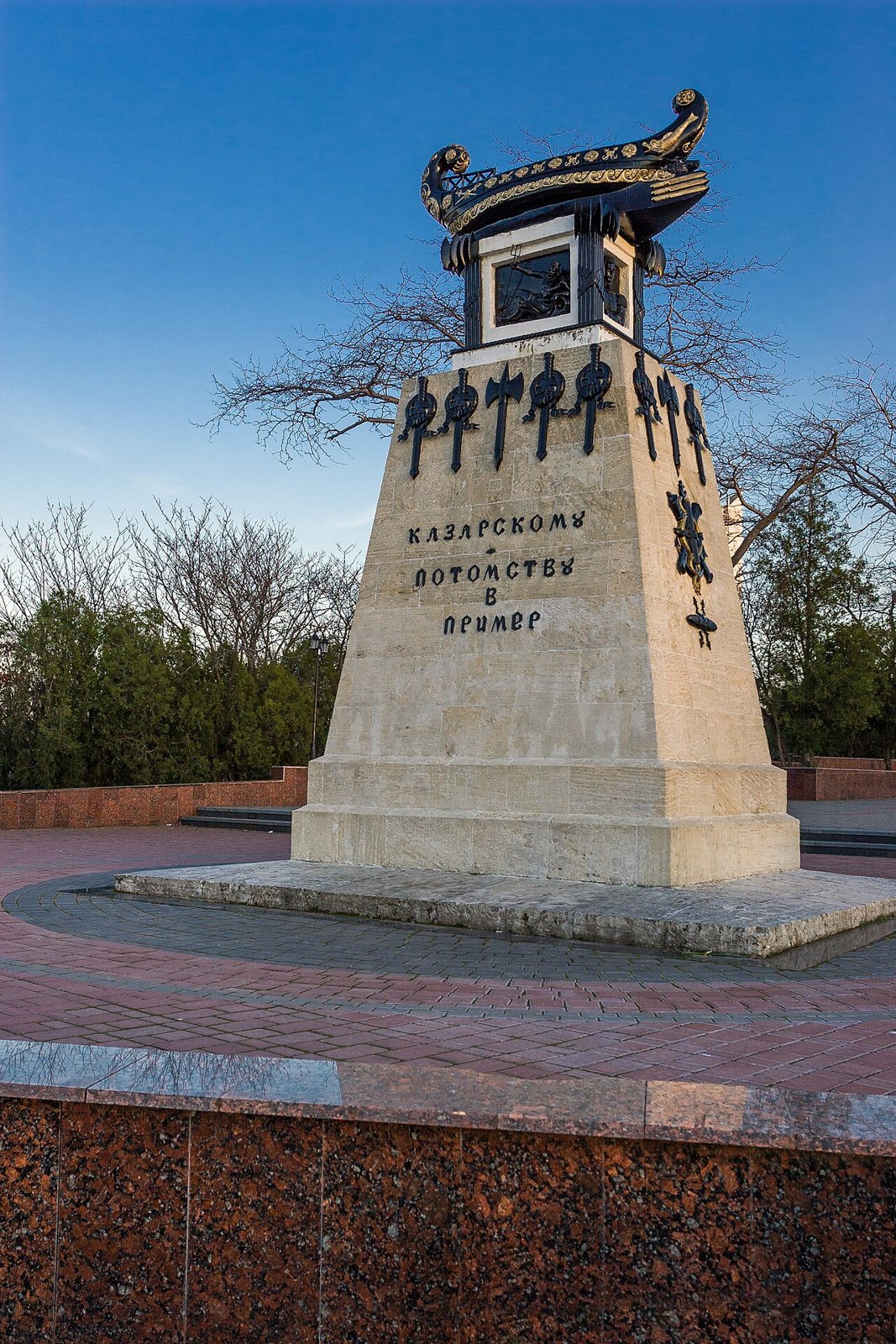
The Kazarsky monument in Sevastopol, with its bronze galley and the inscription "To Kazarsky. An example to posterity." Photo: GIC198, CC BY-SA 4.0, via Wikimedia Commons
Mercury's home port was Sevastopol, and the Black Sea Fleet is still there. On a hill above the harbour stands the Kazarsky monument, unveiled in 1839 and designed by the architect Alexander Bryullov: a tall stone pedestal with a bronze ancient galley on top. The inscription is four words in Russian, usually translated as "To Kazarsky. An example to posterity." It has come through the Crimean War, two world wars and Russia's annexation of Crimea in 2014, and it still looks out over the harbour where the Black Sea Fleet's remaining ships tie up.
Enjoyed this story?Get a new one every day on social.