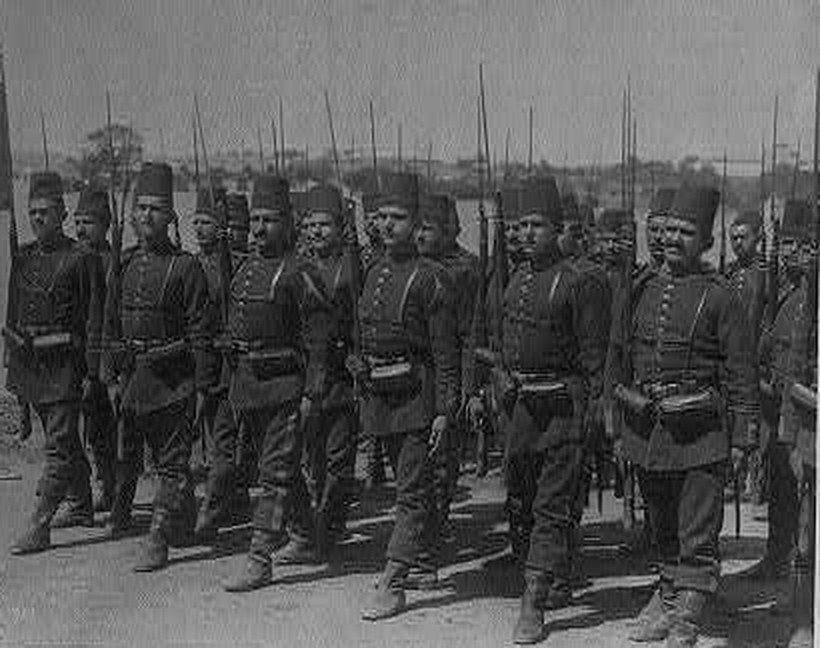
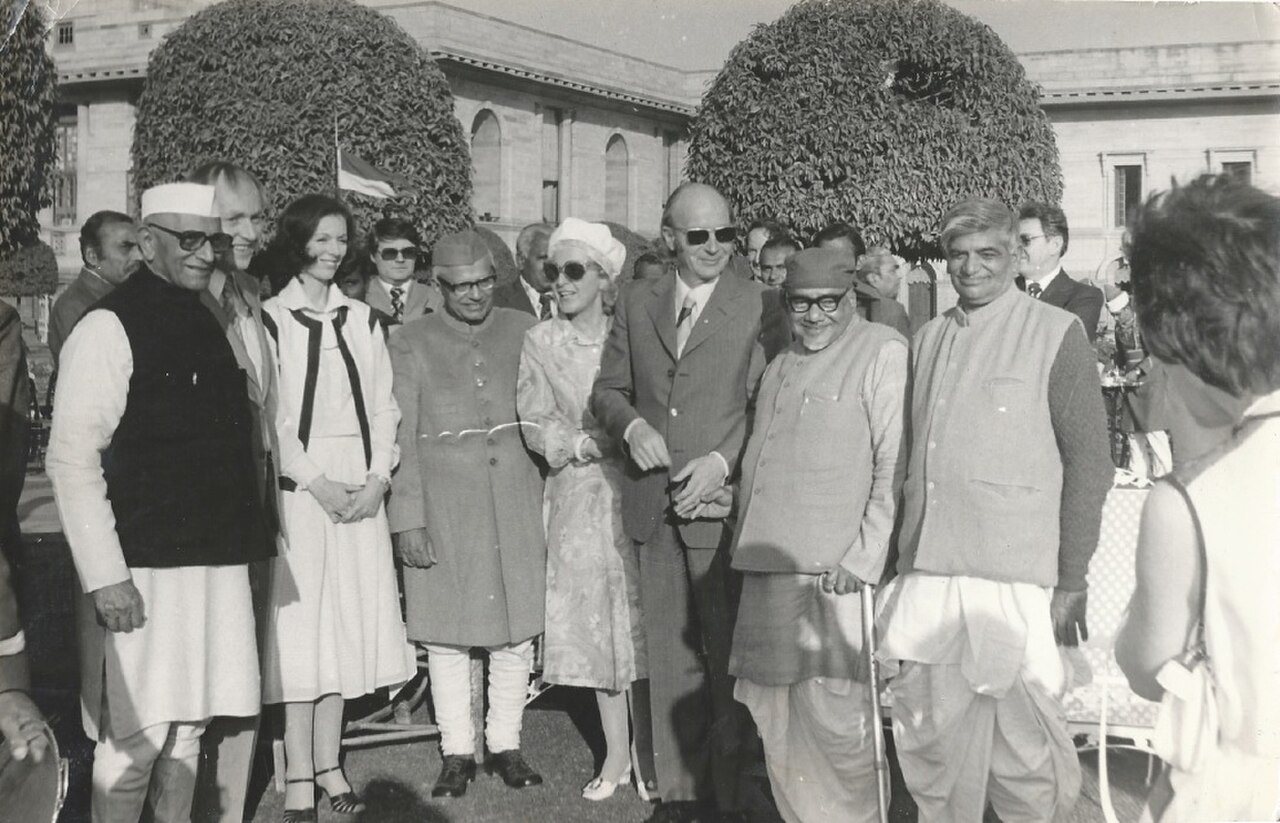
Photo: Soldiers of the First Infantry Regiment of the Ottoman Imperial Guard, Abdullah Frères, between 1880 and 1893, Library of Congress, no known restrictions
In August 1892 an elderly sheikh in Qatar stopped paying his taxes. Jassim bin Mohammed Al Thani was well into his sixties and had run the peninsula's affairs for years, and the taxes were owed to the Ottoman Empire, whose flag he had agreed to fly two decades earlier. Along with the money he gave up his Ottoman title, kaymakam, a sort of district governor. Then he moved out of Doha.
Seven months later his men fought an Ottoman column at a fort called Al Wajbah, about fifteen kilometres west of the town, and won. Qatar counts the battle as one of the founding events of the state. It is a slightly awkward thing to remember this week, because on Friday in Istanbul President Recep Tayyip Erdogan and Sheikh Tamim bin Hamad Al Thani, Jassim's descendant, signed a mutual defence pact.
A flag accepted in 1871
The Ottomans arrived in eastern Arabia in 1871, when Midhat Pasha, the governor in Baghdad, sent an expedition to take the Al-Hasa coast. For Jassim and his father, Mohammed bin Thani, the Ottoman flag was useful. Qatar was a small, poor coast of pearling towns, squeezed between the Al Khalifa of Bahrain, who claimed parts of it, and the rulers of Abu Dhabi to the south. A garrison in Doha and a title from Istanbul gave the Al Thani a large friend against both of them, and a counterweight to Britain, the other large power in the Gulf.
Jassim took the post of kaymakam in the 1870s and for some years the arrangement worked well enough for both sides.
Taxes, a rival and a customs house
It frayed in the 1880s. In 1882 Jassim wanted to take back Khor Al Udaid, an inlet in the south that Abu Dhabi held, and the Ottomans would not help him. In 1888 they encouraged a rival, Mohammed bin Abdul Wahab, who wanted Jassim's job. In 1890 Istanbul announced administrative reforms for the province: more officials, more troops at the fort in Doha (then called Al Bidda) and more tax. There was talk of a customs house, which in a pearling economy meant the empire reaching into the one business that paid.
Jassim's response, in the summer of 1892, was the resignation and the unpaid taxes. He was not declaring independence. He was refusing to be administered, which from Basra looked much the same.
Hafiz Pasha comes from Basra
The governor of Basra, Mehmed Hafiz Pasha, set out for Qatar that autumn with about 200 men and arrived in February 1893, with more troops promised from Kuwait. Jassim had already withdrawn inland, first to Al Daayen and then to the fort at Al Wajbah, where several Qatari tribes gathered around him.
Hafiz Pasha asked him to come in, disband his followers and swear loyalty. Jassim declined to come and sent his brother instead. That turned out to be a mistake. In March the governor seized the brother and somewhere between thirteen and sixteen tribal leaders and locked them aboard the Ottoman corvette Merrikh, anchored off Doha. Jassim offered 10,000 liras for their release. Hafiz Pasha refused, and sent troops toward Al Wajbah.
Seven hours at Al Wajbah
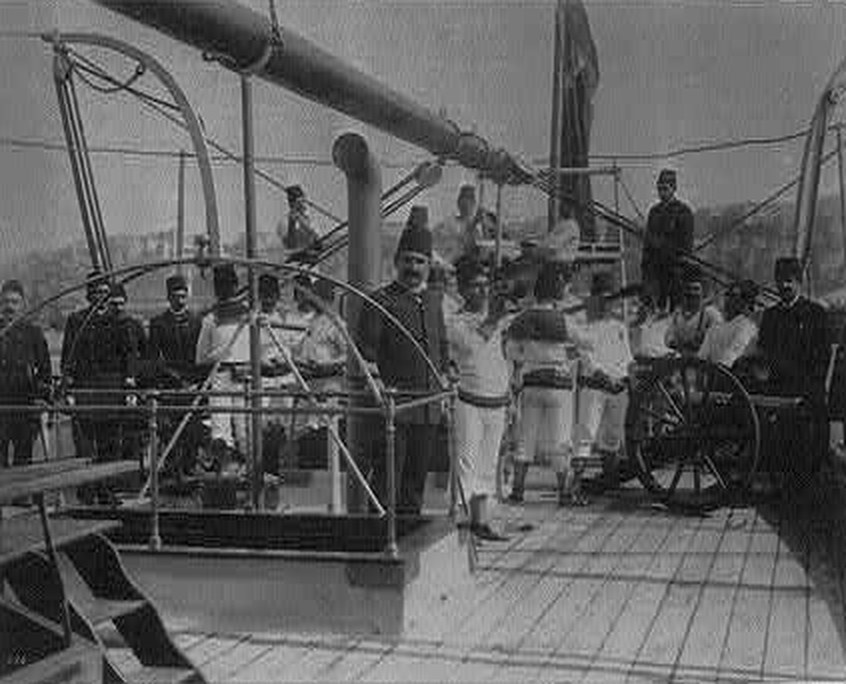
Ottoman sailors at gun drill aboard the ironclad corvette Necm-i Şevket, around 1880 to 1893; the prisoners of 1893 were held on a corvette of the same navy. Abdullah Frères, Library of Congress, no known restrictions
The battle was fought on 25 March 1893, the date Qatari sources give. An Ottoman column under an officer named Yusuf Effendi marched on the fort and was met by Qatari infantry and horsemen, said to number three or four thousand (that figure comes from accounts sympathetic to Jassim, and I would treat it as an upper limit). The fighting went on for about seven hours. Then the Ottomans fell back, first to a smaller fort at Shebaka, where they were raided again, and then all the way to Al Bidda.
Bedouin riders, meanwhile, were catching the messengers between Doha and the reinforcements in Kuwait, so Hafiz Pasha did not know whether help was coming and Kuwait did not know he needed it.
No water in the Doha fort
Back in Al Bidda, the garrison fired into the town and killed civilians, which did not help its position. Jassim's forces surrounded the fort and cut off its water. On that coast, in that heat, a garrison without water was not going to last long. Hafiz Pasha agreed to release Jassim's brother and the other prisoners from the Merrikh, and in return his cavalry was allowed to ride out overland to Hofuf, in Al-Hasa.
Nobody knows the casualties with any confidence. A British report written about a year later put Qatari losses at around 420, including women and children who died in the desert, and called that "probably an outside estimate." It put Ottoman losses at 40 to 100, and noted that both sides had reasons to shade their numbers.
A pardon, then a long goodbye
Istanbul's reaction was not what Hafiz Pasha would have wanted. Sultan Abdul Hamid II, worried about a wider revolt in Arabia, pardoned Jassim in full and removed Hafiz Pasha as governor of Basra. A small Ottoman garrison stayed in Doha for another twenty years, increasingly beside the point. In 1913 the Ottomans agreed to give up their claim to Qatar in a convention with Britain that was never ratified, and in 1915, with the empire at war with Britain, the last soldiers left the fort.
Jassim died in July 1913. Qatar's national day, 18 December, marks his succession in 1878, not the battle, but Al Wajbah fort has been restored and is open to visitors, and in Qatar the battle is remembered as the point at which the Al Thani made themselves hard to remove.
Friday in Istanbul
The pact signed on Friday commits the two countries to a joint response if either is attacked, along with joint exercises, defence industry projects and training. Erdogan said it would "add a new dimension" to the two countries' ties. It sits on top of a 2014 agreement under which Turkey set up a military base in Qatar. I suspect the most telling date in the relationship is not 1893 but the summer of 2017, when Saudi Arabia, the UAE, Bahrain and Egypt cut off Qatar and listed the closure of the Turkish base among their demands. Ankara's answer that June was to fly in more soldiers and armoured vehicles.
Enjoyed this story?Get a new one every day on social.