Kim Tu-bong, 1948, public domain, via Wikimedia Commons
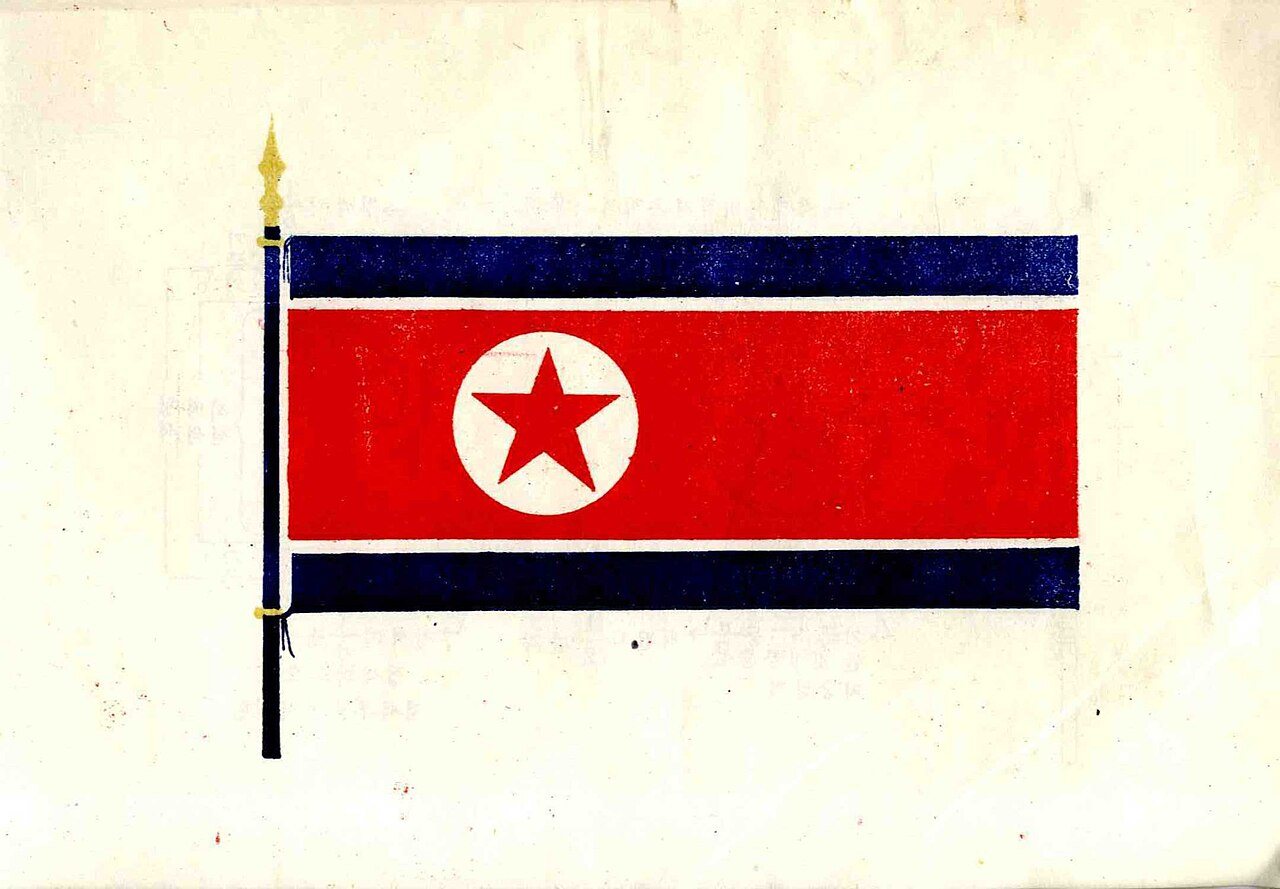
"The ratio of the width to the length is 1:2." That sentence sat in North Korea's constitution, in one form or another, from 1948 until very recently. This week South Korea's Yonhap news agency noticed that it had gone. The revised constitution posted on Naenara, the state's official website, now sets the flag at 1 to 1.65 in Article 166. The stripes, the red star and the white disc are where they always were. The flag is just a little less long for its height than it was, and this is the first time its shape has changed since the state was founded.
Analysts in Seoul have read it as part of Kim Jong Un's habit of putting his own stamp on the symbols he inherited. That may be so. The more interesting thing, to me, is that the proportions were argued over once before, in 1948, and the man who won that argument was also the man who had lost the bigger one.
The flag the north flew first
When Japanese rule ended in August 1945, Koreans on both sides of the 38th parallel ran up the same flag. The taegukgi, the white flag with the red and blue circle and four black trigrams, had been adopted by the Joseon court in 1883 and used by the Korean Empire until Japan annexed the peninsula in 1910. Under the occupation it became the banner of the independence movement. It was the obvious flag for a free Korea, and for the first two years of Soviet occupation it flew in Pyongyang as well as in Seoul.
The man who most wanted it to stay was Kim Tu-bong. He was a scholar of the Korean language, a student of the great grammarian Ju Si-gyeong, who had spent much of his life in exile in China and come home in 1945 as the leader of the returning "Yan'an" communists. He was more than twenty years older than Kim Il Sung and, in 1946, chairman of the new Workers' Party of North Korea, with Kim Il Sung as his deputy.
A design that arrived in Russian
The official story today is that Kim Il Sung called for a new flag and emblem in January 1948, that a team of artists drew up proposals, and that in February he ordered changes to the ratio, the star and the position of the disc. An earlier official version gave the credit to an artist, Kim Chu-gyong, who wrote that the order came in November 1947 and who was given an award for the flag and the emblem in 1978.
The other account comes from Pak Il, a Soviet Korean who worked as an interpreter for the Soviet 25th Army. He said that in 1947 Major General Nikolai Lebedev called in Kim Tu-bong to talk about the taegukgi. Kim defended it; Lebedev waved the arguments away. Some months later, Pak said, a finished design arrived at the army's 7th Department written in Russian, and he was the one who translated it. Another Soviet Korean, Chŏng Sangjin, later backed his story. Neither man was a neutral witness, and historians treat their accounts with some care, but nothing in the timing contradicts them.
The argument in the assembly
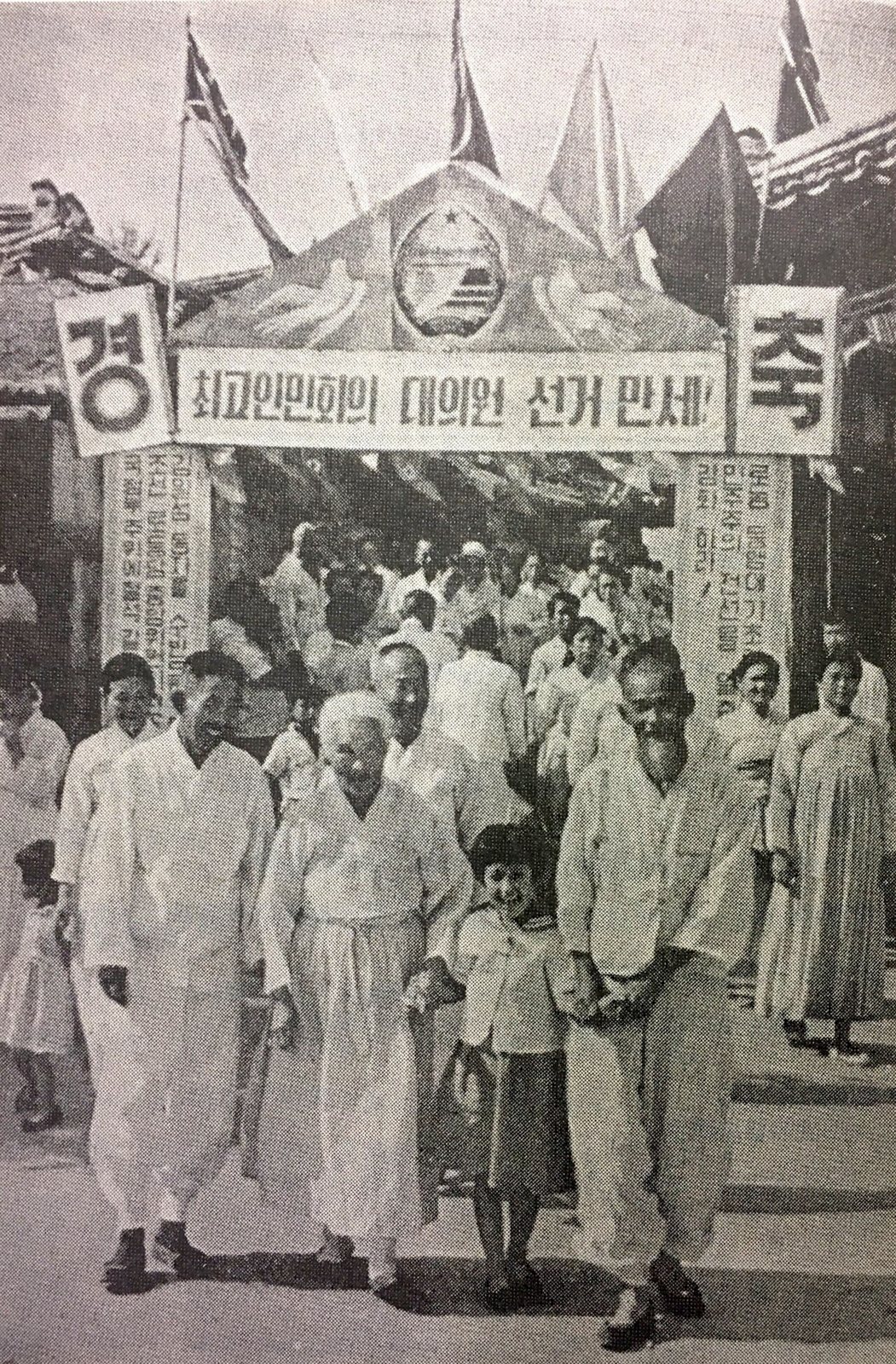
Voters leave a polling station in North Korea during the 1948 election, under a banner decorated with the new state emblem. Photographer unknown, public domain, via Wikimedia Commons
The new design went into the draft provisional constitution, and in February 1948 it came before the People's Assembly of North Korea, with Kim Tu-bong in the chair. It fell to him to read out the flag article. At least one member, Chong Chae-yong, spoke up for the taegukgi. Another, An Mong-yong, accepted the new flag but proposed that it be made 2 by 3, the shape of most flags in the world (and, as it happens, the shape of the taegukgi). Kim Tu-bong replied that the existing dimensions would not be a problem. The 1-to-2 ratio stayed.
The design was written into the provisional constitution on 20 February, confirmed by a special committee on 28 April, and raised in place of the taegukgi at a ceremony at the assembly's meeting place on 10 July. On 8 September 1948 the first Supreme People's Assembly passed the constitution of the Democratic People's Republic of Korea, and the flag became official. The photograph above, taken during the election for that assembly, shows the new state emblem already over the polling-station gate.
Kim Tu-bong's pamphlet
On 20 August 1948, a few weeks before the state was declared, Kim Tu-bong published a short book with the title On the Establishment of the New National Flag and the Abolition of the Taegukgi. The illustration at the top of this story comes from it. In it the scholar who had defended the old flag to a Soviet general called it overly complicated and superstitious (the four trigrams come from the I Ching, an old book of divination, which made that charge easy to level).
I do not know whether he believed it. He was a careful man in a dangerous place, and a linguist knows better than most how much a word like "abolition" can carry. What is known is how it ended for him. After the failed challenge to Kim Il Sung by party factions in August 1956, Kim Tu-bong was accused of belonging to the plotters, stripped of his posts in 1958 and sent away from Pyongyang, and even the year of his death is not certain.
A ratio nobody had touched
North Korea passed a National Flag Law in October 1992 that fixed the colours and the geometry in detail, and the 1-to-2 shape survived every revision of the constitution until this one. The new ratio, 1 to 1.65 (or 20 to 33, if you prefer whole numbers), lands about halfway between Kim Tu-bong's flag and An Mong-yong's.
Pyongyang has not explained the change, and it would be foolish to read a message about the South into a number. Kim Jong Un told his parliament in 2024 to treat South Korea as a separate and hostile state, and nothing since has softened that. Still, I find it hard not to notice that the only man on record asking for a squarer North Korean flag lost his vote in 1948, and that it took seventy-eight years for anyone to move in his direction.
Enjoyed this story?Get a new one every day on social.