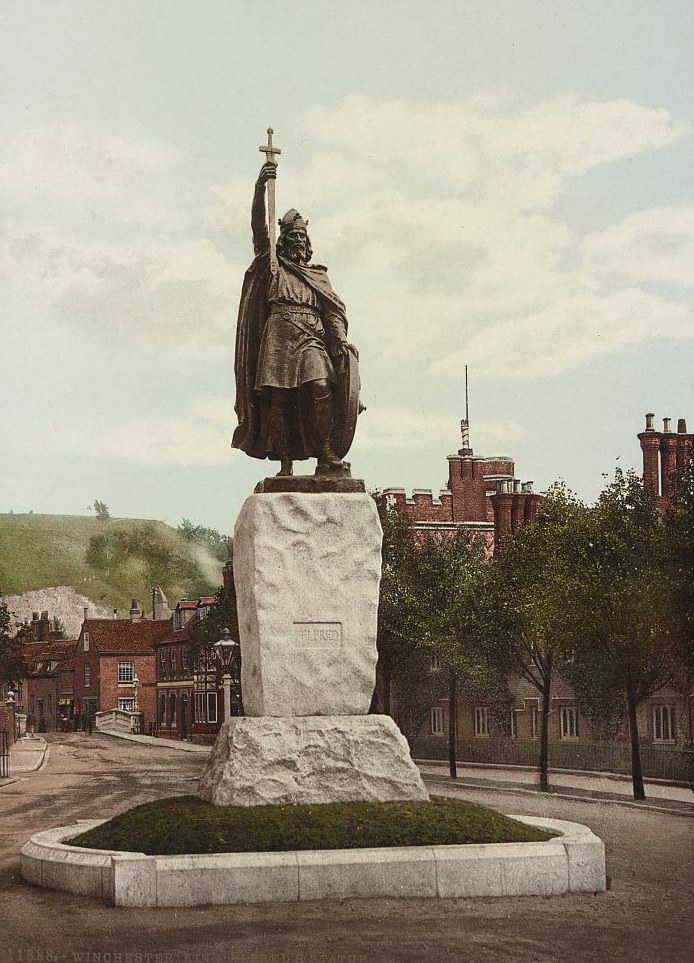
Photochrom print, Winchester, King Alfred's statue, c. 1901 to 1910, Library of Congress Prints & Photographs Division, no known restrictions
Some time in the night of 6 January 878, or shortly after it, a Danish army came through the dark to Chippenham in Wiltshire. It was Twelfth Night, the end of the Christmas feast, and the king of Wessex was in residence with his household. Twelfth Night was the one week of the year a Christian army could be relied on not to be in the field, and Guthrum, the Danish commander, had been camped at Gloucester, two days' march away. Alfred got out with a small party and little else.
The Anglo-Saxon Chronicle, compiled at Alfred's own court and not inclined to make him look bad, puts it plainly: the Danes "rode over Wessex and occupied it, and drove a great part of the people across the sea, and conquered most of the others; and the people submitted to them, except King Alfred". For about three months the kingdom of Wessex consisted of one man, a few companions and a patch of wet ground in Somerset.
What the other kings had done
The Great Army had landed in East Anglia in 865 and had spent thirteen years taking England apart one kingdom at a time. Northumbria fell in 867 and got a client king. Edmund of East Anglia fought, lost and was killed in 869. Mercia lasted until 874, when its king, Burgred, who was married to Alfred's sister, gave up, left the country and went to Rome, where he died; the Danes installed a thegn named Ceolwulf, who swore to hand the kingdom over whenever they asked.
So by 878 an English king facing the Danes in his own hall had two tested options: fight once and die, or take the boat. A king without a court, an army or a treasury was not really a king, and the Danes knew it.
The island in the marsh
Alfred's third option was Athelney. It is a low rise in the Somerset Levels, which in the ninth century were a wilderness of reed beds, alder and winter floodwater, passable only if you knew the causeways. Athelney was an island in the strict sense for half the year. Asser, the Welsh monk who wrote Alfred's biography, says the king lived there "in great tribulation" with a small band, taking what he needed from the Danes and from the Saxons who had submitted. By Easter, 23 March, he had built a fort on it.
This is where the cakes come in, and I should be honest about them. The story of the king sheltering in a swineherd's hut and letting the loaves burn while he brooded is not in Asser or the Chronicle. It first appears a century or more later in a life of St Neot, a Cornish saint whose cult wanted a connection to the famous king. It may rest on something real; it may be a sermon illustration. What it preserves is a true picture of a king at the lowest point any had reached without actually leaving, and that is the detail people have liked for a thousand years.
Hiding was only part of it. Asser and the Chronicle both describe raids out of Athelney against the Danes through the spring, and the message to every thegn who had made his terms with Guthrum was that the king was alive, in the kingdom, and fighting.
Seven weeks after Easter
The gamble was that enough of them would come when called. In the seventh week after Easter, around 4 to 7 May 878, Alfred rode out of the marsh to a landmark the Chronicle calls Egbert's Stone, somewhere on the border of Somerset, Wiltshire and Dorset (people still argue over which hill), and the men of Somerset, Wiltshire and the western part of Hampshire met him there. The next day they moved to Iley Oak, and the day after that they met Guthrum's army at Edington, on the chalk edge above the Wiltshire plain.
Alfred won. Asser says the West Saxons fought in a close shield wall and prevailed, then chased the Danes to their stronghold, almost certainly Chippenham, and sat outside it for a fortnight until hunger did the rest. Guthrum gave hostages, swore to leave Wessex, and agreed to something no Danish leader had accepted before: baptism, with Alfred standing as his godfather.
The feast at Wedmore
Gold and enamel pendant jewel with a figure, made in the manner of the Alfred Jewel, 19th century (the museum's own dating carries a question mark), The Metropolitan Museum of Art, CC0
Three weeks after the battle Guthrum was baptised at Aller, a church on the edge of the same marsh Alfred had been living in, and took the Christian name Athelstan. The unbinding of the baptismal cloth took place at the royal estate of Wedmore, where Alfred kept Guthrum and thirty of his men for twelve days of feasting and gifts. The man who had come within a night raid of taking Wessex was leaving as the king's godson.
Guthrum kept most of his oaths. He moved his army to Cirencester, then to East Anglia, where he ruled as a Christian king until his death in 890, minting coins in his baptismal name. In the 880s he and Alfred put their names to a written treaty that drew a line up the Thames, up the Lea to its source, straight to Bedford and then along Watling Street: Danish law to the north and east, Alfred's to the south and west. That line is why the place names of Lincolnshire end in "by" and those of Hampshire do not.
Alfred used the breathing space to make sure January 878 could not happen again: a chain of fortified towns across Wessex, each within a day's walk of the next, a navy, and a programme of translating Latin books into English that he partly wrote himself. The Danes came back in force in 892 and found a kingdom with no soft centre.
The jewel from the field
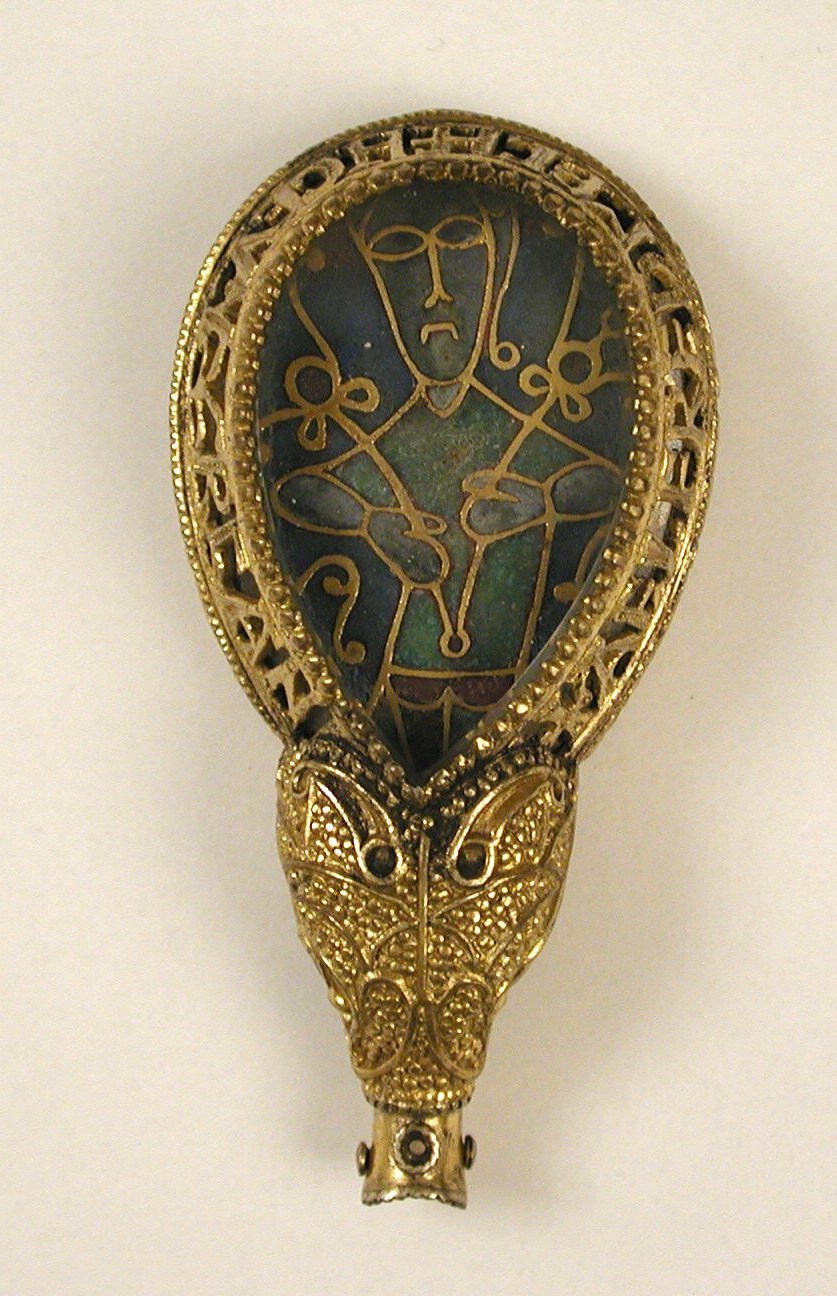
In 1693 a ploughman at North Petherton, about four miles from Athelney, turned up a piece of gold about two and a half inches long: a teardrop of rock crystal over an enamel figure, set in gold filigree, with an animal head at the base holding a socket for a rod, and around the edge the words AELFRED MEC HEHT GEWYRCAN, "Alfred ordered me to be made". It is generally agreed to be the handle of a pointer for following the lines of a manuscript, of the kind Alfred says he sent to each bishop with his translations. It passed to Oxford by bequest in 1718 and sits today in the Ashmolean Museum. Nobody knows how it got into a field by the marsh, though a royal household camping there in a hurry in 878 is as good a guess as any.
The bronze Alfred in Winchester on our cover, sword raised hilt upwards like a cross, was unveiled in 1901 for what was then believed to be the thousandth anniversary of his death (he actually died in 899; the Victorians had the date wrong), when the English were pleased to be reminded that their first great king had been a scholar as well as a soldier. I think the monument misses the point slightly. The decision that made everything else possible was not the sword at Edington but the one taken three months earlier, in a burning hall in Wiltshire, by a man who looked at the boat every other king had taken and chose the swamp.
Enjoyed this story?Get a new one every day on social.