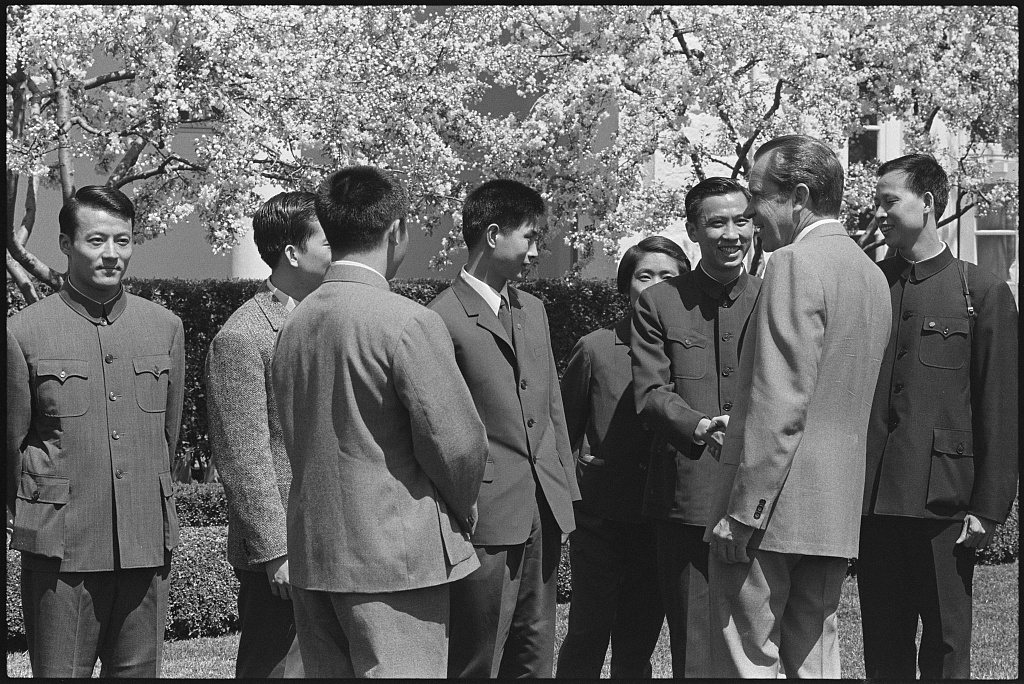
Photo: Warren K. Leffler, U.S. News & World Report, April 18, 1972. Library of Congress, no known restrictions
The leaders of the United States, China and Russia are meeting together in Shenzhen on Thursday, on the edge of the APEC summit, and the thing every report agrees on is that it has never happened before. Donald Trump says he wants to talk about cutting nuclear arsenals. Ukraine and the war with Iran are on the table too, and Moscow says a joint statement is being drafted, which is not the same as saying there will be one.
The reason it has never happened is that for most of the last half century the smart move for Washington was to keep Beijing and Moscow in separate rooms. The man who made that the rule was Richard Nixon, and he did it in a single spring.
Shots on a frozen river
The opening came from a border fight Nixon had nothing to do with. In March 1969 Chinese and Soviet troops clashed on Zhenbao Island (the Russians called it Damansky), a scrap of land in the Ussuri River between Manchuria and the Soviet Far East. Dozens of soldiers were killed. Over the summer there were more clashes further west, and there was talk in Moscow, taken seriously in Beijing, of a strike on Chinese nuclear sites.
Two communist giants that had been allies in 1950 were now openly preparing for war with each other. Nixon and his national security adviser, Henry Kissinger, saw the obvious use for that. If the United States could talk to both, each would worry about what the Americans were saying to the other.
Messages went back and forth through Pakistan and Romania. In July 1971 Kissinger, on a trip to Pakistan, let it be known that he had a stomach upset and was resting in the hills, and flew to Beijing in secret instead. On July 15 Nixon went on television and told a stunned country that he would visit China. (The table tennis teams had broken the ice first. An American team was invited to China in April 1971, and the Chinese team toured the United States a year later, which is how a group of Chinese ping-pong players ended up shaking Nixon's hand on the White House lawn in April 1972.)
A week in Beijing
Nixon landed in Beijing on February 21, 1972. Zhou Enlai met him at the airport, and Nixon made a point of putting his hand out first, because, as the story goes, in 1954 John Foster Dulles had refused to shake Zhou's hand at Geneva and the Chinese had not forgotten. That afternoon he was taken to see Mao Zedong, who was in poor health and had been seriously ill only weeks earlier. The American record of the conversation has Mao in a teasing mood, telling Nixon that he liked rightists.
The rest of the week was banquets, the Great Wall and a long negotiation over a document. The Shanghai Communiqué, issued at the end of the visit, is unusual in that each side wrote out its own position on Taiwan and they simply printed both. At a toast in Shanghai, Nixon called it "the week that changed the world." He was a politician in an election year and it was a toast, but he was not entirely wrong.
Three months later, the Kremlin
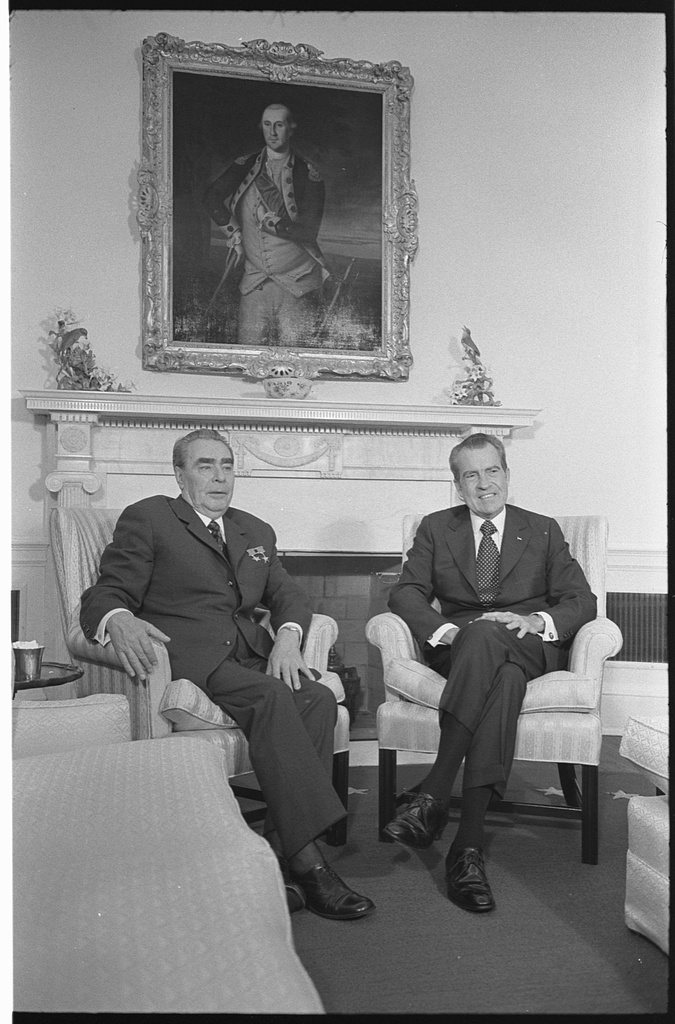
Nixon and Brezhnev at the White House during Brezhnev's return visit in June 1973. Photo: Warren K. Leffler, Library of Congress, no known restrictions
Then came the part that is often forgotten. On May 22, 1972, Nixon arrived in Moscow, the first American president to visit the Soviet capital. (Franklin Roosevelt had gone to Yalta in 1945, but that was Crimea, and a wartime conference.) His host was Leonid Brezhnev, the Soviet party leader.
On May 26 the two men signed the Anti-Ballistic Missile Treaty and an interim agreement limiting strategic offensive arms, the package known as SALT I. They also signed agreements on space cooperation, the environment and avoiding incidents at sea. The Soviets had watched the pictures from Beijing all spring, and most historians think the pictures helped speed things along.
That was the triangle. Kissinger later described the goal as keeping the United States closer to each of the other two than they were to each other. For roughly two decades it mostly worked, and every president after Nixon dealt with Moscow and Beijing on separate tracks, with separate summits and separate treaties.
One table instead of two
What has changed is the map. China and Russia are no longer the quarrelling neighbours of 1969. They describe their relationship in very warm terms, they settled the Ussuri border in a series of agreements ending in 2008, and Zhenbao Island has been Chinese for years. The triangle Nixon worked depended on that feud.
So Shenzhen is a different kind of meeting. Nixon went to each capital to make the other one nervous. Trump is sitting down with both at once, in a city that was a small border town on the Hong Kong frontier in 1972, and this time arms control is being discussed with China in the room as well. Whether that produces a treaty, a joint statement or only a photograph, nobody outside the room knows yet, and from what Moscow is saying about its draft, possibly nobody inside it either.
Enjoyed this story?Get a new one every day on social.