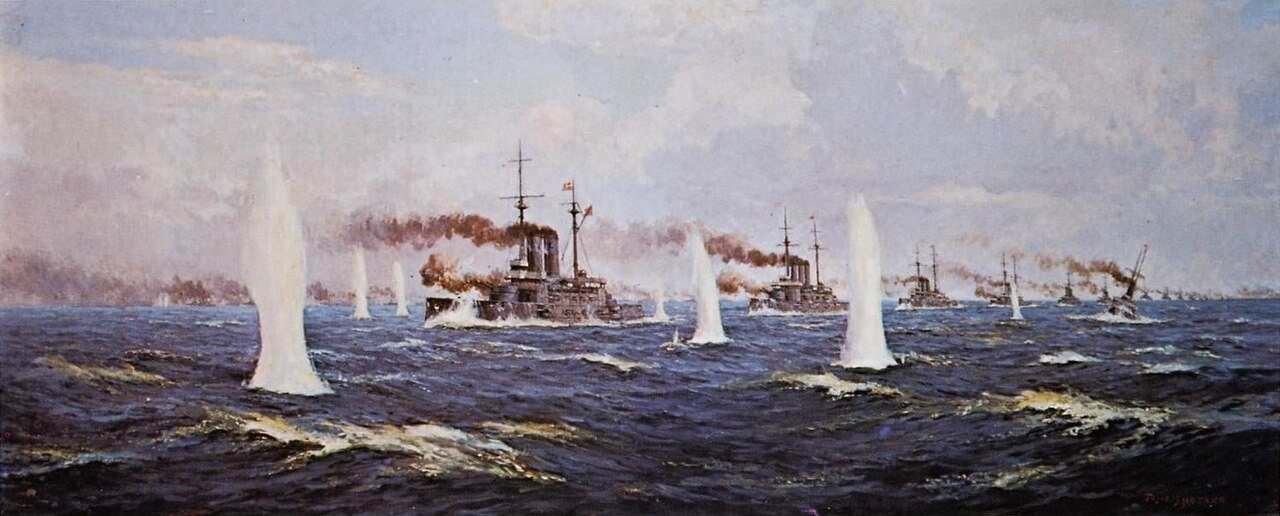
Painting: Tōjō Shōtarō, public domain, via Wikimedia Commons
At about seven minutes past four this morning, Japan time, a suspected Russian military aircraft crossed into Japanese airspace northwest of Okinoshima, a small island in the strait between Kyushu and Korea. A second followed two minutes later. Each stayed for roughly three minutes. According to Japan's Defense Ministry, the planes then flew on through the Tsushima Strait and down between Yonaguni and Taiwan while fighters of the Air Self-Defense Force shadowed them and warned them by radio.
Defense Minister Shinjiro Koizumi called it "a serious violation of our sovereignty" and "utterly unacceptable," and Tokyo lodged a protest with Moscow. It was the first Russian violation of Japanese airspace since September 2024, and it came days before a possible meeting between Prime Minister Sanae Takaichi and Vladimir Putin at the APEC gathering in China.
The geography is what caught my eye. The waters just off Okinoshima are where, on 27 May 1905, the Russian Empire lost most of a navy it had sent halfway around the world, and where a man serving at the island's shrine sat and wrote down what he saw.
Eighteen thousand miles to the wrong strait
The fleet that died there was the Second Pacific Squadron, mostly ships of Russia's Baltic Fleet, put under the command of Vice Admiral Zinovy Rozhestvensky. It left the Baltic in October 1904 with orders to relieve Port Arthur, Russia's besieged base in Manchuria, and to win back control of the sea from Japan.
The voyage started badly and stayed that way. In the North Sea, nervous crews convinced that Japanese torpedo boats were lurking off England opened fire on British fishing trawlers from Hull at the Dogger Bank, killing fishermen and nearly starting a war with Britain. Because Britain was Japan's ally, the squadron could not count on friendly ports. It coaled at sea from chartered German colliers, the bigger ships going the long way around Africa, and sat for weeks off Madagascar waiting for reinforcements.
Port Arthur surrendered on 2 January 1905, while the fleet was still on the far side of the world. The original mission was gone. The new one was to reach Vladivostok, the only Russian Pacific port left, which meant getting past Japan.
The choice Rozhestvensky made
There were three ways into the Sea of Japan from the south: the wide Tsushima Strait between Korea and Kyushu, or the long route east of Japan to the Tsugaru or La Pérouse straits farther north. The northern routes were longer and colder and would have stretched a fleet already short of coal. Tsushima was direct, and it was exactly where Admiral Togo Heihachiro was waiting for him with the Combined Fleet at its base in Korea.
Rozhestvensky chose Tsushima. Historians have argued about that ever since. My own view is that he did not have a good option, only a short one, and he took it. He also kept his supply ships with him, which slowed the whole squadron to the speed of its slowest freighter.
In the early hours of 27 May, a Japanese auxiliary cruiser, the Shinano Maru, spotted the lights of a Russian hospital ship in the mist. The signal went out that the enemy was in sight. Togo put to sea.
Togo's flag and Togo's turn
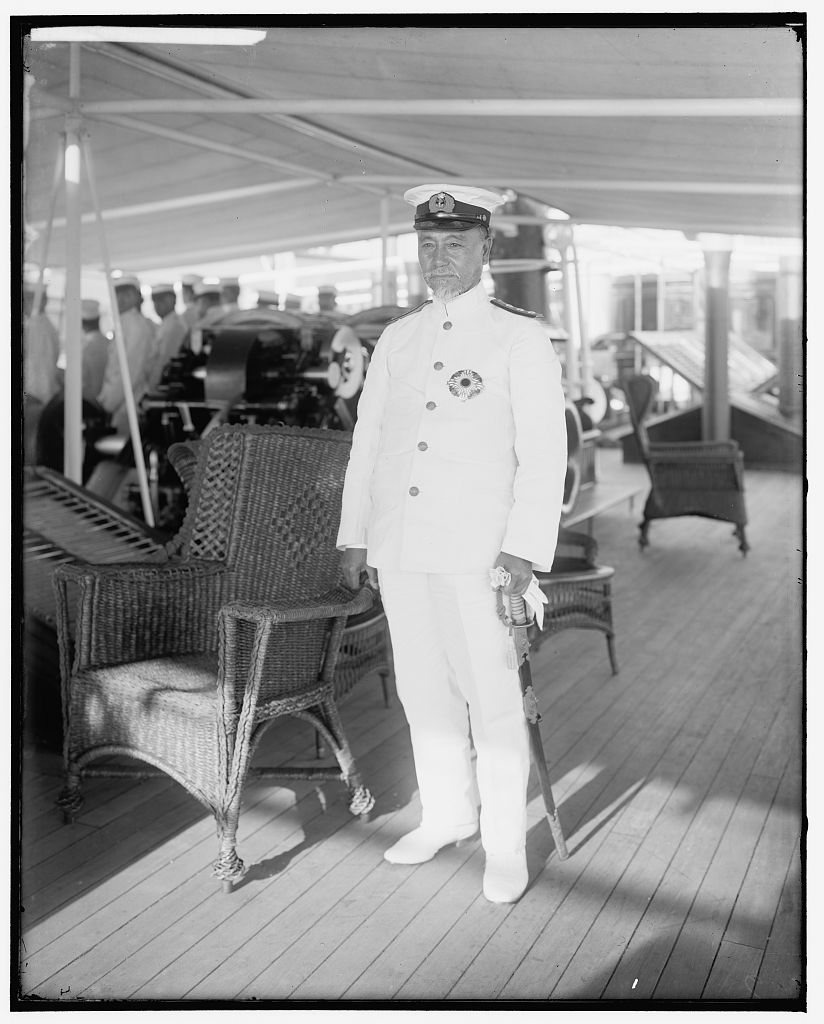
Admiral Togo Heihachiro in white uniform on the deck of a ship. Photo: Harris & Ewing, Library of Congress, no known restrictions
Before the guns opened, Togo raised the Z flag on his flagship Mikasa, with a message usually translated as: the fate of the Empire rests on this battle, let every man do his utmost. (Nelson's signal at Trafalgar is the obvious ancestor, and Togo had trained with the Royal Navy, so the borrowing was probably not an accident.)
Early in the afternoon, Togo turned his battle line across the head of the Russian column, a manoeuvre that exposed his ships to fire while they swung round in sequence. It worked. The Japanese gunners concentrated on the leading Russian battleships, and Rozhestvensky's flagship, the Knyaz Suvorov, was wrecked. The admiral, badly wounded in the head, was carried off onto a destroyer and later captured.
The fighting went on through the night as Japanese destroyers and torpedo boats hunted the survivors. On 28 May, Rear Admiral Nikolai Nebogatov, surrounded with what was left of the main force, surrendered.
What a day and a half cost
The numbers are hard to read even now. Russia lost 21 ships sunk, among them most of its battleships, and others were captured or interned in neutral ports. More than 4,000 Russian sailors were killed and around 6,000 taken prisoner. Of the warships that set out, only a light cruiser and two destroyers made it to Vladivostok. Japan lost three torpedo boats and a little over a hundred men.
The defeat made the Tsar's position at home much harder in a year already full of strikes and mutinies, and it pushed St Petersburg towards peace. The Treaty of Portsmouth was signed in New Hampshire that September, with Theodore Roosevelt as the broker, and it won him the Nobel Peace Prize. Japan had beaten a European great power at sea, and the admiralties of Europe spent years studying how.
Rozhestvensky was court-martialled after he came home and acquitted, largely on the grounds that he had been unconscious when the decisive moments came. Nebogatov, who had surrendered, was sentenced to death, a sentence commuted to imprisonment. Togo became one of the most famous men in Japan and stayed that way until his death in 1934.
The witness on the island
Okinoshima is not an ordinary island. It is the sacred territory of Okitsu-miya, one of the three shrines that make up Munakata Taisha, and it has been a place of worship for well over a thousand years. One priest at a time is stationed there. In May 1905, the man on duty watched the battle from the island and recorded it in his journal, which is about as close a view as any civilian in Japan got.
Togo later gave Munakata Taisha a compass from the Mikasa. It is on display in the Shimpokan museum at Hetsu-miya, the shrine on the Kyushu mainland. On neighbouring Oshima, where some of the Russian dead washed ashore and were buried, a memorial to the sailors of both sides was put up in 2013, and Japanese and Russian participants have gathered there for an annual service.
Okinoshima today
The island was inscribed as a UNESCO World Heritage Site in 2017, along with the associated Munakata sites. It still runs on rules that have nothing to do with any ministry: women are not permitted to land, and men who do must strip and purify themselves in the sea first. Since 2018 the shrine has not allowed ordinary visitors ashore at all, so the island you can see from the Oshima battery on a clear day is, for practical purposes, closed. A priest is still on the island in ten-day shifts, alone, and this morning at about ten past four two Russian aircraft crossed the sky to its northwest.
Enjoyed this story?Get a new one every day on social.