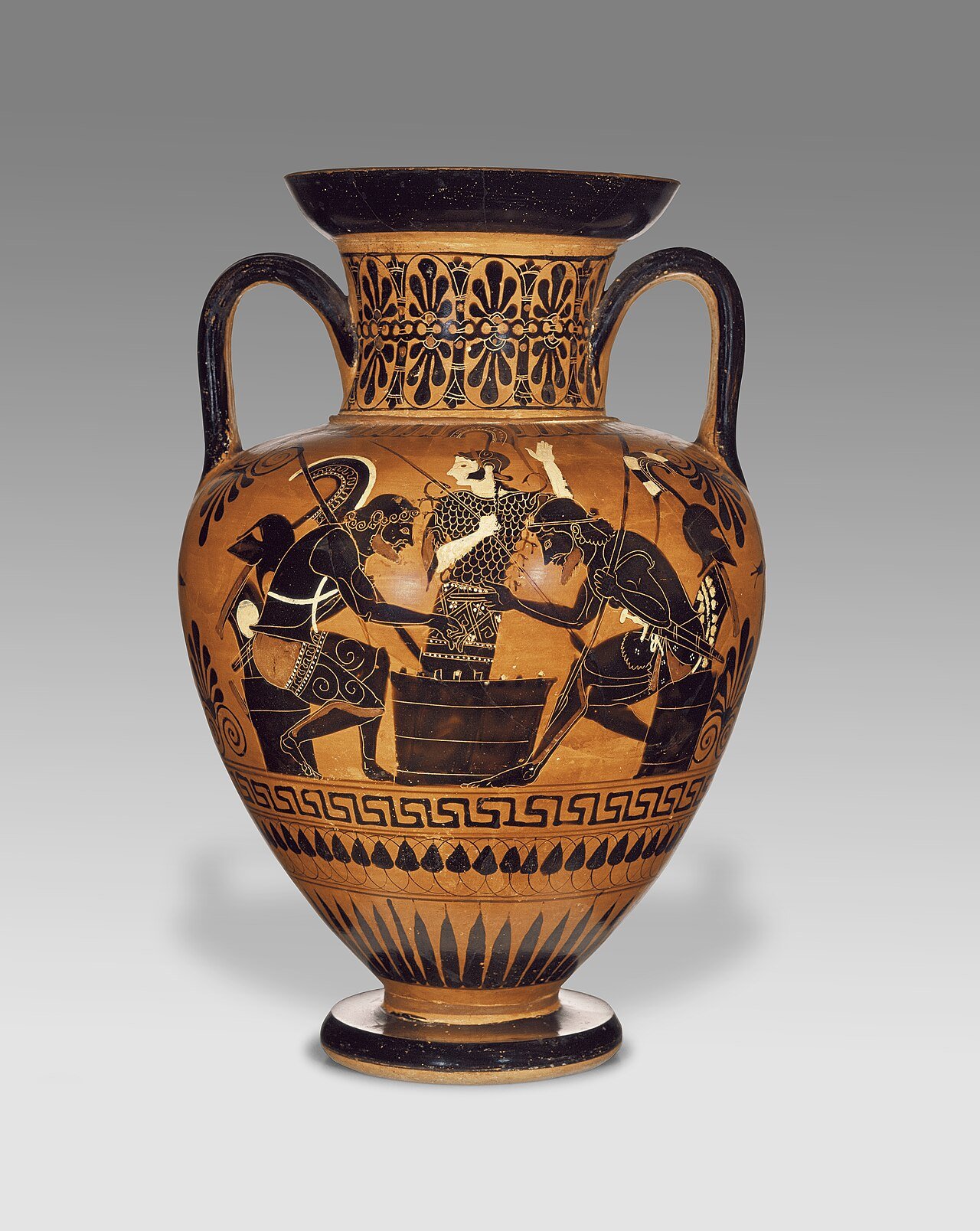
Amphora attributed to the Medea Group, about 520 BC, CC0, via Wikimedia Commons
About ten kilometres from Troy, on the Dardanelles coast near the ancient town of Rhoiteion, Turkish archaeologists have spent two years digging into a low hill called Işıldaktepe Altı. When Fecri Polat and Rüstem Aslan first recorded the site in 2011 they took it for a Copper Age settlement. The rescue excavations that began in October 2024 have changed their minds. Under the earth are rows of stones set carefully in mud and sealed with greenish clay, the sort of base you build when you mean to pile a large artificial mound on top. Turkey's culture ministry announced this month that the team thinks it is a burial mound, and that it may be the one ancient writers called the Tomb of Ajax.
The archaeologists are careful about that "may". Nothing found so far carries Ajax's name, there is no inscription and no reported human remains, and the centre of the mound has not been opened. The finds are pottery from several periods, spindle whorls, worked bone and pieces of big storage jars. What makes the idea worth taking seriously is the location, and the fact that the ancient world was quite sure where Ajax was buried.
The second-best warrior at Troy
Ajax, son of Telamon, is the huge, slow-spoken fighter of the Iliad, the man who carries a shield like a tower and holds the Greek ships when everyone else has run. Homer rates him second only to Achilles. Athenian vase painters loved the pair and painted them over and over hunched across a gaming board in their armour, which is how the cover picture shows them (a scene, as far as I know, that appears nowhere in Homer).
His death comes after the Iliad ends. When Achilles was killed, his armour was to go to the best of the surviving Greeks, and the prize went to Odysseus. Ajax, in the version Sophocles put on the Athenian stage, could not live with the insult and died by his own sword. The tradition that grew up around his burial put him on the shore of the Troad, at Rhoiteion, facing the sea the Greek fleet had crossed.
Strabo's tomb and Antony's statue
By the time the Greek geographer Strabo wrote in the reign of Augustus, the Tomb of Ajax at Rhoiteion was a shrine with a temple and a statue of the hero. Strabo tells a nice story about the statue: Mark Antony took it off to Egypt, presumably as a gift for Cleopatra, and Augustus sent it back after he had beaten them both. Whatever was actually in the tomb, it was a famous stop on what amounted to a tourist trail of Homeric sites around Troy, the same circuit Alexander the Great had walked in 334 BC when he crossed into Asia and honoured the grave of Achilles.
When the sea opened it
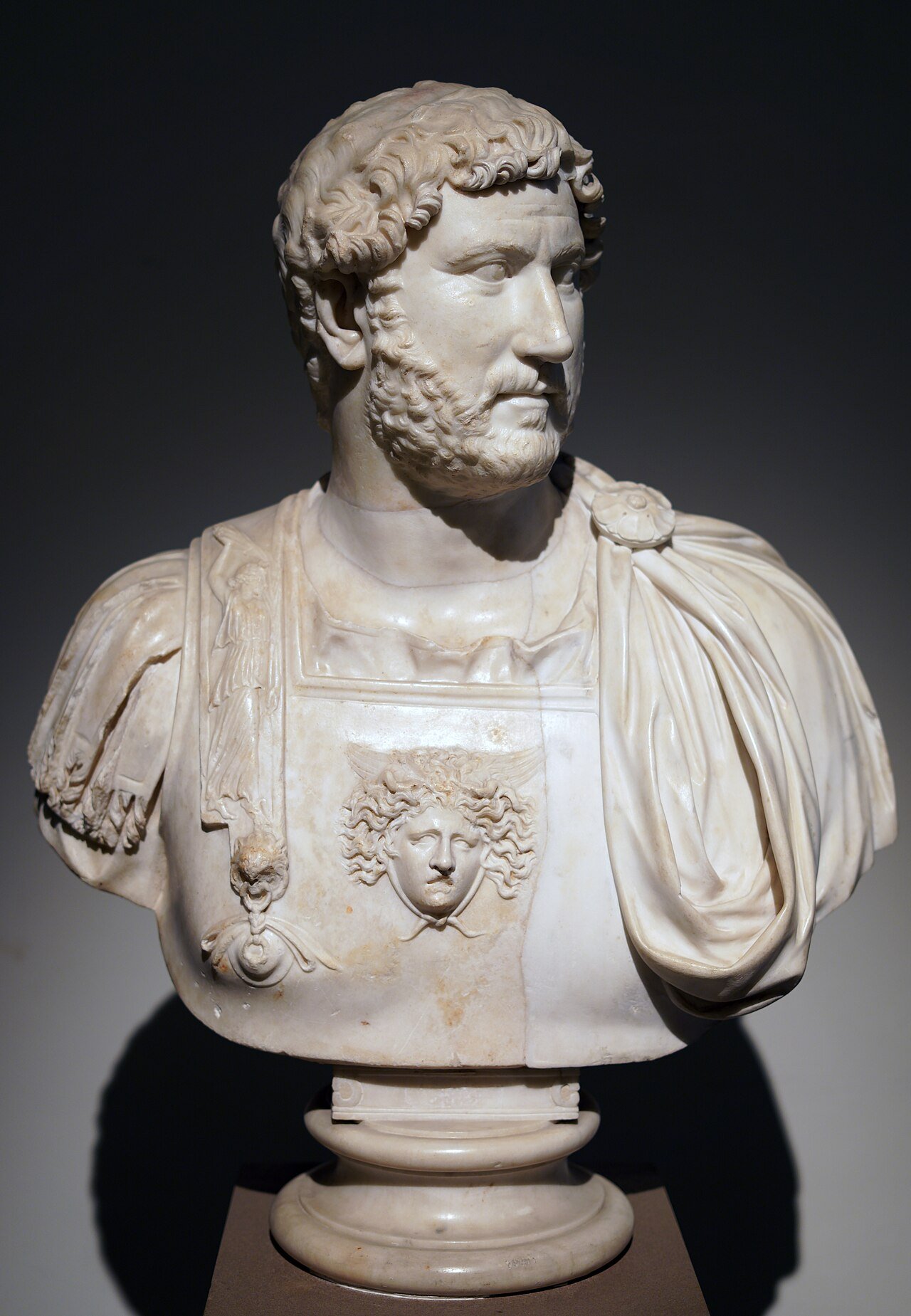
Marble bust of the emperor Hadrian in the National Archaeological Museum of Naples. Photo: Commonists, CC BY-SA 4.0, via Wikimedia Commons
The best stories about the tomb come from the second century AD. The travel writer Pausanias, describing Salamis, the island Ajax came from, reports what he was told by a man from Mysia: the sea had washed away the side of the tomb facing the beach, so that it was easy to get in, and the bones of the corpse were enormous. The man said the kneecaps were as big as the discus boys threw in the pentathlon.
Philostratus, writing a little later, takes it further in his dialogue the Heroicus. In his account the sea broke open the tomb, the giant skeleton lay exposed, and the emperor Hadrian, visiting Troy, embraced the bones and had them reburied and the tomb restored. Hadrian toured the region, probably in 124, and he was exactly the kind of emperor who would make a show of honouring a Greek hero, so the visit is plausible even if the details are not. Philostratus gives a precise length for the bones, which I am not going to repeat, because it describes a man several times taller than anyone who has ever lived.
Heroes made of mammoth
Historians have a reasonable guess about what those visitors saw. Large fossil bones of extinct animals turn up in the Aegean region, and some scholars, the historian of science Adrienne Mayor most prominently, have argued that ancient Greeks often read them as the remains of heroes. A storm-cut mound on the Dardanelles that spilled out a mammoth's thigh bone would have looked very much like a giant hero coming back into the light. That is a theory rather than a finding, but it fits Pausanias's discus-sized kneecaps rather well.
Travellers in the nineteenth century usually pointed to a different mound nearby, In Tepe, as the Tomb of Ajax, so the new identification is also an argument with two hundred years of guidebooks. The excavators will need a date for the mound's construction and, ideally, a look inside its centre before anyone can say much more. For now Işıldaktepe Altı is a fenced dig on a scrubby rise above the strait, with tankers and ferries going up and down the Dardanelles below it.
Enjoyed this story?Get a new one every day on social.