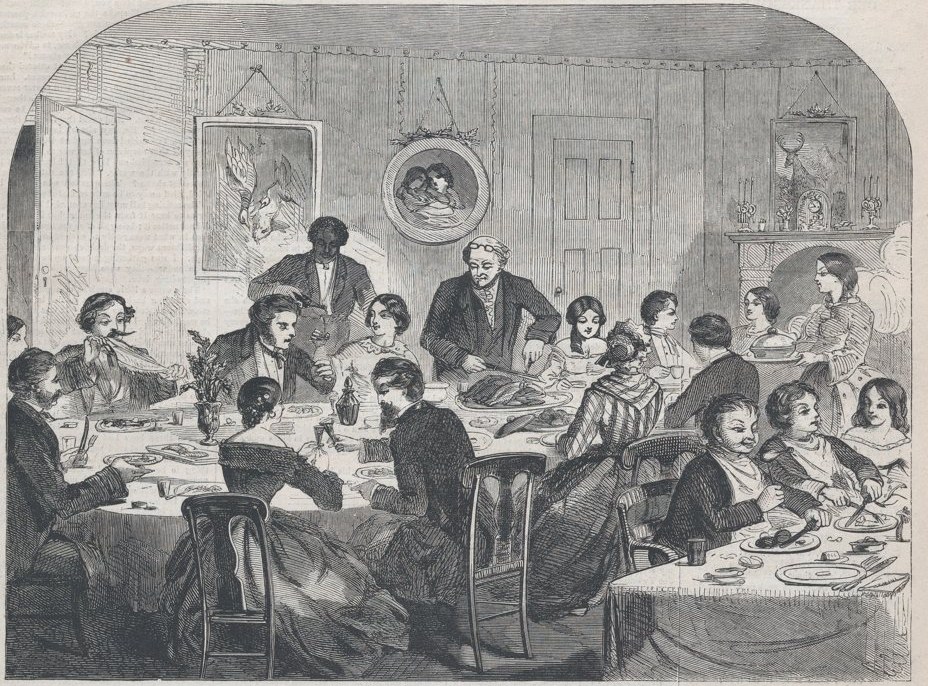
Winslow Homer, Thanksgiving Day, The Dinner, Harper's Weekly, 27 November 1858, The Metropolitan Museum of Art, CC0
"American Cookery, or the art of dressing viands, fish, poultry and vegetables, and the best modes of making pastes, puffs, pies, tarts, puddings, custards and preserves, and all kinds of cakes, from the imperial plum to plain cake. Adapted to this country, and all grades of life. By Amelia Simmons, an American orphan."
That is the whole of the title page, more or less, of a pamphlet printed in Hartford, Connecticut, in 1796 by Hudson and Goodwin. It ran to 47 pages, had no cover (the title page was the cover), and the words "for the author" at the bottom mean that Amelia Simmons paid for the printing herself. It is the first cookbook written by an American and published in America. Everything we know about the woman who wrote it is in the book.
Who she was, as far as anyone can tell
Cookbooks had been printed in the colonies before, but they were English books with the title pages changed. Eliza Smith's Compleat Housewife came off a press in Williamsburg in 1742, and Susannah Carter's Frugal Housewife was reprinted in Boston and New York. Simmons was the first to write for a different country.
She says almost nothing about herself beyond the word orphan, which she uses as a credential. An orphan, she writes in her preface, has no parents to advise her and must have "an opinion and determination of her own", and she addresses the book to women "who by the loss of their parents, or other unfortunate circumstances, are reduced to the necessity of going into families in the line of domestics". In plain words, she was or had been a servant, she had learned to cook in other people's kitchens, and she was writing for girls like herself. Nobody has found her in a census, a church register or a gravestone. The food historian Karen Hess, who edited a facsimile for the book's bicentenary, thought from the Dutch words in it that she came from the Hudson Valley rather than New England, and called her "a good plain cook".
What was new in it
Quite a lot of the book is not hers. Hess showed that whole chapters were lifted from Carter's Frugal Housewife. What matters is the part that is hers, and it is the part that uses American ingredients.
There are five recipes using cornmeal, which no English book had: three for Indian pudding, one for "Johny cake, or hoe cake", and one for "Indian slapjack", which is a pancake. There is a recipe for roast turkey that ends "serve up with boiled onions and cranberry-sauce", which is the first time anyone printed those two things on the same plate. There are two recipes headed "pompkin", stewed, strained, mixed with cream and eggs, spiced with ginger and baked in a crust, and they are what we would call pumpkin pie, in print for the first time.
Two words appear in English print for the first time. One is "slapjack". The other is "cookie", spelled "cookey", from the Dutch koekje, a little cake. Her "Christmas Cookey" calls for pearl ash, a refined potash, dissolved in milk to make the dough rise. That is the first printed use of a chemical leavener, and the ancestor of every recipe that calls for baking soda.
The book is otherwise what a servant in a prosperous Connecticut household would have needed: how to choose fish and fowl at market, how to pickle and preserve, and a great many cakes, including the "Independence Cake" that needed twenty pounds of flour, fifteen pounds of sugar and ten pounds of butter and was clearly for a town, not a family.
The hired hand who spoiled it
The first edition went out with a page of errata, and the second, printed in Albany the same year, carried an angry note. Simmons said she had paid someone to prepare her manuscript for the printer, being unable to do it herself, and that this person had inserted mistakes "with a design to injure the sale or reputation of the work". She does not name them. I have always wanted to know who it was and what the quarrel was about, and no one ever will.
The Albany edition was 64 pages and corrected the recipes. After that the book got away from her. Printers in Troy, Poughkeepsie, Brattleboro, Walpole, Windsor and Woodstock brought out their own editions, thirteen in all between 1796 and 1831, and in 1808 a woman named Lucy Emerson in Montpelier, Vermont copied most of it, retitled it The New-England Cookery and put her own name on the front. Whether Simmons saw a cent from any of them is unknown. Whether she was alive is unknown.
Where the four copies are
Four copies of the Hartford first edition are known to survive, one of them at the Library of Congress, which in 2012 put American Cookery on its list of 88 "Books That Shaped America". The one illustrated edition, printed in Woodstock, Vermont in 1831 with eight woodcuts on how to carve at table, went up for auction in San Francisco in February with an estimate of 4,000 to 6,000 dollars.
Four weeks from now a large share of the country will sit down to roast turkey with cranberry sauce and pumpkin pie, which is to say to three recipes from a 47-page pamphlet by a servant who could not afford a copy editor. Nobody will mention her. She would, I suspect, have found that about right for an orphan.
Enjoyed this story?Get a new one every day on social.