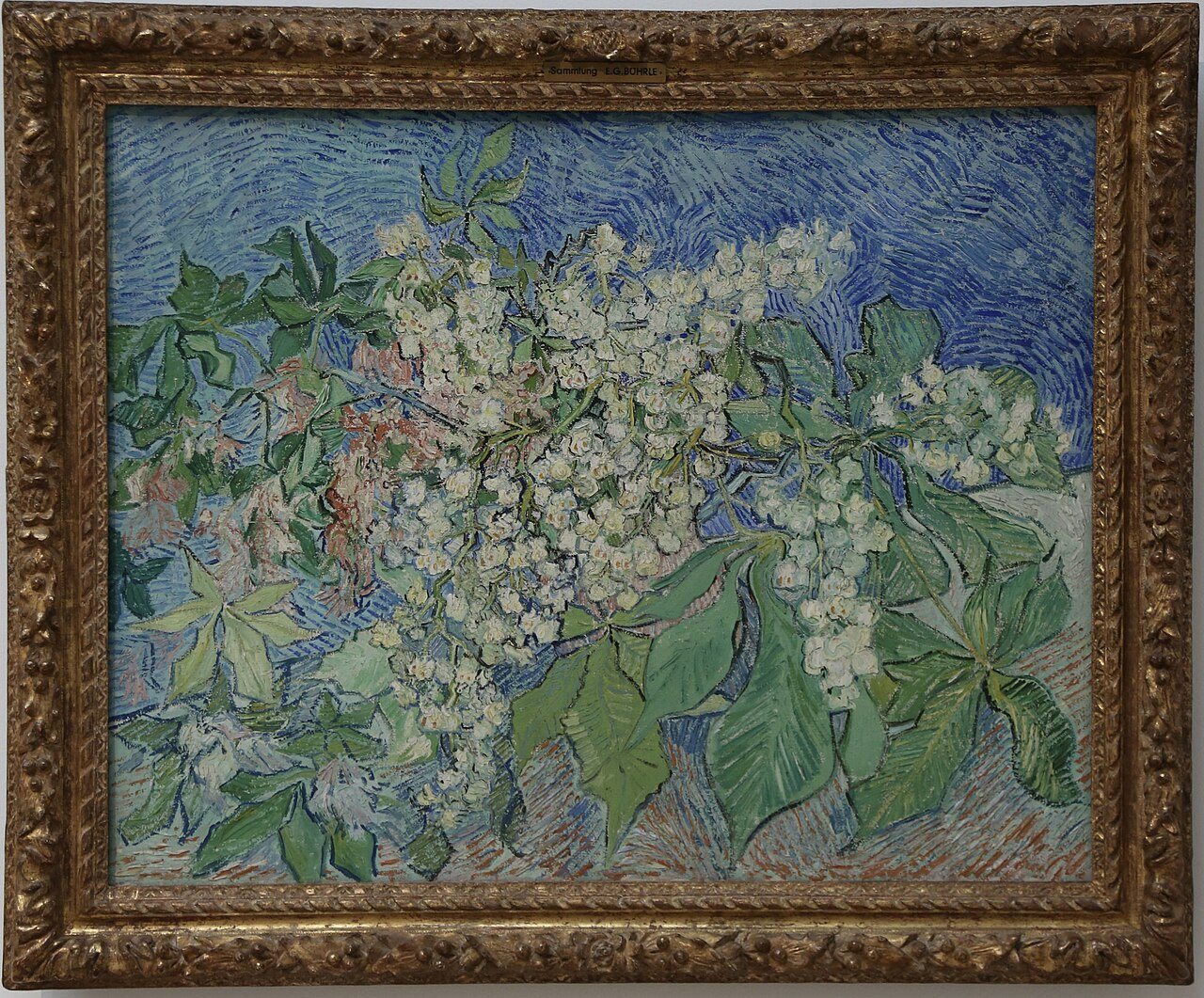
Van Gogh's Blossoming Chestnut Branches, painted at Auvers in May 1890, a companion to the canvas at Sotheby's. Photo: Paradise Chronicle, public domain, via Wikimedia Commons
Sixty-eight thousand Swiss francs, or roughly 22,000 dollars at the time. That is what Vincent van Gogh's Châtaigniers en fleurs, Blossoming Chestnut Trees, fetched when it was sold to a collector in Paris in June 1936. Tonight in New York, Sotheby's expects it to make about 180 million dollars, which would beat the record for a Van Gogh at auction, the 117.2 million paid at Christie's in 2022 for Orchard with Cypresses from Paul Allen's collection.
For five days it looked as if the sale might not happen at all. On 12 November a Berlin restitution researcher, Gunnar Schnabel, wrote to Sotheby's on behalf of the heirs of the painting's first German owner, a Jewish publisher, arguing that the 1936 sale had been forced by Nazi persecution. He asked the auction house to show that the price had been fair and that the family would have sold anyway. "Otherwise," the letter concluded, "no auction may take place." On 17 November, hours before the sale, Sotheby's announced that the heirs and the current owners had reached an agreement. Nobody has said what is in it.
Seventy days in Auvers
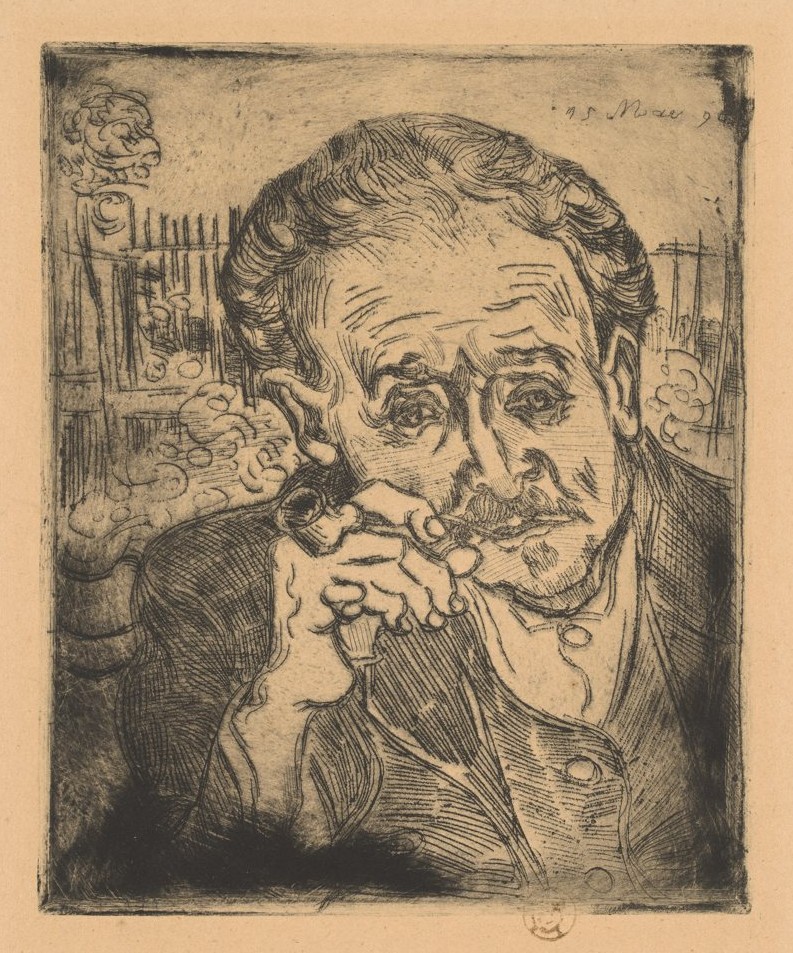
Van Gogh's etching of Dr Paul Gachet with a pipe, made in Auvers in 1890. The Metropolitan Museum of Art, CC0
Van Gogh arrived in Auvers-sur-Oise, a village north of Paris, on 20 May 1890, after a year in the asylum at Saint-Rémy. He was there for about seventy days and painted something like seventy canvases, which is the kind of pace that makes art historians reach for words like frantic. Dr Paul Gachet, the doctor who was supposed to keep an eye on him there, sat for the only etching he ever made. He died there on 29 July.
The chestnut trees were in flower when he arrived, and he painted them more than once in those first weeks. The canvas at Sotheby's is 70 by 58 centimetres and was painted in May. Two related pictures from those weeks are in public collections: a view of chestnut trees in blossom at the Kröller-Müller Museum in the Netherlands, and a close-up of cut branches in Zurich, shown above. (The Zurich one has its own history; it was among four paintings stolen from the Bührle collection in an armed robbery in 2008 and recovered.)
The publisher who bought it
According to Sotheby's catalogue, Samuel Fischer bought the painting from a Paris gallery in 1909. Fischer had founded his publishing house in Berlin in 1886, and by then S. Fischer Verlag was one of the most important literary publishers in Germany. It published Gerhart Hauptmann, Thomas Mann's Buddenbrooks and, later, Hermann Hesse. A Van Gogh in a German collector's house in 1909 was not yet the safe bet it would become; German collectors and dealers were in fact among the first to take him seriously.
Around 1932 or 1933, roughly when Hitler came to power, the painting was placed with Walter Feilchenfeldt of the Paul Cassirer gallery in Amsterdam, along with two Cézannes. It was lent to the Boijmans museum in Rotterdam in 1933 and to the Kunsthalle in Bern in 1934. Samuel Fischer died in October 1934, and the firm passed to his son-in-law, Gottfried Bermann Fischer, while the regime banned one author after another from its list.
Vienna, 1936
In 1936 the family moved the business to Vienna. The painting was sold in Amsterdam that June. The heirs say the sale was made under the pressure of persecution and heavy publishing losses. Sotheby's says its research has not shown a forced sale, that the buyer was independent, and that 68,000 francs was a good price; it compares it with Orchard with Cypresses, which sold in 1935 for 15,000 dollars. Sotheby's lawyer has also pointed out that the painting does not appear on a postwar list of works the family wanted back.
Both of those things can be true at once, and that is what makes these cases so hard. A fair price does not tell you whether a family would have sold at all if it had not been squeezed out of its own country. Vienna did not stay safe for long. In 1938 the Anschluss forced the family out again, and the Gestapo took their home there, their library and what remained of their collection.
Sugar money and a quiet wall
After 1936 the painting passed through several hands. In 1975 it was bought by the Argentine collectors Carlos Pedro Blaquier and Nelly Arrieta de Blaquier, whose family fortune came from the Ledesma sugar company. Nelly Arrieta de Blaquier died in 2020. The work is the star of twelve Impressionist and Post-Impressionist pictures from their collection in tonight's sale, estimated together at around 450 million dollars.
A deal with no details
Restitution claims like this one are usually handled under the Washington Principles of 1998, which ask for "just and fair solutions" rather than a court's yes or no, and that is roughly what seems to have happened here, in a hurry. All three parties have issued warm statements. The heirs thanked Sotheby's and the Blaquier-Arrieta family for a "trusting and fair" negotiation, and the Blaquiers said they were pleased with an "amicable resolution". Sotheby's has said only that the sale will go ahead as planned, with the painting guaranteed. I would like to know what the Fischer heirs got, and I suspect we will not be told.
The Blaquiers kept the picture out of sight for a long time. It was last shown at a public exhibition in 1964.
Enjoyed this story?Get a new one every day on social.