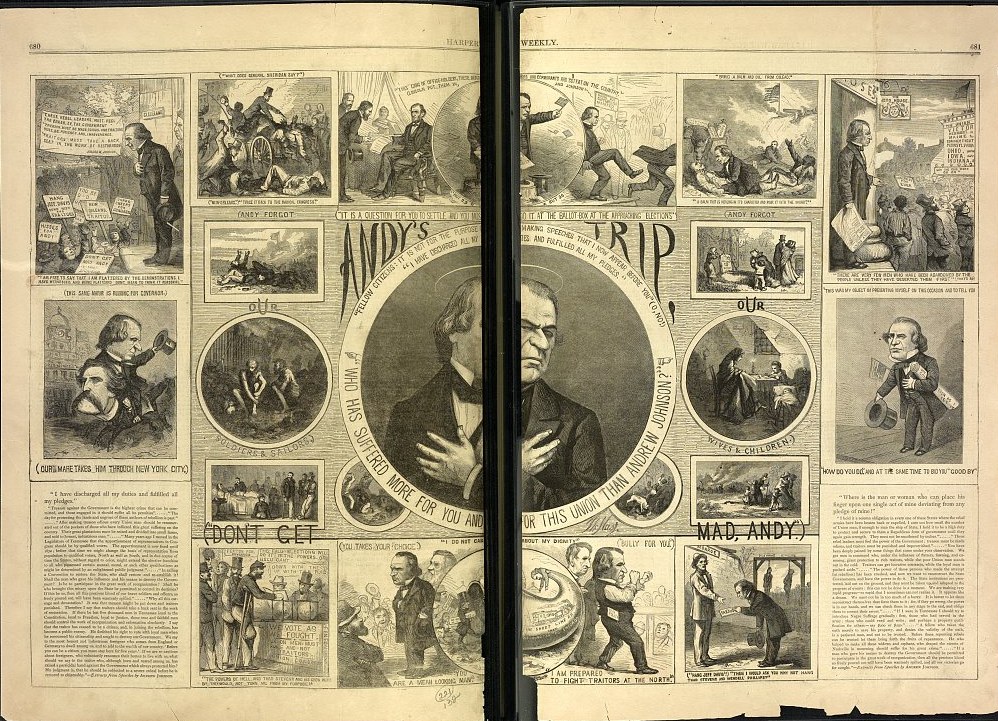
Cartoon: Thomas Nast, Andy's Trip, Harper's Weekly, 27 October 1866, Library of Congress Prints & Photographs Division, no known restrictions
A little after nine on the evening of 3 September 1866, Andrew Johnson stepped onto the balcony of the Kennard House hotel in Cleveland to say a few words to the crowd in the street. He had Ulysses Grant with him, and Admiral Farragut, and the Secretary of State, and he had been told by his own advisers to keep it short. Somebody in the crowd shouted "Hang Jeff Davis!" Johnson shouted back: "Why not hang Thad Stevens and Wendell Phillips?" The crowd roared, some for him and more against, and for the next twenty minutes the President of the United States argued with a street.
The midterms are eight days away, and these days nobody blinks when a president flies around the country for his party's candidates. Before Johnson, presidents did not campaign in person at all; it was thought beneath the office. He was the first to try it in a midterm year, and it went so badly that his successors mostly stayed home for half a century.
A tailor from Tennessee with a plan the North hated
Johnson had become president in April 1865 because Lincoln was shot. He was a Southern Democrat on a Republican ticket, a former tailor who had never gone to school, and the only senator from a seceding state to stay loyal to the Union. The Radical Republicans briefly hoped he would be harder on the defeated South than Lincoln. Instead, through 1865 he pardoned former Confederates by the thousand, let the Southern states reorganise themselves under white rule, and watched them pass Black Codes without objection.
In 1866 Congress fought back. In April it overrode his veto of the Civil Rights Act, the first time in American history that a major piece of legislation had become law over a president's veto. In June it passed the Fourteenth Amendment and sent it to the states. Johnson urged the states to reject it. Then, after a massacre in Memphis in May, a white mob in New Orleans on 30 July, police among them, attacked a convention of Black and white Republicans and killed dozens of people. The fall elections turned into a referendum on whether the President or the Congress would run Reconstruction.
Swing around the circle
Johnson needed a reason to travel that was not, officially, an election campaign. He found one in Chicago, where the cornerstone of a monument to Stephen Douglas was to be laid on 6 September. He would go by way of New York and the Great Lakes, come back down through St. Louis and the Ohio valley, and give speeches from the train and from hotel balconies all the way. He called it, in one of those speeches, swinging around the circle, and the name stuck.
He took the war heroes with him, Grant and Farragut above all, so that the army and navy would seem to stand behind him on every platform. Seward and Navy Secretary Welles came too, and so did a young cavalry officer named George Custer. The party left Washington at the end of August.
The first days went well enough. The trouble was that Johnson had essentially one speech and gave it at every stop: his humble origins, his loyalty in the war, his sacrifices, the Radicals' plots against him, and an invitation to the crowd to say whether he looked like a traitor. The newspapers printed it each time. By the second week, crowds who had read it over breakfast knew what was coming and were ready to shout back.
Cleveland, St. Louis, Indianapolis
Cleveland was where it broke. After the exchange about hanging Stevens and Phillips, the heckling never stopped, and Johnson never stopped answering it. At one point supporters were overheard urging him to think of his dignity. "I don't care about my dignity," he answered, within earshot of the reporters, and that went into the papers as well.
St. Louis on 8 September was worse. Johnson blamed the New Orleans massacre on the Radical Congress, said the convention that had been attacked was an illegal body, and then cast himself as a Christ betrayed by the men he had trusted. (If he was Judas, he asked the crowd, who had been his Christ? He meant that the Radicals had no right to the role.) Grant, who was supposed to be the silent attraction, was by now keeping away from the balconies, and in a private letter home he is reported to have called the speeches a national disgrace. The Republican papers had long since stopped pretending to be neutral.
Indianapolis, a day or so later, would not let him speak at all. The crowd shouted him down, Johnson went back inside, and in the fighting between his supporters and his opponents afterwards one man was shot dead. At Johnstown, Pennsylvania, on 14 September a temporary platform put up for people to see the train gave way and dropped hundreds of them into a drained canal some twenty feet below. Thirteen people died. Johnson wanted to stop the train and help, but other traffic on the line made it impossible; he went on to Harrisburg and sent $500 for the victims. He was back in Washington on 15 September.
The vote
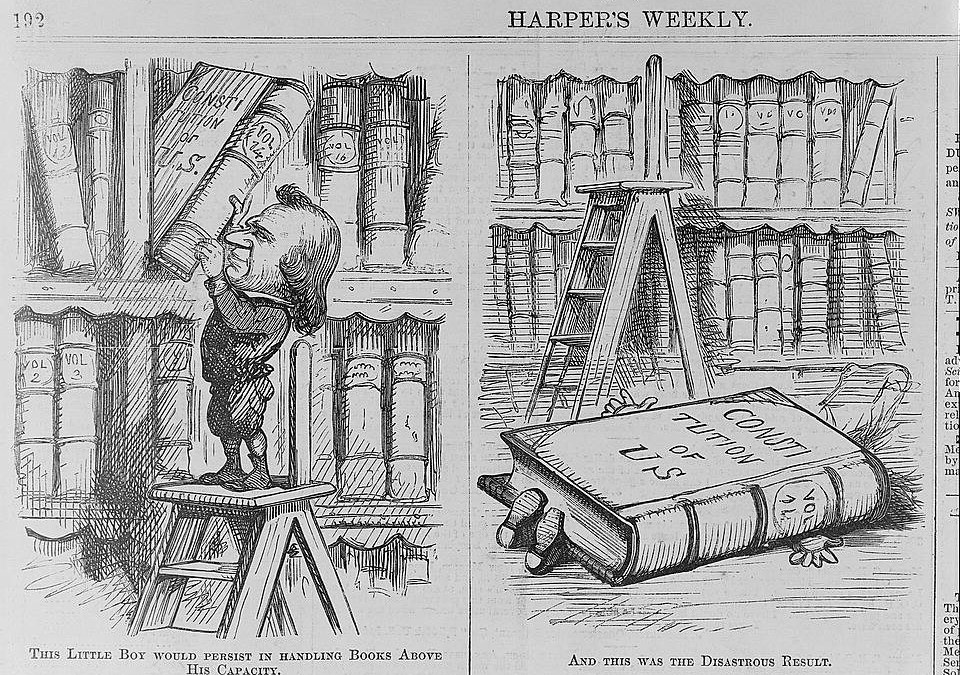
Thomas Nast cartoon from Harper's Weekly, March 1868: Andrew Johnson on a stepladder pulling at a volume marked Constitution of U.S., then crushed beneath it. Library of Congress Prints & Photographs Division, no known restrictions
The elections were spread over the autumn, state by state, as they were then. Maine and Vermont went first in September, and Republicans won everything. Pennsylvania, Ohio and Indiana voted in early October and went the same way, and the rest followed in November. When the new Congress met, Republicans held well over two-thirds of both houses. Johnson could veto whatever he liked, and they could override whatever he vetoed. In March 1867 they passed the Reconstruction Acts over his veto, placing ten Southern states under military rule, and the Tenure of Office Act, forbidding him to sack his own cabinet without the Senate's consent.
He sacked the Secretary of War anyway, in February 1868, and the House impeached him within three days. Most of the eleven articles concerned the dismissal. Article 10, pushed through by Benjamin Butler, concerned the tour. It charged that Johnson, "unmindful of the high duties of his office and the dignity and proprieties thereof," had delivered "certain intemperate, inflammatory, and scandalous harangues" in Washington, Cleveland and St. Louis, and it quoted them at length. I have always found it the oddest article in the set (it is, more or less, a charge of being rude from a balcony), but the men who wrote it had read the speeches, and they meant it.
What he left behind
The Senate acquitted Johnson by a single vote, 35 to 19, in May 1868. Article 10 was never put to a vote, because the managers knew they did not have the numbers for it.
Washington drew a simple lesson from 1866, which was that presidents should stay off the stump in a midterm. It held, more or less, until Franklin Roosevelt went out in 1938 to try to purge the conservative Democrats in his own party, and most of them won anyway. Since then nearly every president has done it, with mixed results, and the old rule has been forgotten.
Johnson went home to Tennessee and kept running for things. In January 1875 the state legislature sent him back to the Senate, the body that had come within one vote of removing him. He took his seat that March, made one speech attacking his successor, Grant, and died at the end of July.
Enjoyed this story?Get a new one every day on social.