The Shortest War in History Lasted 38 Minutes, and Zanzibar Was Billed for the Shells
The telegram from London to the British consul in Zanzibar, which reached him on the evening of 26 August 1896, read in full: "You are authorised to adopt whatever measures you may consider necessary, and will be supported in your action by Her Majesty's Government. Do not, however, attempt to take any action which you are not certain of being able to accomplish successfully." The consul, Basil Cave, was certain. He had five warships in the harbour and the other side had a wooden palace. He sent an ultimatum that expired at nine o'clock the next morning.
A sultan dies before lunch
The trouble had started the day before. Sultan Hamad bin Thuwaini, who had ruled Zanzibar for three years with British approval and under British supervision, died suddenly at twenty to twelve on the morning of 25 August. He was 39. His cousin Khalid bin Barghash was in the palace within hours, and by the afternoon had moved in, declared himself sultan and begun collecting soldiers. Whether Khalid had poisoned Hamad has been suspected ever since and never shown; the timing was, at the least, convenient for him.
Zanzibar in 1896 was a sultanate in name and a British protectorate in fact. A treaty of 1890 had given Britain a veto over who sat on the throne, and the man Britain wanted was Hamoud bin Mohammed, who could be relied on to do as he was told. Khalid could not. He had tried to take the palace once before, in 1893, when the previous sultan died, and had been talked out of it by the same General Mathews and a landing party of British sailors. This time he had learned, and brought numbers.
Two thousand eight hundred men and one yacht
By the evening of the 25th Khalid had about 2,800 armed men inside and around the palace compound on the seafront: the palace guard, armed townspeople, slaves and servants with rifles handed out from the armoury. He had a few field guns, a Gatling, two Maxim machine guns and a bronze cannon that had been cast in the seventeenth century, all pointed at the harbour. He also had a navy, consisting of the royal yacht Glasgow, a wooden steamer with a few small guns, and two steam launches.
Cave and the British commander on the island, General Lloyd Mathews, told him to stand down. Khalid declined. Cave telegraphed the Foreign Office and waited. Rear-Admiral Harry Rawson arrived on the 26th with the cruiser St George, joining the Philomel, the Racoon, the Thrush and the Sparrow, and that evening the telegram from Lord Salisbury's office came through. The British residents were moved to the English club and to the ships. Khalid was told to haul down his flag and leave the palace by nine the following morning, or the ships would open fire.
His answer, sent at eight on the morning of the 27th, was that he had no intention of hauling down his flag and did not believe the British would fire on him. Cave replied that he did not want to open fire, but that unless Khalid did as he was told, he certainly would. At nine Khalid sent one last note to say he was staying.
Nine-oh-two to nine-forty
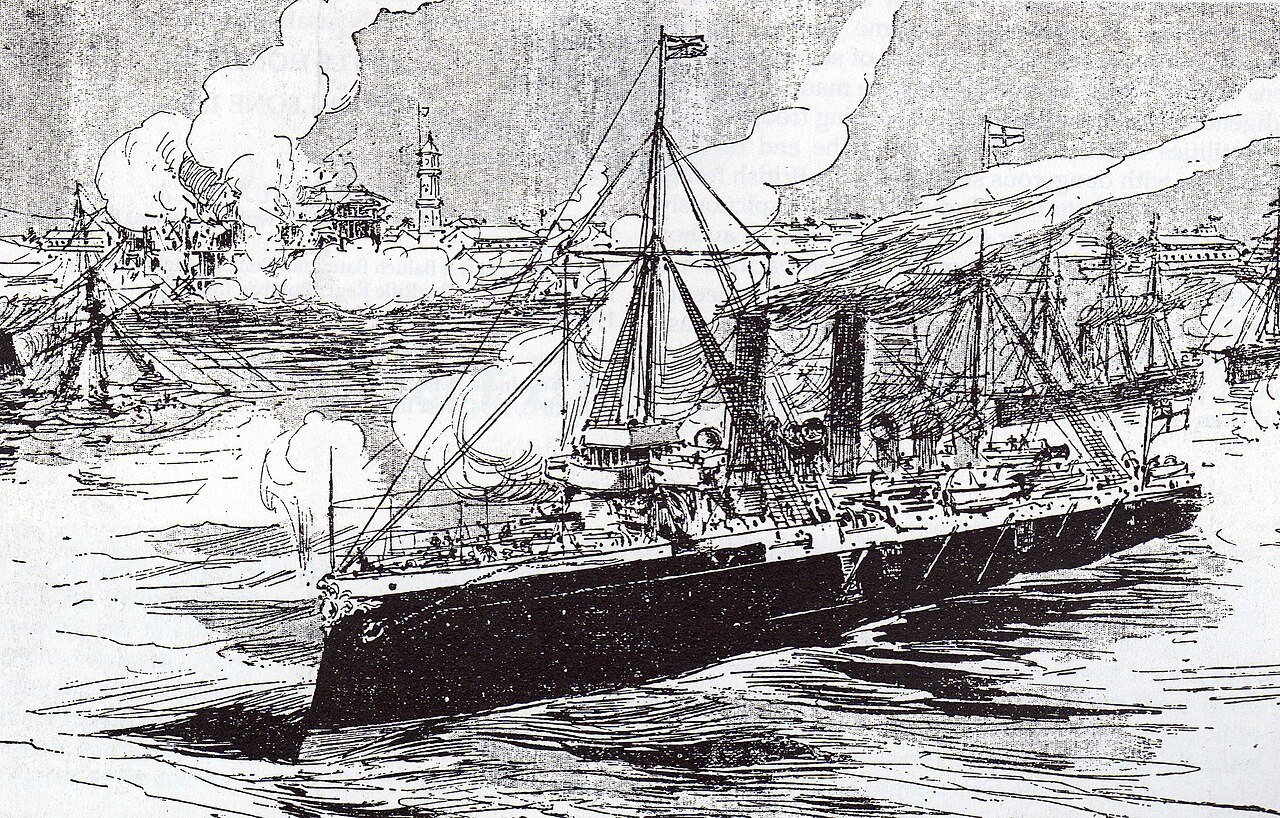
The ships opened fire at two minutes past nine. The palace was timber and the harem next to it was timber, and both were burning within minutes. The Zanzibari guns got off a few rounds and were then silenced, and the roughly 3,000 people inside the compound took the full weight of the shelling, which is where almost all of the casualties came from. The Glasgow fired at the St George, which was a brave and pointless thing to do, and was sunk by return fire in the shallow harbour; the British picked up her crew. The two launches went down too. A detachment of marines was landed to deal with sniping from the town.
Khalid left by a back door early in the proceedings with about forty followers and ran for the German consulate, which was a few streets away. The flag over the palace kept flying because nobody was left to lower it, until a shell brought the flagpole down. The British took that as a surrender and ceased fire at twenty to ten. Thirty-eight minutes, by the usual reckoning; some accounts stretch it to forty-five, depending on when you start counting. The Guinness book has listed it as the shortest war on record for as long as I have been reading the Guinness book.
The British fired about 500 shells, a few thousand machine-gun rounds and about a thousand rifle rounds. On the Zanzibari side some 500 people were killed or wounded, most of them by the fires and the shelling of the compound. On the British side one petty officer on the Thrush was badly wounded and recovered. Hamoud bin Mohammed was proclaimed sultan that afternoon.
A sultan leaves by boat without touching the ground
Khalid's position in the German consulate was legally awkward. Britain demanded that he be handed over; Germany said the consulate was German soil and its guest had broken no German law. The two countries had divided East Africa between them only six years earlier and neither wanted a quarrel over one deposed sultan. For five weeks Khalid stayed inside, with British marines watching the gate.
The Germans solved it with tide tables. On 2 October the cruiser Seeadler anchored off the consulate and sent a boat, which was carried up the beach at high water and set down in the consulate garden. Khalid stepped from the German garden into the German boat, which was German territory, and was rowed out to a German ship, without his feet ever touching ground that was under British control. The British watched from the gate and could do nothing about it. He was taken to Dar es Salaam, on the German mainland, and lived there for twenty years.
What it cost, and who paid
The new sultan's government was presented with a bill for the ammunition expended in overthrowing his predecessor and paid 300,000 rupees. The wreck of the Glasgow sat in the harbour with its masts above the water for years before it was broken up. The palace and the harem were not rebuilt; the House of Wonders next door, which had been damaged, was repaired and became the sultan's offices and later a museum. Under British pressure, Hamoud abolished the legal status of slavery in Zanzibar in April 1897, which is the one consequence of the war that anyone on the island had cause to be glad of.
Khalid's story went on longer than the war. When the First World War reached East Africa the British captured him at Dar es Salaam in 1916 and sent him first to the Seychelles and then to St Helena, where they had previously kept Napoleon and the Boer prisoners. He was allowed back to East Africa in 1925 and died in Mombasa in 1927. The House of Wonders, which survived his war, partly collapsed in December 2020 and has been under restoration with money from Oman since; at the time of writing I could not find a confirmed date for it reopening. The Guinness entry, as far as I know, still stands.