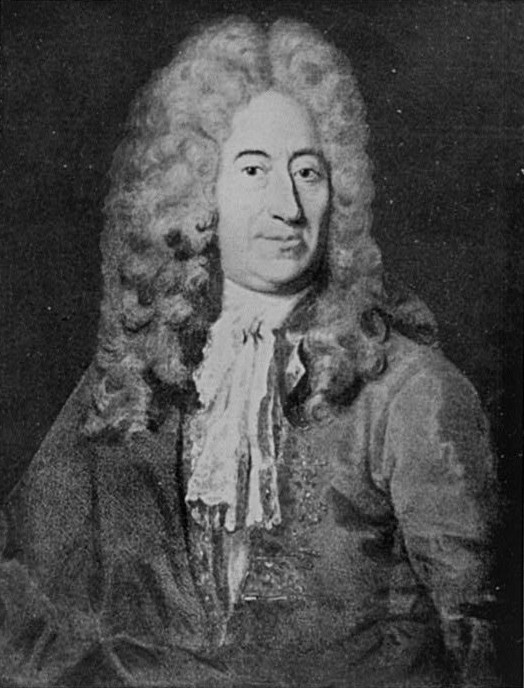
Portrait of Ole Rømer, plate from the Journal of the Royal Astronomical Society of Canada, 1913. Library of Congress, no known restrictions
Paris Observatory, 9 November 1676. Io, the innermost of the moons Galileo had found around Jupiter, slid out of the planet's shadow at 5:35 and 45 seconds by the observatory's clock. According to the tables everyone at the observatory used, it should have reappeared at 5:25:45. A 32-year-old Danish assistant named Ole Rømer had told the Académie royale des sciences weeks earlier that it would be about ten minutes late, and he had told them why: the light carrying the news had farther to travel.
On Wednesday, 18 November, at 10:16 UTC by NASA's reckoning, Voyager 1 will be one light-day from Earth, roughly 25.9 billion kilometres out. A command sent from California will take a whole day to reach it, and the reply another day to come back. That a radio signal needs a day for anything is the old Dane's point, stretched as far as it has ever gone. The engineers at the Jet Propulsion Laboratory already live with it: by the time they hear that a command worked, the spacecraft has been doing something else for a day.
A Danish student goes to Paris
Rømer was born in Aarhus in 1644, the son of a merchant and skipper, and studied at the University of Copenhagen, where he lodged for years with his mentor Erasmus Bartholin. In 1671 the French astronomer Jean Picard came to Denmark to fix the exact position of Tycho Brahe's old observatory on the island of Hven, and Rømer worked with him there. Between them they timed about 140 eclipses of Io.
Picard was impressed enough to take him back to Paris in 1672, to the new royal observatory run by Giovanni Domenico Cassini. Rømer built instruments, taught, and kept timing Jupiter's moons.
The moons were not an academic hobby. Io circles Jupiter every 42 and a half hours and disappears into the planet's shadow on schedule, which makes it a clock in the sky visible from anywhere with a decent telescope. If you knew the Paris time of an eclipse and saw it from somewhere else, the difference told you your longitude. Picard and Cassini wanted that clock to be perfect, so every irregularity in it was a problem to be explained away.
The clock that would not keep time
The irregularity was this. When Earth was moving towards Jupiter in its orbit, the eclipses came a little early compared with the average. When Earth was moving away, they came late. The error built up over months and then unwound.
Cassini noticed it first and briefly toyed with the idea that light might take time to cross the gap, then dropped it. (The historian Suzanne Débarbat has argued he believed it for a short while; he certainly did not defend it later.) Rømer kept the idea. If light needed time, then as the distance between Earth and Jupiter grew, each eclipse would be seen later than it happened, and the lateness should follow the distance. It did.
In September 1676 he made the prediction about the November eclipse. When Io came out ten minutes behind the tables, he had something better than an argument. On 21 November he presented the result to the Académie, and in December a short account ran in the Journal des sçavans, the first scientific journal printed in Europe. Light, he said, took about 22 minutes to cross the diameter of Earth's orbit.
Twenty-two minutes, and nobody's number
The real figure is closer to 16 and a half minutes, so Rømer was well off. That matters less than it sounds. Before 1676 most natural philosophers, Descartes among them, assumed light arrived instantly, and the question of how fast it went was barely a question. Rømer moved it from "infinite" to "about this much," and the order of magnitude was right.
He never actually wrote down a speed. The Journal des sçavans piece gives a time, not a velocity, because nobody knew the size of Earth's orbit well enough to turn one into the other. Christiaan Huygens did the division later in his Treatise on Light, using his own guesses for the distances. It is Huygens's sum, not Rømer's, that sits behind the textbook line that "Rømer measured the speed of light," which is one of those sentences that is right in spirit and wrong on paper.
The reaction was mixed. Robert Hooke thought the speed "so exceeding swift that 'tis beyond Imagination" and doubted it was finite at all. John Flamsteed in Greenwich accepted it, and Isaac Newton used the eclipse argument in his Opticks in 1704, putting the Sun's light at about seven minutes from Earth (the modern figure is a bit over eight). Cassini never came round.
How the argument was finally settled
The proof that satisfied the doubters came from somewhere else entirely. In 1728 the English astronomer James Bradley was trying to measure the parallax of a star, the tiny shift in its position as Earth goes round the Sun, and instead found a different shift: stars appeared to tilt slightly in the direction Earth was moving, the way rain seems to slant at you when you run. That aberration of light only made sense if light had a finite speed, and Bradley's figure came out within about one per cent of the modern value.
Bradley's discovery is the one that should have made Rømer famous in his lifetime, and it came eighteen years too late for that. By then Rømer had been back in Denmark for decades. He went home in 1681 and spent the rest of his life as a royal mathematician and, more surprisingly, as a civic official in Copenhagen, where his duties ran from weights and measures to the city's police. He died in 1710.
The notebook problem
Here is the part I find hardest to pin down. Rømer published almost nothing about his method, and for two centuries historians could not say how he had arrived at 22 minutes. Most of his papers, by the usual account, burned in the great Copenhagen fire of 1728. The working is only known because a folio of his handwritten eclipse lists, covering 1668 to 1677, turned up in 1913, showing he leaned mostly on observations from 1671 to 1673.
There is also an older muddle about who said what in 1676. A later secretary of the Académie, Jean-Baptiste du Hamel, wrote that it was Cassini who warned in August of a ten-minute delay, for an eclipse on 16 November rather than the 9th. Most historians treat that as a garbled record and give the prediction to Rømer. The surviving paperwork does not let anyone close the question completely, and I have yet to read a version of it that I would call the last word.
Enjoyed this story?Get a new one every day on social.